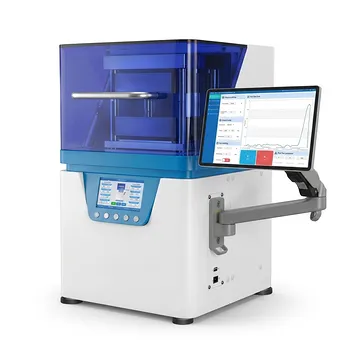
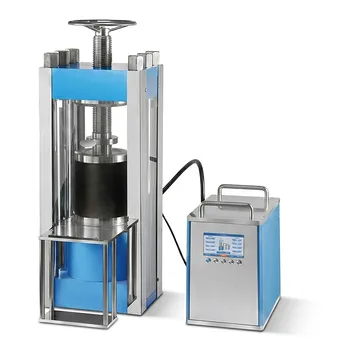
A heated laboratory press ensures the quality of PEEK/SWCNT thin films by maintaining precise temperature compensation at 380 °C and applying multi-stage pressure holding. This specific combination of heat and force transforms a molten mixture into a film with uniform thickness while effectively excluding trace gases from the melt. By stabilizing these variables, the equipment produces films with superior surface flatness and internal structural integrity, which are critical for subsequent processing and lamination.
Core Takeaway: The high-precision heated press acts as a quality control gate, using synchronized thermal melting and incremental pressure steps to eliminate internal defects and ensure the dense, uniform distribution of SWCNTs within the PEEK matrix.
Achieving Structural Homogeneity through Multi-Stage Pressure
The transition from a raw PEEK/SWCNT mixture to a high-quality thin film requires more than just raw force; it requires the strategic application of pressure.
The Role of Incremental Pressure Holding
By cycling through specific pressure levels—such as 5, 40, and 130 bar—the press allows the material to settle and air to escape before the final compression. This staged approach prevents the "trapping" of gases that occurs when high pressure is applied too rapidly, which would otherwise result in internal voids.
Eliminating Porosity and Voids
High-pressure environments promote the expulsion of residual air and trace gases from the polymer melt. This reduction in porosity is essential for ensuring the film possesses the necessary mechanical strength and does not fail prematurely under stress.
Ensuring Thickness Uniformity
Precise control over the hydraulic or mechanical force ensures that the molten PEEK flows evenly across the mold or plates. This results in a consistent thickness profile, which is a prerequisite for predictable electrical and thermal performance in SWCNT-reinforced composites.
Thermal Precision and Interfacial Integrity
PEEK is a high-performance semi-crystalline thermoplastic that requires high temperatures to reach a processable molten state.
Maintaining Optimal Processing Temperatures
The press must provide stable, high-precision heating, often around 380 °C, to reach the PEEK melting point effectively. Consistent temperature compensation across the heating plates ensures that there are no "cold spots" that could lead to incomplete melting or uneven SWCNT distribution.
Enhancing Polymer-Nanotube Infiltration
When PEEK reaches its molten state at these controlled temperatures, its viscosity drops sufficiently to infiltrate the SWCNT network. The simultaneous application of heat and pressure forces the polymer chains into the gaps between the carbon nanotubes, creating high-strength interfacial connections.
Surface Flatness for Post-Processing
The quality of a thin film is often judged by its surface topology. A precision laboratory press uses smooth, heated plates to produce a high-quality surface finish, ensuring the films are ready for lamination without the need for additional abrasive smoothing.
Understanding the Trade-offs and Challenges
While a laboratory press is the standard for high-quality film preparation, operators must balance several technical variables to avoid material degradation.
The Risk of Thermal Degradation
Maintaining temperatures as high as 380 °C or 400 °C for extended periods can lead to the thermal oxidation of the PEEK matrix. Finding the "dwell time" that allows for full melting without compromising the polymer's molecular weight is a critical technical challenge.
Crystallinity vs. Processing Speed
Rapid cooling or "quenching" after pressing can inhibit crystallization, producing amorphous films which may be necessary for specific calibrations. However, if the goal is a semi-crystalline engineering component, the cooling rate must be meticulously controlled within the press to allow the PEEK to develop its intended physical properties.
How to Apply Laboratory Pressing to Your Goal
The configuration of your heated press should be dictated by the specific technical requirements of your PEEK/SWCNT project.
- If your primary focus is mechanical strength: Prioritize multi-stage pressure holding to maximize interfacial bonding and eliminate internal air bubbles.
- If your primary focus is electrical conductivity: Ensure precise temperature control to facilitate the thorough infiltration of the PEEK matrix into the SWCNT filler network.
- If your primary focus is absolute crystallinity control: Use a press capable of stable 400 °C temperatures followed by specialized cooling or quenching protocols.
- If your primary focus is transparency or surface finish: Focus on highly polished heating plates and vacuum-assisted environments to minimize surface imperfections and gas inclusions.
By mastering the interplay between 380 °C thermal management and 130 bar pressure holding, researchers can consistently produce PEEK/SWCNT films that meet the most demanding industrial standards.
Summary Table:
| Key Processing Factor | Mechanism | Quality Impact |
|---|---|---|
| Precise Temperature (380°C) | Ensures complete polymer melting and SWCNT infiltration | High-strength interfacial connections |
| Multi-Stage Pressure Holding | Incremental steps (5, 40, 130 bar) to expel air | Elimination of porosity and internal voids |
| Uniform Heat Distribution | Prevents cold spots across heating plates | Consistent thickness and surface flatness |
| Controlled Cooling Rates | Manages the transition from melt to solid | Optimization of PEEK crystallinity levels |
Elevate Your Advanced Material Research with KINTEK
Achieve uncompromising precision in your PEEK/SWCNT and battery research projects with KINTEK’s comprehensive laboratory pressing solutions. We offer a specialized range of equipment designed to meet the rigorous demands of modern material science, including:
- Manual & Automatic Heated Presses for consistent thermal management.
- Multifunctional & Glovebox-Compatible Models for sensitive research environments.
- Cold & Warm Isostatic Presses (CIP/WIP) widely applied in high-performance battery research.
Our solutions empower researchers to eliminate defects, ensure structural homogeneity, and optimize surface integrity. Contact KINTEK today to find the perfect press for your lab's specific needs.
References
- Ana M. Díez‐Pascual, Marián A. Gómez‐Fatou. Influence of carbon nanotubes on the thermal, electrical and mechanical properties of poly(ether ether ketone)/glass fiber laminates. DOI: 10.1016/j.carbon.2011.03.011
This article is also based on technical information from Kintek Solution Knowledge Base .
Related Products
- Lab Heat Press Special Mold
- Automatic Hydraulic Hot Press with Large Plate and Precision Temperature Control for Advanced Material Sample Preparation and Industrial Research
- Cylindrical Lab Electric Heating Press Mold for Laboratory Use
- Automatic High Temperature Heated Hydraulic Press Machine with Heated Plates for Lab
- Automatic Heated Hydraulic Press Machine with Heated Plates for Laboratory
People Also Ask
- How is a laboratory heat press used to evaluate bio-based aliphatic polyesters? Prepare Reliable Samples for Analysis
- How is a laboratory heat press utilized in MEA preparation? Achieve High-Efficiency Iron-Chromium Redox Flow Batteries
- Why is a laboratory heat press necessary for biodegradable films? Unlock Precision Bonding and Barrier Performance
- What is the purpose of incorporating cartridge heaters into a lab press mold for MLCC block compression? Optimize Results
- What is the purpose of using a laboratory heated press for PDMS composite molding? Enhance Density & Quality