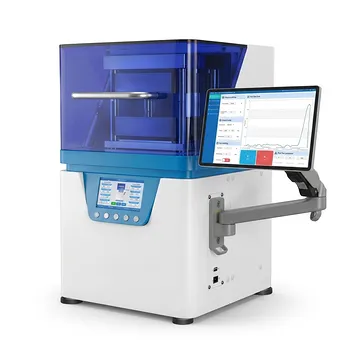
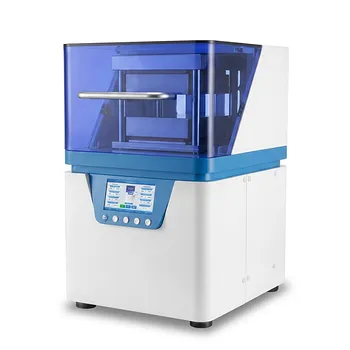
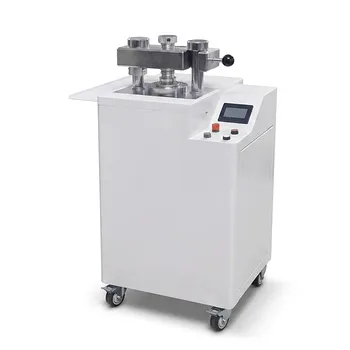
The high-precision electric heated plate vulcanizing press ensures the quality of rubber nanocomposites by providing a perfectly synchronized environment of stable high temperature and uniform hydraulic pressure. These conditions facilitate a complete and uniform cross-linking reaction within the rubber matrix, transforming the raw plastic compound into a dense, high-performance elastomeric three-dimensional network with standardized geometric dimensions.
The core function of the vulcanizing press is to regulate the "thermal-pressure" equilibrium, which directly dictates the density of the molecular network. Without this precision, the resulting nanocomposite will suffer from internal defects, inconsistent mechanical properties, and compromised flame retardancy.
Thermal Field Stability and Cross-linking Dynamics
Maintaining Constant Temperature
The press typically maintains a specific thermal environment, such as 160 °C, within a steel mold to trigger vulcanizing agents like dicumyl peroxide or sulfur. This stability is critical for determining the ideal vulcanization time, ensuring the reaction is neither premature nor incomplete.
Achieving Uniform Cross-linking
A stable thermal field allows for a uniform cross-linking reaction across the entire specimen. This uniformity is essential for forming a stable three-dimensional spatial network, which converts plastic raw rubber into a high-strength, elastic material.
Impact on Molecular Structure
Precision heating ensures that rubber macromolecular chains bond effectively with fillers. This process is the foundation for the material's structural integrity and its ability to withstand high-temperature environments without degrading.
Pressure Control and Structural Density
Elimination of Internal Defects
Continuous and stable pressure (often ranging from 30 bar to 1500 psi) is applied to ensure dense specimen formation. This high-pressure environment is vital for eliminating internal air bubbles and voids that could act as failure points under stress.
Precise Dimensional Control
The press maintains exact control over specimen thickness, often targeting measurements like 2 mm or 4 mm. This precision ensures that the samples meet rigorous international standards for mechanical and physical performance testing.
Reducing Material Stress
By providing a uniform pressure distribution, the equipment helps eliminate internal material stresses. This results in a finished product with low surface roughness and stable geometric dimensions, which are required for accurate data in research and development.
Material Performance and Functional Integrity
Enhancing Flame Retardancy
The quality of the 3D network formed during vulcanization directly determines the flame retardancy efficiency of the nanocomposite. A well-vulcanized structure is more effective at resisting combustion and maintaining integrity during oxygen index or micro-combustion testing.
Transitioning from Plastic to Elastic
The combination of heat and pressure facilitates the chemical transition of the rubber matrix. This transformation is what gives Nitrile Butadiene Rubber (NBR) and other elastomers their characteristic thermal resistance and superior physical properties.
Standardizing for Research
For laboratory applications, the press ensures that every sample is identical. This consistency is mandatory for accurate performance testing, allowing researchers to isolate the effects of different nanocomposite additives without process-induced variables.
Common Pitfalls to Avoid
Managing Thermal Gradients
Even in high-precision presses, large plates can develop thermal gradients where the edges are cooler than the center. If not monitored, this leads to uneven vulcanization, resulting in a single sheet of rubber with varying mechanical properties.
Risks of Over-Vulcanization
Maintaining the high-temperature state for too long—beyond the calculated ideal vulcanization time—can lead to polymer degradation. This "over-cooking" breaks down the molecular chains, reducing the elasticity and strength of the composite.
Pressure Fluctuations
If the hydraulic system fails to maintain continuous pressure during the cooling phase, the material may shrink inconsistently. This can introduce surface defects or warp the specimen, making it useless for standardized mechanical testing.
How to Apply This to Your Project
Recommendations for Success
- If your primary focus is material research: Ensure your press can maintain a temperature tolerance of ±1°C to guarantee that cross-linking density remains a controlled variable.
- If your primary focus is flame retardancy testing: Prioritize a press that offers high-pressure stability (at least 30 bar) to eliminate all air pockets, as internal voids can artificially accelerate combustion.
- If your primary focus is mechanical standardization: Use precision-ground steel molds in conjunction with the press to ensure specimen thickness remains within a 0.1mm tolerance for valid tensile testing.
By mastering the precise control of temperature and pressure, you ensure the creation of a robust molecular network that defines the performance of modern rubber nanocomposites.
Summary Table:
| Feature | Benefit | Impact on Quality |
|---|---|---|
| Thermal Stability | Uniform Cross-linking | High-strength, 3D molecular networks |
| High Pressure | Void Elimination | Dense specimens with no internal defects |
| Precision Control | Dimensional Accuracy | Standardized samples for reliable testing |
| Equilibrium Management | Stress Reduction | Stable geometry and low surface roughness |
Optimize Your Material Research with KINTEK Precision Presses
Are you looking to achieve flawless structural density and uniform cross-linking in your rubber nanocomposites? KINTEK specializes in comprehensive laboratory pressing solutions designed for the most demanding research environments.
We offer an extensive range of equipment tailored to your needs, including:
- Manual & Automatic Presses for versatile lab applications.
- Heated & Multifunctional Models for precise thermal-pressure control.
- Glovebox-Compatible Systems for air-sensitive research.
- Cold & Warm Isostatic Presses (CIP/WIP) widely applied in advanced battery research.
Ensure your samples meet rigorous international standards with equipment built for accuracy and durability. Contact our experts today to find your perfect pressing solution!
References
- Przemysław Rybiński, G. Janowska. Thermal stability and flammability of nanocomposites made of diene rubbers and modified halloysite nanotubes. DOI: 10.1007/s10973-013-3035-1
This article is also based on technical information from Kintek Solution Knowledge Base .
Related Products
- Split Automatic Heated Hydraulic Press Machine with Heated Plates
- Automatic High Temperature Heated Hydraulic Press Machine with Heated Plates for Lab
- Automatic Heated Hydraulic Press Machine with Heated Plates for Laboratory
- Automatic Heated Hydraulic Lab Press Machine 200x200 Plate Size for Battery Research and Materials Science
- 24T 30T 60T Heated Hydraulic Lab Press Machine with Hot Plates for Laboratory
People Also Ask
- What are the requirements for electrode pressing with high-viscosity ionic liquids like EMIM TFSI? Optimize Performance
- How does a laboratory heated hydraulic press facilitate PBN sample prep for WAXS? Achieve Precise X-Ray Scattering
- What are the industrial applications of heated hydraulic presses? Master Heat & Force for Precision Manufacturing
- Why is a laboratory hydraulic press with heating plates required for PLA/TEC films? Achieve Precise Sample Integrity
- Function of a Laboratory Hydraulic Press with Heated Platens in SSE? Enhance Battery Density & Conductivity