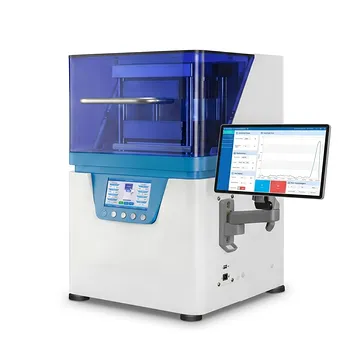
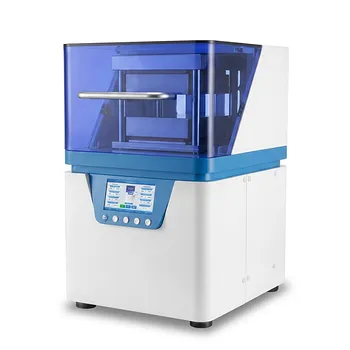
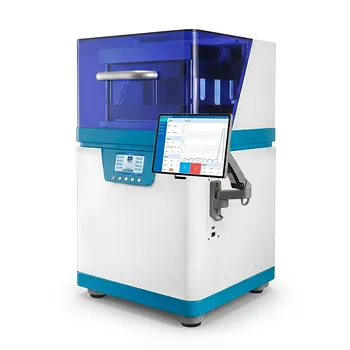
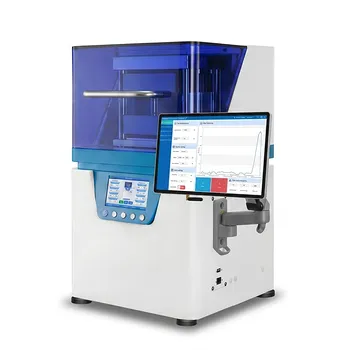
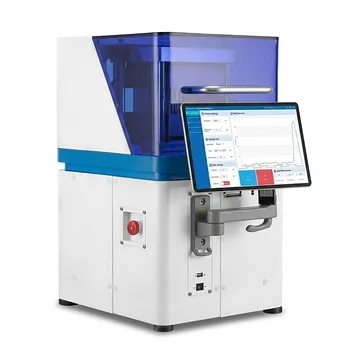
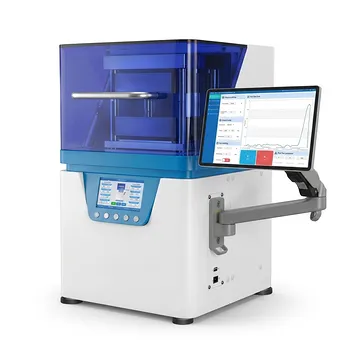
The laboratory heated hydraulic press acts as the critical catalyst and shaping mechanism for carbon black filled elastomers. It simultaneously provides the precise thermal energy required to trigger the chemical vulcanization process and the mechanical pressure necessary to eliminate internal defects and force the compound into a uniform, high-density geometric shape.
The laboratory heated hydraulic press transforms unvulcanized rubber compounds into standardized elastomer specimens by integrating controlled heat for cross-linking and high pressure for mold conformance. This dual-action process is essential for creating high-density, defect-free samples suitable for rigorous mechanical and thermoelastic analysis.
Thermal Activation of the Vulcanization Reaction
Driving the Chemical Cross-Linking
In the processing of elastomers, the press serves as the primary source of thermal energy. This heat is necessary to drive the vulcanization reaction, where chemical bonds (cross-links) form between polymer chains, turning a plastic-like raw material into an elastic solid.
Maintaining Temperature Precision
Precise temperature control, often maintained at specific levels like 160 °C or 143 °C, ensures a consistent degree of vulcanization throughout the entire specimen. Without this stability, the elastomer would exhibit localized variations in mechanical properties, rendering it useless for standardized testing.
Specialized Chemical Induction
In certain specialized compounds, such as CR/SBR rubber, the thermal energy from the press induces specific reactions like Friedel–Crafts alkylation. These reactions, often facilitated by additives like tin oxide (SnO), are essential for forming the complex cross-elastomer bonds required for performance materials.
Mechanical Compaction and Geometric Shaping
Ensuring Complete Mold Conformance
The hydraulic system applies high mechanical pressure—ranging from 15 MPa to 29 MPa—to force the rubber compound into every corner of the mold cavity. This ensures the final product achieves its intended geometric shape, such as thin sheets of 0.5 mm or 1 mm thickness.
Elimination of Internal Porosity
High pressure is vital for expelling internal air pockets and gases trapped within the raw compound. By eliminating these air bubbles, the press produces a high-density physical structure with a smooth surface finish, significantly reducing the risk of premature material failure during testing.
Particle Rearrangement and Adhesion
In carbon black filled systems, the pressure facilitates particle displacement and rearrangement. This increases the contact area between the elastomer matrix and the carbon black filler, ensuring a homogeneous internal structure and better mechanical strength.
Achieving Standardization for Material Analysis
Creating Baseline Specimens
The laboratory press is the standard tool for preparing baseline samples used in mechanical property testing and thermoelastic analysis. By controlling the density and thickness of every sample, researchers can ensure that variations in test results are due to the material's chemistry rather than manufacturing flaws.
Enhancing Surface Integrity
Compared to additive manufacturing methods like 3D printing, compression molding via a hydraulic press results in superior edge adhesion and fewer surface defects. This structural integrity is essential for spectroscopic analysis and high-temperature sintering processes where cracking must be avoided.
Understanding the Trade-offs and Limitations
Thermal Degradation Risks
While high heat is necessary for curing, excessive exposure can lead to thermal degradation of the elastomer. If the press temperature is not precisely calibrated, the outer layers of the specimen may "over-cure" and become brittle before the core has fully vulcanized.
Pressure-Induced Internal Stress
Applying excessive pressure can sometimes result in residual internal stresses within the elastomer sheet. When the specimen is removed from the mold, these stresses may cause warping or dimensional instability, potentially skewing the results of precision mechanical tests.
Complexity of Filler Dispersion
A hydraulic press is excellent for shaping and curing, but it cannot fix a poorly mixed compound. If the carbon black is not properly dispersed during the initial mixing stage, the press will simply solidify those inconsistencies, leading to specimens with "hot spots" of filler concentration.
How to Optimize Your Compression-Moulding Process
To achieve the best results with carbon black filled elastomers, your approach should vary based on your specific research or production requirements:
- If your primary focus is mechanical property testing: Prioritize precise pressure control (e.g., 15-20 MPa) to ensure the elimination of all internal air bubbles and the creation of a perfectly uniform 0.5 mm sheet.
- If your primary focus is rapid chemical prototyping: Focus on the stability of the heating elements to ensure that the vulcanization reaction is consistent across multiple batches for accurate comparative data.
- If your primary focus is high-density composite strength: Utilize higher pressure settings (up to 29 MPa) to maximize particle contact area and ensure the elastomer matrix thoroughly infiltrates the carbon black filler.
The laboratory heated hydraulic press remains the definitive tool for converting raw elastomer compounds into high-performance, standardized specimens through the synchronized application of heat and force.
Summary Table:
| Key Function | Action | Primary Benefit |
|---|---|---|
| Thermal Activation | Controlled heat (140-160°C) | Triggers chemical vulcanization and cross-linking. |
| Mechanical Compaction | High pressure (15-29 MPa) | Eliminates internal porosity and air pockets. |
| Geometric Shaping | Mold conformance | Ensures standardized 0.5-1mm specimen thickness. |
| Filler Interaction | Particle rearrangement | Enhances adhesion between matrix and carbon black filler. |
Optimize Your Material Testing with KINTEK
Precision is paramount in elastomer and battery research. KINTEK provides a comprehensive range of laboratory pressing solutions, including manual, automatic, heated, and multifunctional models. Our systems—from cold and warm isostatic presses to glovebox-compatible units—are engineered to deliver the precise thermal stability and mechanical pressure required for superior specimen integrity and consistent research data.
Discover how KINTEK can enhance your lab's efficiency—Contact us today!
References
- Vanessa Fernandes, Davide S. A. De Focatiis. Anisotropic swelling of rubber: extension of the Flory theory. DOI: 10.1007/s42464-022-00183-2
This article is also based on technical information from Kintek Solution Knowledge Base .
Related Products
- Heated Hydraulic Press Machine with Heated Plates for Vacuum Box Laboratory Hot Press
- Automatic High Temperature Heated Hydraulic Press Machine with Heated Plates for Lab
- Automatic Heated Hydraulic Lab Press with Programmable Touch Screen Controls and Precision Temperature Regulation
- Automatic Hydraulic Heat Press Machine with Multi Stage Programmable Control and Integrated Water Cooling Plate Size 180x180mm
- Automatic Hydraulic Hot Press with Large Plate and Precision Temperature Control for Advanced Material Sample Preparation and Industrial Research
People Also Ask
- How does a laboratory heated hydraulic press facilitate PBN sample prep for WAXS? Achieve Precise X-Ray Scattering
- What are the requirements for electrode pressing with high-viscosity ionic liquids like EMIM TFSI? Optimize Performance
- What are the industrial applications of heated hydraulic presses? Master Heat & Force for Precision Manufacturing
- Function of a Laboratory Hydraulic Press with Heated Platens in SSE? Enhance Battery Density & Conductivity
- How are heated hydraulic presses utilized in the preparation of thin films? Key Mechanisms and Applications