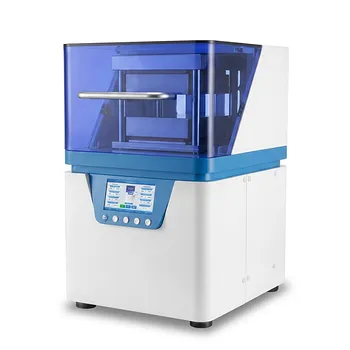
Heated hydraulic presses are primarily utilized to compact powder mixtures into dense, uniform solid forms. By combining high pressure with controlled temperature, these systems facilitate the creation of consistent samples for compositional analysis and the manufacturing of materials requiring precise mechanical properties.
Core Insight While hydraulic pressure forces particles together, the addition of heat is the catalyst that overcomes internal friction and material resistance. This dual-action approach is essential for achieving high densification and structural integrity in materials that would otherwise remain porous or brittle under cold pressing alone.
The Mechanics of Heated Compaction
Overcoming Internal Friction
In powder compaction, friction between particles often resists densification.
A heated hydraulic press applies stable high pressure that helps overcome this internal friction. This allows powder particles to pack more densely, creating a "green compact" with sufficient structural integrity to hold its shape.
Inducing Plastic Deformation
Pressure alone often causes only elastic (reversible) deformation.
The application of heat promotes plastic deformation and particle rearrangement. This ensures that the powder does not spring back to its original form once the pressure is released, resulting in a permanent, solid shape.
Enabling Solid-Phase Reactions
For advanced materials, physical compaction is not enough; chemical bonding is required.
In powder metallurgy and composite creation, hydraulic hot presses facilitate solid-phase reactions. This results in materials with significantly improved densification and enhanced mechanical properties compared to cold-pressed alternatives.
Critical Applications
Sample Preparation for Analysis
The primary reference highlights the need for creating uniform samples for compositional analysis.
Techniques such as Infrared (IR) spectroscopy and XRF spectroscopy require samples with homogeneous density. Heated pressing ensures that the surface and internal structure of the sample are consistent, preventing data errors caused by gradients or porosity.
Material Manufacturing
Beyond the lab, these presses are used to manufacture parts with precise properties.
Industries ranging from ceramics to pharmaceuticals utilize heated compaction to produce pills, polymer films, and composite parts. The controlled heat ensures that these products meet strict quality control standards for density and strength.
Understanding the Trade-offs
Thermal Sensitivity
Not all powders respond well to heated compaction.
Certain polymers or pharmaceutical compounds may suffer from thermal degradation if the temperature exceeds their stability limits. Precise temperature control is required to avoid altering the chemical composition of the sample.
Cycle Time and Throughput
Heated pressing is generally a slower process than cold pressing.
The equipment requires time to ramp up to the target temperature and may require a cooling cycle before the part can be ejected. This can limit throughput volume in high-speed manufacturing environments.
Making the Right Choice for Your Goal
To determine if heated hydraulic compaction is necessary for your specific application, consider your end-use requirements:
- If your primary focus is Compositional Analysis: The heated press is essential for creating perfectly uniform samples to ensure accurate spectroscopic readings.
- If your primary focus is Structural Integrity: The heat is required to induce plastic deformation and solid-phase reactions, yielding a denser, stronger final product.
- If your primary focus is High-Volume Production: You must balance the need for material density against the slower cycle times inherent in heating and cooling the mold.
By leveraging heat to reduce friction and enable deformation, you transform loose powder into high-performance material.
Summary Table:
| Feature | Cold Pressing | Heated Hydraulic Pressing |
|---|---|---|
| Mechanism | Pressure alone | Pressure + Thermal Energy |
| Particle Interaction | Elastic deformation | Plastic deformation & rearrangement |
| Material Integrity | Potential for spring-back | High densification & permanent bonding |
| Sample Quality | Possible porosity/gradients | Uniform homogeneity for spectroscopy |
| Best Used For | Basic shaping/high-speed | Advanced materials & chemical analysis |
Elevate Your Laboratory Precision with KINTEK
Unlock the full potential of your material research with KINTEK’s premium pressing solutions. As specialists in comprehensive laboratory pressing, we provide a versatile range of equipment including manual, automatic, heated, and multifunctional models. Our systems are specifically engineered for battery research, powder metallurgy, and high-precision spectroscopy, offering both cold and warm isostatic presses to meet your exact density requirements.
Why choose KINTEK?
- Glovebox Compatibility: Seamlessly integrate heating solutions into inert environments.
- Precision Control: Maintain strict temperature stability to prevent thermal degradation.
- Versatility: From polymer films to ceramic composites, our presses handle it all.
Ready to transform your powder compaction workflow? Contact KINTEK today to find your perfect pressing solution!
Related Products
- Heated Hydraulic Press Machine with Heated Plates for Vacuum Box Laboratory Hot Press
- Automatic High Temperature Heated Hydraulic Press Machine with Heated Plates for Lab
- Automatic Heated Hydraulic Lab Press with Programmable Touch Screen Controls and Precision Temperature Regulation
- Automatic Hydraulic Heat Press Machine with Multi Stage Programmable Control and Integrated Water Cooling Plate Size 180x180mm
- Automatic Hydraulic Hot Press with Large Plate and Precision Temperature Control for Advanced Material Sample Preparation and Industrial Research
People Also Ask
- What are the requirements for electrode pressing with high-viscosity ionic liquids like EMIM TFSI? Optimize Performance
- How does a laboratory heated hydraulic press facilitate PBN sample prep for WAXS? Achieve Precise X-Ray Scattering
- What are the industrial applications of heated hydraulic presses? Master Heat & Force for Precision Manufacturing
- Function of a Laboratory Hydraulic Press with Heated Platens in SSE? Enhance Battery Density & Conductivity
- How are heated hydraulic presses utilized in the preparation of thin films? Key Mechanisms and Applications