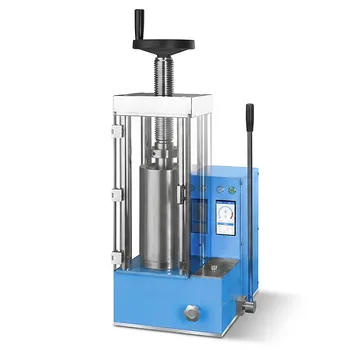
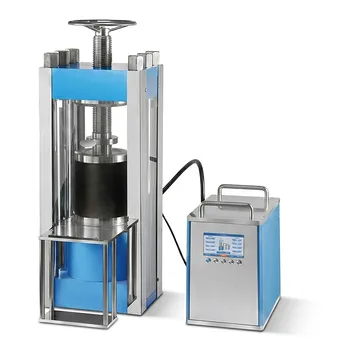
A high-precision laboratory press is fundamental to ensuring the microscopic flatness and structural integrity of substrate materials, which are critical for the functionality of superconducting nanowire devices. By providing stable pressure control—from ultra-low starting points to high theoretical density compaction—the press eliminates density gradients and surface irregularities. This precise preparation ensures that subsequent thin-film deposition and nano-etching can occur on a perfectly level platform, directly preserving the continuity and critical current capacity of the nanowires.
The core value of a high-precision laboratory press lies in its ability to transform raw materials into standardized, sub-micron-level substrates through exact pressure regulation. This control is vital for maintaining the physical properties and electrical performance required for sensitive superconducting transitions.
Achieving Microscopic Flatness and Consistency
The Foundation for Thin-Film Deposition
In the world of superconducting devices, microscopic flatness is not a luxury but a requirement. If a substrate has even minor surface deviations, it can cause discontinuities in the nanowires, which are often only a few atoms thick.
A high-precision press utilizes assisted diffusion bonding and compaction to ensure that the substrate surface remains uniform at the micrometer scale. This uniformity provides the ideal physical platform for high-quality thin-film deposition, ensuring the superconducting layer adheres perfectly without structural flaws.
Eliminating Internal Density Gradients
Standardized testing and device performance depend on the microscopic density of the material. High-precision presses ensure that precursor powders reach their maximum packing density within a mold, eliminating internal voids and defects.
By achieving a high theoretical density, researchers can ensure that grain boundary connectivity is optimized after the sintering process. This reduction in internal defects is essential for maximizing the current-carrying capacity of the superconducting material.
Protecting and Integrating Fragile Nanostructures
Low-Pressure Sensitivity and Stability
Superconducting nanowires are notoriously fragile and sensitive to physical structural deviations. High-precision presses provide extremely low and stable starting pressures, which prevent the crushing or distortion of nanostructures during lamination.
This capability for precision pressure holding allows researchers to bond layers without initiating structural collapse or uneven agglomeration. Without this fine-tuned control, the delicate geometries required for nanoelectronics would be destroyed during the assembly phase.
Optimizing Ohmic Contact for Signal Efficiency
The interface between a superconducting nanowire and its electrode is a common point of failure. A high-precision press allows for the application of force to ensure tight ohmic contact without damaging the underlying thin-film structure.
By fine-tuning the pressure, researchers can achieve high signal transmission efficiency and maintain the device's transition characteristics. This delicate balance ensures that the physical connection does not introduce unwanted resistance or thermal noise into the system.
Understanding the Trade-offs and Limitations
The Balance Between Density and Fragility
While high pressure is necessary to eliminate voids and increase density, excessive force can lead to internal stress or micro-cracks. Navigating the window between "high theoretical density" and "structural damage" requires precise kinematic control over displacement speeds.
Precision vs. Throughput
High-precision laboratory presses are designed for accuracy and the creation of high-fidelity reference samples rather than mass production. While they allow for the exact replication of HPC (High-Performance Computing) simulations, the process is slower and more methodical than industrial-scale forming.
Selecting the Right Approach for Your Objectives
How to Apply This to Your Project
To achieve the best results with superconducting nanowire substrates, your approach to pressing must align with your specific research or fabrication goals. The following recommendations provide a baseline for equipment utilization:
- If your primary focus is maximizing superconducting current ($I_c$): Utilize high-stability pressure to achieve maximum packing density and eliminate density gradients within the green body.
- If your primary focus is protecting delicate nanostructures: Prioritize equipment with ultra-low starting pressures and high-precision pressure holding to prevent structural collapse during lamination.
- If your primary focus is validating theoretical simulations: Use precise kinematic boundary conditions, such as constant displacement speeds, to ensure physical samples match high-fidelity computer models.
The integration of high-precision pressing into the substrate preparation workflow turns a mechanical process into a vital tool for ensuring the reliability and performance of next-generation superconducting electronics.
Summary Table:
| Key Feature | How it Contributes | Impact on Device Performance |
|---|---|---|
| Pressure Stability | Eliminates internal density gradients | Maximizes critical current-carrying capacity ($I_c$) |
| Surface Flatness | Provides a sub-micron level platform | Ensures continuity in thin-film deposition |
| Low-Pressure Control | Prevents distortion of nanostructures | Protects fragile geometries during lamination |
| Ohmic Contact | Ensures tight material interface | Boosts signal efficiency and reduces thermal noise |
Elevate Your Superconducting Research with KINTEK Precision
Achieving the perfect substrate requires more than just force—it requires absolute control. KINTEK specializes in comprehensive laboratory pressing solutions designed for the most demanding research environments. Whether you are developing next-generation batteries or superconducting nanowires, our range of manual, automatic, heated, multifunctional, and glovebox-compatible models, as well as cold and warm isostatic presses, provide the sub-micron accuracy your project demands.
Ready to eliminate defects and optimize your signal efficiency?
Contact KINTEK Today to Find Your Ideal Pressing Solution
References
- D. M. Hoyle, Tom McLeish. Large amplitude oscillatory shear and Fourier transform rheology analysis of branched polymer melts. DOI: 10.1122/1.4881467
This article is also based on technical information from Kintek Solution Knowledge Base .
Related Products
- Automatic Hydraulic Hot Press with Large Plate and Precision Temperature Control for Advanced Material Sample Preparation and Industrial Research
- Automatic Heated Hydraulic Lab Press with Programmable Touch Screen Controls and Precision Temperature Regulation
- Special Shape Lab Press Mold for Laboratory Applications
- Lab Round Bidirectional Press Mold
- 24T 30T 60T Heated Hydraulic Lab Press Machine with Hot Plates for Laboratory
People Also Ask
- What are the specific features and applications of hydraulic hot press machines? Precision Solutions for Modern Labs
- How does an automatic hydraulic press operate? Achieve Precision and Consistency in Lab Pelleting
- What are the advantages and common applications of an automatic hydraulic press? Elevate Your Lab's Precision
- What is the technical significance of setting a precise dwell time? Achieve Peak Material Density and Stability
- When is an automatic hydraulic press more suitable than a manual press? Scale Your Lab with Precision & Speed