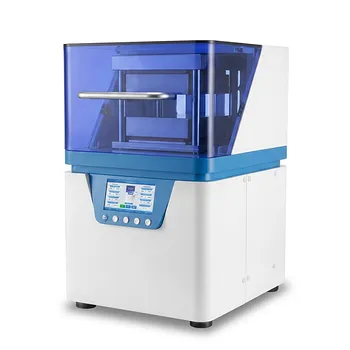
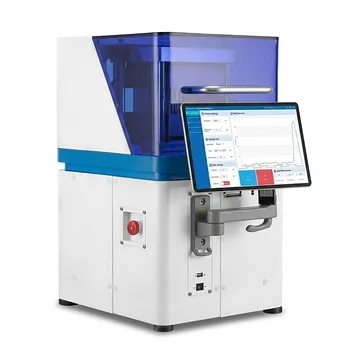
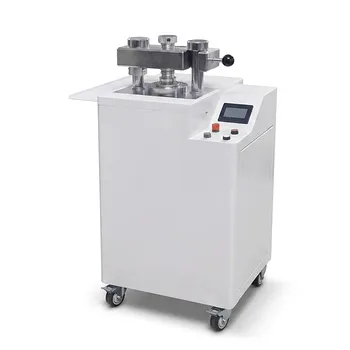
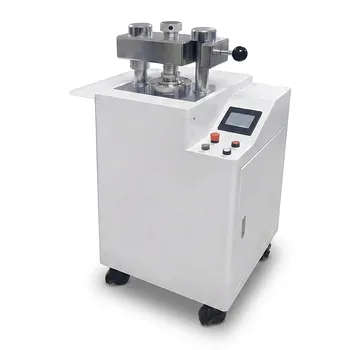
An automatic hydraulic press operates by utilizing an electric motor to drive a hydraulic pump, replacing manual physical effort with automated precision. Unlike manual presses that rely on a hand lever, this machine is controlled via a button or electronic interface where the user pre-sets the desired load. Once activated, electric switches regulate a relief valve to execute the press cycle with high accuracy and repeatability.
The core advantage of an automatic press is the removal of operator variability. By digitizing the control of hydraulic pressure, the system ensures that the exact same force is applied during every cycle, regardless of who is operating the machine.
The Mechanism of Automation
The transition from manual to automatic changes how the hydraulic force is initiated and regulated.
Electric Motor Drive
In a manual press, a human operator physically pumps a lever to build pressure. An automatic press replaces this effort with an electric motor.
This motor powers the pump directly, ensuring a consistent flow of hydraulic fluid without physical exertion from the user.
Electronic Control Logic
Instead of relying on the operator to stop pumping at the right moment, the machine uses electric switches to monitor the system.
These switches control the relief valve. When the system detects that the pre-set load has been reached, the valve modulates the pressure automatically.
Automated Cycles
The die within an automatic machine is often programmed to perform complex actions independent of the operator.
Once the button is pressed, the machine can execute a full press and release cycle automatically, engaging the object and retracting without further input.
The Physics of Force Generation
While the controls are electronic, the actual force generation relies on fundamental hydraulic principles.
Pascal’s Law
The underlying physics is based on Pascal’s Law. This states that pressure applied to a confined fluid is transmitted equally in all directions.
Force Multiplication
The system utilizes two cylinders of different sizes connected by fluid-filled piping. A small mechanical force applied to a smaller piston (the plunger) generates pressure in the fluid.
Because this pressure is constant throughout the closed system, it exerts a significantly multiplied force when it pushes against the larger surface area of the main piston (the ram).
The Hydraulic Circuit
The pump moves hydraulic fluid (usually oil) into the cylinder containing the large piston. As fluid enters, it cannot compress, so it forces the piston to extend.
This extension provides the compressive force needed to crush, mold, or shape the object placed in the die.
Understanding the Trade-offs
While automatic presses offer superior consistency, there are operational considerations to keep in mind.
Complexity and Maintenance
The integration of electric motors, switches, and automated controllers adds complexity to the machine. Unlike a simple manual lever system, there are more electronic components that may require maintenance or calibration over time.
Setup Requirements
Because the machine relies on pre-set loads, the initial setup is critical. The operator must accurately program the desired force; an incorrect setting will be repeated flawlessly until corrected.
Making the Right Choice for Your Goal
When deciding if an automatic hydraulic press fits your operational needs, consider your specific output requirements.
- If your primary focus is Production Volume: The automatic cycle allows for rapid, repetitive tasks without causing operator fatigue, significantly increasing throughput.
- If your primary focus is Precision and Quality Control: The ability to set an exact load ensures that every part is subjected to identical force, reducing the rejection rate due to variance.
By combining the raw power of hydraulic fluid dynamics with the precision of electronic control, the automatic press transforms brute force into a calibrated industrial tool.
Summary Table:
| Feature | Manual Hydraulic Press | Automatic Hydraulic Press |
|---|---|---|
| Power Source | Manual Lever (Human Effort) | Electric Motor / Pump |
| Force Control | Visual Gauge / Manual Stop | Electronic Interface / Pre-set Load |
| Repeatability | Lower (Operator Dependent) | High (Standardized Cycles) |
| Best Use Case | Low Volume / Simple Tasks | Production Volume / Precision Quality Control |
| Key Component | Manual Pump | Relief Valve & Electric Switches |
Elevate Your Material Research with KINTEK
Consistency is the backbone of scientific excellence. KINTEK specializes in comprehensive laboratory pressing solutions, providing everything from manual and automatic models to heated, multifunctional, and glovebox-compatible presses. Whether you require cold or warm isostatic presses for advanced battery research or high-throughput pelleting, our equipment eliminates operator variability and guarantees precise force application.
Ready to automate your laboratory workflow? Contact our specialists today to find the perfect press for your application and experience the KINTEK advantage in precision engineering.
Related Products
- Automatic Hydraulic Hot Press with Large Plate and Precision Temperature Control for Advanced Material Sample Preparation and Industrial Research
- Automatic Hydraulic Heat Press Machine with Multi Stage Programmable Control and Integrated Water Cooling Plate Size 180x180mm
- Automatic Heated Hydraulic Lab Press with Programmable Touch Screen Controls and Precision Temperature Regulation
- Automatic Laboratory Hydraulic Press Lab Pellet Press Machine
- Automatic Heated Hydraulic Press Machine with Hot Plates for Laboratory
People Also Ask
- What are the specific features and applications of hydraulic hot press machines? Precision Solutions for Modern Labs
- What are the advantages and common applications of an automatic hydraulic press? Elevate Your Lab's Precision
- What is the technical significance of setting a precise dwell time? Achieve Peak Material Density and Stability
- When is an automatic hydraulic press more suitable than a manual press? Scale Your Lab with Precision & Speed
- How does a laboratory hydraulic heat press facilitate the molding of cellulose composite specimens? Precision Molding