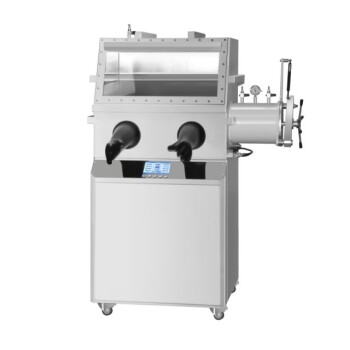
The high-purity argon glove box serves as an airtight, inert sanctuary for sensitive battery chemistry. It replaces ambient air with a purified argon atmosphere, strictly maintaining moisture and oxygen levels to concentrations typically below 0.1 ppm. This isolation is critical to prevent the immediate oxidation of lithium metal and the degradation of electrolytes, which would otherwise compromise the cell's electrochemical performance.
A high-purity argon glove box protects coin cell assembly by eliminating reactive atmospheric contaminants. This ensures that the resulting electrochemical data reflects the intrinsic properties of the active materials rather than artifacts caused by environmental degradation.
Neutralizing Atmospheric Reactivity
Protecting Lithium Metal Anodes
Metallic lithium is extremely reactive and begins to oxidize the moment it contacts oxygen or moisture. Within the glove box, the inert argon environment prevents the formation of an insulating oxide layer on the lithium foil. This preservation is vital for maintaining the low interfacial resistance required for accurate Electrochemical Impedance Spectroscopy (EIS).
Preventing Electrolyte Hydrolysis
Organic electrolytes and lithium salts, such as LiPF6 or LiTFSI, are highly hygroscopic and react with trace water to form hydrofluoric acid. The glove box’s ultra-low moisture levels prevent this hydrolysis, ensuring the electrolyte remains chemically stable. Without this protection, acidic byproducts would corrode the cell internals and trigger premature battery failure.
Stabilizing High-Nickel Cathode Materials
High-nickel cathode materials (NMA) are sensitive to carbon dioxide and moisture, which can form lithium carbonate (Li2CO3) layers on the particle surfaces. By assembly within a controlled atmosphere, researchers prevent these residual alkali layers from forming. This step is essential for achieving accurate initial coulombic efficiency measurements and long-term cycling stability.
Ensuring Data Integrity and Reproducibility
Eliminating Experimental Variables
In battery research, the goal is to evaluate the performance of specific materials, such as coal-based graphene. Any contamination from the assembly environment introduces "noise" that can mask the material's true potential. The glove box provides a standardized environment, ensuring that every cell produced is consistent and the results are reproducible.
Maintaining Interface Stability
The stability of the interface between the electrode and the electrolyte determines the battery's cycle life. By assembling the cell in an argon-rich environment, the interface remains pure, preventing undesirable side reactions during the first charge/discharge cycles. This allows for a clear assessment of the material’s intrinsic lithium storage performance.
Enhancing Safety During Assembly
Handling highly active materials like lithium foil in open air can pose fire risks due to rapid exothermic reactions with humidity. The glove box provides a safe, sealed environment for technicians to manipulate these components. This containment protects both the experimental samples and the laboratory personnel.
Understanding the Trade-offs
Operational Complexity and Maintenance
While a glove box provides a superior environment, it requires constant monitoring of oxygen and moisture sensors. If these sensors are not calibrated or the catalyst for gas purification is exhausted, the atmosphere can silently degrade. This necessitates a strict maintenance schedule to ensure the environment remains within the required sub-0.1 ppm range.
Ergonomic and Material Limitations
Performing delicate tasks through thick butyl gloves reduces tactile feedback and can lead to assembly errors or punctured gloves. A small leak in the glove can compromise the entire internal atmosphere quickly. Furthermore, the cost of high-purity argon gas and the energy required for continuous gas circulation and purification represent a significant operational overhead.
Applying This to Your Project
Recommendations for Environment Control
Effective coin cell assembly requires matching your environmental controls to your specific material sensitivities.
- If your primary focus is high-nickel cathode research: Prioritize a glove box that can maintain oxygen levels below 0.1 ppm to prevent the formation of lithium carbonate surface layers.
- If your primary focus is electrolyte development: Ensure your system is equipped with high-capacity moisture removal filters to prevent the hydrolysis of sensitive lithium salts like LiPF6.
- If your primary focus is rapid prototyping of standard materials: A slightly higher threshold (near 1 ppm) may be acceptable, provided the lithium metal handling time is minimized to prevent significant oxidation.
A properly maintained high-purity argon glove box is the foundational tool that transforms sensitive battery components into a reliable, high-performance electrochemical system.
Summary Table:
| Environmental Factor | Impact on Coin Cell Performance |
|---|---|
| Inert Argon Atmosphere | Prevents oxidation of lithium metal anodes, maintaining low interfacial resistance. |
| Moisture (< 0.1 ppm) | Eliminates electrolyte hydrolysis and the formation of corrosive hydrofluoric acid. |
| Oxygen (< 0.1 ppm) | Protects high-nickel cathodes from forming lithium carbonate layers on surfaces. |
| Contaminant Control | Ensures data reproducibility by removing external experimental variables. |
| Sealed Containment | Provides a safe environment for handling highly reactive materials like lithium foil. |
Elevate your battery research with KINTEK’s specialized laboratory pressing solutions. We offer a diverse range of manual, automatic, heated, and multifunctional models specifically engineered for seamless glovebox compatibility. Our cold and warm isostatic presses are industry favorites for battery research, ensuring your materials maintain their intrinsic electrochemical properties. Contact us at KINTEK today to discover how our high-precision equipment can optimize your coin cell assembly and research workflows!
References
- Xiao Ma, Shaoqing Wang. Laser‐Induced Coal‐Based Porous Graphene as Anode Toward Advanced Lithium‐Ion Battery. DOI: 10.1002/advs.202504592
This article is also based on technical information from Kintek Solution Knowledge Base .
Related Products
People Also Ask
- How does a laboratory hydraulic press contribute to the preparation of Li3-3xScxSb samples? Optimize Ionic Conductivity
- What is the function of a laboratory hydraulic press in FT-IR of curcumin-coated MWCNTs? Achieve Optical Clarity.
- Why is a laboratory hydraulic press required for compression molding boron-siloxane? Solve High-Loading Density Challenges
- What role does a laboratory hydraulic press play in reaction pellets? Optimizing Lunar Soil and Metal Fuel Density
- What role does a laboratory hydraulic press play in the preparation of piezoelectric ceramic discs for DC-PG? | KINTEK