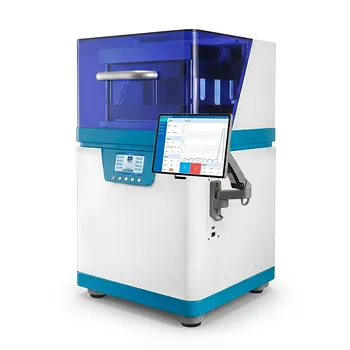
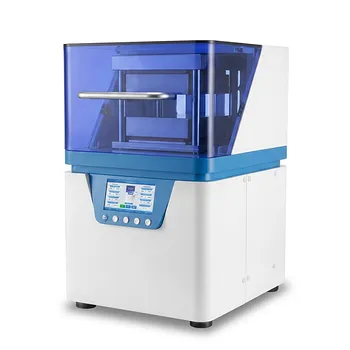
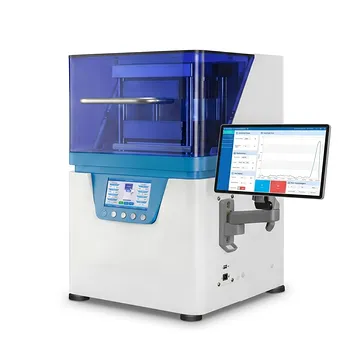
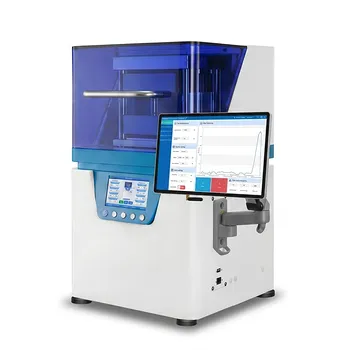
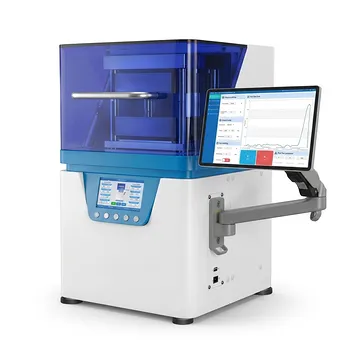
A hydraulic press is an essential tool for transforming loose powder mixtures into solid, uniform samples through the application of controlled, high-force compression. By compacting these powders, the press facilitates particle rearrangement and deformation, creating stable pellets or blocks. This step is critical for ensuring the accuracy of compositional analysis and the structural integrity of materials in manufacturing processes.
The primary value of a hydraulic press in powder preparation is its ability to eliminate internal voids and create a homogenous, dense material. This uniformity is the prerequisite for accurate analytical data and successful downstream processing, such as sintering or high-energy grinding.
The Mechanics of Powder Compaction
Particle Rearrangement and Deformation
When loose powder is subjected to the unidirectional pressure of a hydraulic press, it undergoes a distinct physical transformation. Initially, the particles simply rearrange to fill gaps.
As pressure increases, the particles undergo plastic deformation, changing shape to interlock with one another. This transforms a loose mixture into a solid body with mechanical strength, often referred to as a "green compact."
Eliminating Voids
A major function of the press is the removal of air and space between particles. Whether working with nanocrystalline powders or cement mixtures, high pressure significantly increases loading density.
By eliminating these internal voids, the press prevents the final product from deforming during subsequent high-temperature steps or curing processes.
Ensuring Analytical Precision
Creating Uniform Samples
For compositional analysis, the consistency of the sample is paramount. Hydraulic presses create highly uniform samples that allow researchers to accurately determine the material's composition and properties.
Without this compression, loose powder could segregate or settle unevenly, leading to skewed data regarding the material's true makeup.
Standardization for Spectroscopy
Techniques like X-ray fluorescence (XRF) spectroscopy and electrochemical testing require a flat, dense surface to yield repeatable results.
The hydraulic press ensures that every sample is prepared under standardized pressure, guaranteeing that differences in data reflect actual material differences, not inconsistencies in sample preparation.
Enhancing Process Efficiency
Pre-Treatment for Milling
Hydraulic presses are often used as a preliminary step to break down larger, hard rock blocks into smaller fragments.
This "pre-crushing" prepares the material for fine grinding in high-energy mills. It increases overall production efficiency and protects sensitive grinding equipment from the wear and tear of processing large, raw chunks.
Facilitating Sintering and Forging
In powder metallurgy, the press creates a cohesive shape that can withstand handling before it is fired (sintered).
In direct powder forging, industrial presses deliver energy that triggers dynamic recrystallization. This enhances the microstructure's uniformity and achieves rapid densification, which is impossible to achieve with loose powder alone.
Understanding the Trade-offs
Managing Internal Friction
While hydraulic presses are powerful, they must overcome internal friction between particles and the mold walls.
If the pressure is not applied continuously or is insufficient for the aspect ratio of the sample (e.g., long block samples), the powder may not achieve a dense packing state. This can result in a sample that lacks structural integrity.
The Need for Controlled Speed
Pressure cannot be applied haphazardly. In applications like magnesium powder compaction, pressure must be applied slowly and continuously.
Rapid, uncontrolled compression can fail to induce the necessary elastic and plastic deformation, potentially leading to cracks or uneven density gradients within the sample.
Making the Right Choice for Your Goal
To maximize the utility of a hydraulic press in your laboratory or production line, align your technique with your specific objective:
- If your primary focus is Compositional Analysis: Prioritize the creation of thin, perfectly flat pellets to ensure high accuracy and repeatability for instruments like XRF.
- If your primary focus is Powder Metallurgy: Focus on achieving sufficient "green strength" so the compacted part maintains its shape and integrity during the transfer to a sintering furnace.
- If your primary focus is Milling Efficiency: Use the press to fracture large, hard materials first to extend the lifespan of your high-energy milling equipment.
By controlling density and uniformity, the hydraulic press turns unpredictable powders into reliable, testable, and usable solids.
Summary Table:
| Process Stage | Action | Primary Benefit |
|---|---|---|
| Initial Compression | Particle rearrangement | Fills internal gaps and voids |
| High-Pressure Phase | Plastic deformation | Creates interlocking particles for mechanical strength |
| Sample Shaping | Unidirectional compaction | Produces flat, standardized surfaces for spectroscopy |
| Pre-Treatment | Pre-crushing blocks | Enhances milling efficiency and protects equipment |
| Sintering Prep | Creating 'Green Compacts' | Ensures structural integrity during thermal processing |
Elevate Your Material Research with KINTEK Pressing Solutions
Precision in powder preparation is the foundation of accurate laboratory analysis. KINTEK specializes in comprehensive laboratory pressing solutions, offering a versatile range of equipment including manual, automatic, heated, multifunctional, and glovebox-compatible models, as well as cold and warm isostatic presses widely applied in battery research and metallurgy.
Whether you need to create perfect pellets for XRF analysis or develop high-density green compacts for sintering, our experts can help you select the ideal configuration for your workflow.
Ready to improve your sample uniformity and data repeatability? Contact KINTEK Today to Find Your Perfect Pressing Solution
Related Products
- Automatic Hydraulic Hot Press with Large Plate and Precision Temperature Control for Advanced Material Sample Preparation and Industrial Research
- Automatic Hydraulic Heat Press Machine with Multi Stage Programmable Control and Integrated Water Cooling Plate Size 180x180mm
- Automatic High Temperature Heated Hydraulic Press Machine with Heated Plates for Lab
- Automatic Heated Hydraulic Lab Press with Programmable Touch Screen Controls and Precision Temperature Regulation
- Manual Heated Hydraulic Lab Press with Integrated Hot Plates Hydraulic Press Machine
People Also Ask
- What are the specific features and applications of hydraulic hot press machines? Precision Solutions for Modern Labs
- How does an automatic hydraulic press operate? Achieve Precision and Consistency in Lab Pelleting
- What are the advantages and common applications of an automatic hydraulic press? Elevate Your Lab's Precision
- What is the technical significance of setting a precise dwell time? Achieve Peak Material Density and Stability
- When is an automatic hydraulic press more suitable than a manual press? Scale Your Lab with Precision & Speed