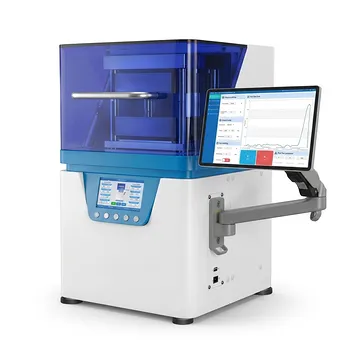
A hydraulic press functions by utilizing the physics of confined fluids to amplify a relatively small input force into a massive output force. The process begins when mechanical force is applied to a small piston (the plunger), which pumps hydraulic fluid into a larger cylinder containing a larger piston (the ram). Because fluids like oil are incompressible, the pressure created by the small piston is transferred instantly to the large piston, driving it down to crush or shape the target material.
Core Takeaway: The immense power of a hydraulic press relies on Pascal’s Principle, which states that pressure applied to an enclosed fluid is transmitted equally in all directions. The machine creates mechanical advantage by applying this constant pressure across the significantly larger surface area of the main output piston.
Understanding the Physics
The Role of Confined Fluid
Hydraulic presses rely on a closed system filled with hydraulic fluid, typically oil. Because this fluid cannot be compressed, any force applied to it must be transmitted elsewhere immediately.
Pascal’s Principle in Action
According to Pascal’s Law, pressure changes in this enclosed system act equally in all directions. This means the pressure generated at the small pump is the exact same pressure exerted against the massive main cylinder.
The Mechanism of Action
The Input Stage (The Plunger)
The operation starts with a small piston, often referred to as the plunger. A modest mechanical force—generated by a hand lever or a motor—pushes this plunger to displace the fluid.
Fluid Transmission
As the plunger depresses, it forces the hydraulic oil out of its small chamber. The fluid is directed through the system into a second, much larger cylinder.
The Output Stage (The Ram)
The fluid enters the main cylinder and pushes against the large piston, known as the ram. The fluid pressure exerts force across the entire surface area of the ram, extending it to press the object.
How Force is Multiplied
The Ratio of Areas
The level of force amplification is strictly determined by the ratio of the two pistons' areas. Specifically, it is the area of the large piston divided by the area of the small piston.
Calculation of Power
If the output piston has a surface area ten times larger than the input piston, the resulting force is multiplied by ten. This allows the machine to generate tons of pressure from a relatively weak input source.
Operational Variations and Trade-offs
Manual Operation
Manual presses utilize a hand-operated lever to move the piston. This method provides the user with direct control, allowing for incremental pressure adjustments based on "feel."
Automatic Systems
Automatic presses typically employ electric pumps and automated controllers to regulate the piston. While they lack tactile feedback, they offer superior repeatability and consistency for industrial tasks.
Reliability vs. Complexity
Manual systems are mechanically simple and easier to maintain but rely on operator skill for consistency. Automatic systems ensure precise pressure application every time but require more complex maintenance of switches and controllers.
Making the Right Choice for Your Goal
To select or utilize the right press, you must understand the relationship between control and consistency.
- If your primary focus is tactile control and variable pressure: Utilize a manual press, where the hand lever allows you to modulate force in real-time.
- If your primary focus is high-volume repeatability: Rely on an automatic press with an electronic controller to ensure the exact same pressure is applied during every cycle.
By manipulating the surface area ratio between the plunger and the ram, a hydraulic press transforms simple fluid dynamics into a tool of immense industrial power.
Summary Table:
| Feature | Manual Hydraulic Press | Automatic Hydraulic Press |
|---|---|---|
| Power Source | Hand-operated lever | Electric pump / Motor |
| Control Mechanism | Tactile, user-modulated | Electronic controllers |
| Consistency | Variable (operator dependent) | High (automated repeatability) |
| Maintenance | Simple mechanical design | Requires electrical/switch maintenance |
| Best Use Case | Small-scale / Precise tactile feel | High-volume industrial / Battery research |
Elevate Your Pressing Precision with KINTEK
Ready to harness the power of Pascal’s Principle for your research? KINTEK specializes in comprehensive laboratory pressing solutions tailored to your specific needs. Whether you require manual control for delicate adjustments or automatic systems for high-volume consistency, our range of manual, automatic, heated, and multifunctional models delivers unmatched reliability.
From glovebox-compatible presses to specialized cold and warm isostatic presses for advanced battery research, we provide the tools that drive scientific innovation. Contact KINTEK today to discover the ideal hydraulic solution for your laboratory!
Related Products
- Automatic Hydraulic Hot Press with Large Plate and Precision Temperature Control for Advanced Material Sample Preparation and Industrial Research
- Automatic Hydraulic Heat Press Machine with Multi Stage Programmable Control and Integrated Water Cooling Plate Size 180x180mm
- Automatic High Temperature Heated Hydraulic Press Machine with Heated Plates for Lab
- Automatic Heated Hydraulic Lab Press with Programmable Touch Screen Controls and Precision Temperature Regulation
- Manual Heated Hydraulic Lab Press with Integrated Hot Plates Hydraulic Press Machine
People Also Ask
- What are the specific features and applications of hydraulic hot press machines? Precision Solutions for Modern Labs
- How does an automatic hydraulic press operate? Achieve Precision and Consistency in Lab Pelleting
- What are the advantages and common applications of an automatic hydraulic press? Elevate Your Lab's Precision
- What is the technical significance of setting a precise dwell time? Achieve Peak Material Density and Stability
- When is an automatic hydraulic press more suitable than a manual press? Scale Your Lab with Precision & Speed