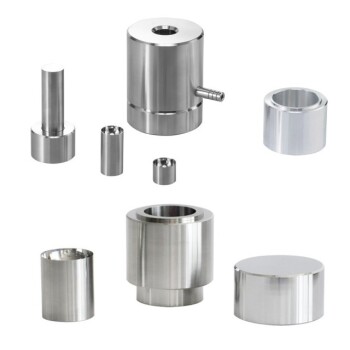
A laboratory hydraulic press is the fundamental tool used to transform loose $Li_{2+x}S_{1-x}N_x$ powder into a functional, testable ceramic pellet. It applies precise mechanical force—specifically 2.5 to 2.7 tons for a standard 10 mm diameter mold—to compress the material. This densification is the physical prerequisite for conducting valid electrochemical stability tests.
By eliminating microscopic pores and increasing the geometric density of the sample, the press minimizes internal resistance. This ensures that data collected during Cyclic Voltammetry (CV) reflects the true electrochemical performance of the material, rather than artifacts caused by poor particle contact.
The Physics of Sample Preparation
Eliminating Porosity via High Pressure
The primary function of the hydraulic press is to remove the air gaps inherent in powdered materials. When you apply high pressure, you force the solid electrolyte particles closer together, effectively squeezing out the empty space (pores) between them. This process significantly increases the geometric density of the pellet, transforming it from a loose aggregate into a cohesive solid.
Establishing Uniform Charge Transport
For a solid electrolyte to function, ions must be able to move freely through the material. If the pellet remains porous, the air gaps act as insulators that block ion movement and disrupt the electrical pathway. By compressing the sample into a dense pellet, the hydraulic press establishes a continuous physical network that supports uniform charge transport throughout the material.
Minimizing Contact Resistance
A critical barrier to accurate testing is the resistance found at the interfaces between particles (grain boundaries) and between the sample and the testing electrodes. The hydraulic press forces these surfaces into intimate contact. This mechanical bonding drastically reduces contact resistance, allowing current to flow efficiently during testing.
Enabling Reliable Cyclic Voltammetry (CV)
Cyclic Voltammetry (CV) is used to determine the electrochemical stability window of the $Li_{2+x}S_{1-x}N_x$ electrolyte. The validity of CV data is entirely dependent on the quality of the sample preparation. Without the high-density compaction provided by the press, high internal resistance would distort the CV curves, making it impossible to distinguish the material's actual stability limits from noise.
Understanding the Trade-offs
Pressure Consistency vs. Sample Variability
While high pressure is necessary, manual hydraulic presses can introduce human error. Slight variations in the pressure applied or the duration of the hold time between samples can lead to inconsistent pellet densities. This variability acts as a hidden variable in your experiments, potentially skewing data when comparing different batches of electrolytes.
The Risk of Over-Densification
Applying pressure is a balancing act. While the primary goal is densification, excessive pressure beyond the material's tolerance can induce structural defects or micro-cracks within the pellet. These physical flaws can paradoxically increase impedance or cause mechanical failure during the cycling process, negating the benefits of the compression.
Optimizing Your Pressing Strategy
To ensure your stability testing yields accurate and reproducible results, consider the following strategic adjustments:
- If your primary focus is Data Reliability: Adhere strictly to the recommended pressure range (e.g., 2.5 to 2.7 tons for a 10 mm mold) to ensure the contact resistance is minimized without damaging the sample.
- If your primary focus is Batch Consistency: Utilize an automatic hydraulic press with preset pressure and dwell times to eliminate manual variations and standardize the density across all experimental samples.
- If your primary focus is Material Conductivity: Ensure the pressure is sufficient to induce plastic deformation in the particles, maximizing grain boundary contact for the clearest possible ion transport path.
The laboratory hydraulic press is not just a shaping tool; it is a critical instrument for defining the structural integrity required to unlock accurate electrochemical data.
Summary Table:
| Feature | Impact on Electrochemical Testing |
|---|---|
| Densification | Eliminates porosity to ensure true geometric density and structural integrity. |
| Charge Transport | Establishes continuous physical networks for uniform ion movement. |
| Resistance Reduction | Minimizes contact resistance at grain boundaries and electrode interfaces. |
| CV Accuracy | Prevents data distortion by reducing internal resistance for clear stability windows. |
Maximize Your Battery Research Precision with KINTEK
Ensure the highest data reliability for your electrochemical stability tests with KINTEK’s industry-leading laboratory pressing solutions. As specialists in battery research equipment, we offer a comprehensive range of manual, automatic, heated, and multifunctional presses, as well as glovebox-compatible models and isostatic presses (CIP/WIP) designed to meet the rigorous demands of solid electrolyte preparation.
Don't let sample variability compromise your results. Contact us today to find the perfect press for your lab and experience the KINTEK advantage in material science.
References
- Victor Landgraf, Theodosios Famprikis. Disorder-Mediated Ionic Conductivity in Irreducible Solid Electrolytes. DOI: 10.1021/jacs.5c02784
This article is also based on technical information from Kintek Solution Knowledge Base .
Related Products
- Lab XRF Boric Acid Powder Pellet Pressing Mold for Laboratory Use
- Automatic Laboratory Hydraulic Press for XRF and KBR Pellet Pressing
- XRF KBR Steel Ring Lab Powder Pellet Pressing Mold for FTIR
- XRF KBR Plastic Ring Lab Powder Pellet Pressing Mold for FTIR
- Laboratory Hydraulic Press 2T Lab Pellet Press for KBR FTIR
People Also Ask
- Why are pellets used in XRF analysis, and what is their limitation? Boost Accuracy and Speed in Your Lab
- What are the primary factors to consider when deciding between a manual and an automatic XRF pellet press? Optimize Your Lab's Efficiency
- What are the differences between manual and automatic XRF pellet presses? Choose the Right Press for Your Lab's Needs
- What are the different pellet pressing options for XRF sample preparation? Choose the Best Method for Accurate Analysis
- What are specialized XRF pellet preparation presses designed for? Boost Lab Efficiency with High-Throughput Automation