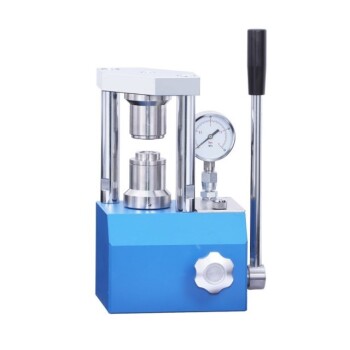
A laboratory lab press or rolling machine serves as a critical precision tool for transforming bulk metallic sodium into standardized reference electrodes. By mechanically processing the raw metal into thin foils with a specific thickness—typically around 200 micrometers—these machines eliminate geometric irregularities that would otherwise compromise test results. This mechanical preparation is essential for creating the high flatness and uniform thickness required for reliable sodium-ion battery baselines.
Core Takeaway While manual preparation leads to variances, using a press or rolling machine ensures the reference electrode has a strictly uniform geometry. This physical consistency is the primary safeguard against electrochemical impedance non-uniformity, preventing distorted data in sensitive kinetic evaluations.
The Necessity of Geometric Precision
Achieving Specific Thickness
Raw metallic sodium is bulky and unsuited for direct use in precision testing. A lab press or rolling machine processes this bulk material into a thin foil, achieving a specific, controllable thickness such as 200 micrometers.
Ensuring Surface Flatness
Beyond thickness, the primary function of this equipment is to ensure high flatness across the electrode's surface. This mechanical leveling removes the peaks and valleys often found in manually prepared samples.
Eliminating Physical Burrs
Precision processing helps minimize physical defects like burrs on the edges of the electrode. As noted in general electrode preparation, clean edges are vital to preventing internal battery short circuits and ensuring the physical integrity of the cell.
Impact on Electrochemical Data Integrity
Reducing Impedance Non-Uniformity
The accuracy of electrochemical data relies heavily on the consistency of the electrode interface. By creating a uniform surface, the press reduces impedance non-uniformity, ensuring that resistance is consistent across the entire contact area.
Preventing Uneven Current Distribution
Surface irregularities on a reference electrode can cause current to concentrate in specific spots (hotspots). A perfectly flat, machine-rolled electrode ensures that current is distributed evenly, which is fundamental for validating the performance of the battery chemistry itself rather than the artifacts of preparation.
Optimizing Kinetic Tests (GITT)
Advanced testing methods, such as the Galvanostatic Intermittent Titration Technique (GITT), are highly sensitive to potential variances. The precision provided by these machines ensures accurate potential responses during these kinetic tests, preventing data distortion caused by irregular surface contact.
Understanding the Trade-offs
The Risk of Surface Irregularities
Without the mechanical standardization of a press or rolling machine, reference electrodes often suffer from varying thicknesses. This inconsistency introduces "noise" into the data, making it difficult to distinguish between the actual behavior of the battery material and errors caused by the electrode's geometry.
Material vs. Process Variables
In battery testing, the goal is to isolate the performance of the active material. If the reference electrode is not uniform, it becomes an uncontrolled variable. Using a machine to standardize the sodium electrode shifts the focus back to the chemistry, removing the physical preparation as a source of error.
Making the Right Choice for Your Goal
To maximize the reliability of your sodium-ion battery research, apply the machine's capabilities based on your specific testing requirements:
- If your primary focus is Kinetic Analysis (e.g., GITT): Prioritize high flatness to ensure even current distribution and accurate potential response data.
- If your primary focus is Reproducibility: rigorous thickness control (e.g., exactly 200 micrometers) to standardize impedance across multiple test cells.
Reliable battery data begins with the physical perfection of the reference electrode, making precision compression not just a step, but a requirement.
Summary Table:
| Feature | Impact on Sodium Electrode Preparation | Benefit for Battery Testing |
|---|---|---|
| Thickness Control | Achieves uniform ~200μm foil thickness | Eliminates geometric variables and data noise |
| Surface Flatness | Mechanical leveling of raw bulk sodium | Prevents uneven current distribution & hotspots |
| Edge Precision | Minimizes physical burrs and defects | Reduces risk of internal short circuits |
| Interface Uniformity | Ensures consistent contact area | Minimizes impedance non-uniformity for GITT tests |
Elevate Your Battery Research with KINTEK Precision
Don't let manual preparation errors compromise your electrochemical data. KINTEK specializes in comprehensive laboratory pressing solutions, offering manual, automatic, heated, multifunctional, and glovebox-compatible models, as well as cold and warm isostatic presses designed for the rigorous demands of battery research.
Whether you need precise thickness control for sodium foils or uniform compression for solid-state electrolytes, our equipment provides the consistency your kinetic evaluations deserve. Contact KINTEK today to find your perfect pressing solution and ensure your research is built on a foundation of physical perfection.
References
- Nicolas Schneider, Alexander Fill. Towards Accurate Sodium-Ion Cell Modelling: Parametrization and Validation of a Commercial Sodium-Ion Cell Incorporating Temperature-Dependent Kinetic. DOI: 10.1149/1945-7111/adfd16
This article is also based on technical information from Kintek Solution Knowledge Base .
Related Products
- Laboratory Hydraulic Press Lab Pellet Press Machine for Glove Box
- Laboratory Split Manual Heated Hydraulic Press Machine with Hot Plates
- Automatic Laboratory Hydraulic Press Lab Pellet Press Machine
- 24T 30T 60T Heated Hydraulic Lab Press Machine with Hot Plates for Laboratory
- Automatic Heated Hydraulic Press Machine with Hot Plates for Laboratory
People Also Ask
- How does a laboratory hydraulic press contribute to the preparation of Li3-3xScxSb samples? Optimize Ionic Conductivity
- What is the function of a laboratory hydraulic press in FT-IR of curcumin-coated MWCNTs? Achieve Optical Clarity.
- Why is a laboratory hydraulic press required for compression molding boron-siloxane? Solve High-Loading Density Challenges
- What role does a laboratory hydraulic press play in the preparation of piezoelectric ceramic discs for DC-PG? | KINTEK
- What role does a laboratory hydraulic press play in reaction pellets? Optimizing Lunar Soil and Metal Fuel Density