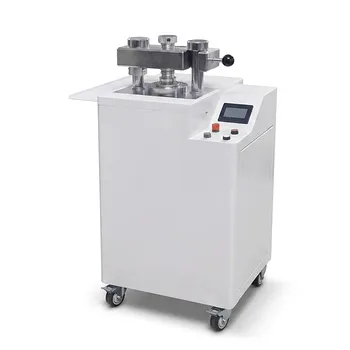
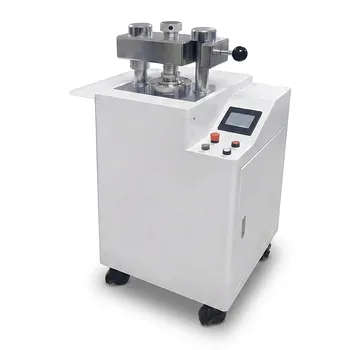
A manual hydraulic press operates entirely through mechanical leverage and fluid dynamics. It functions by using a hand-operated lever to drive a piston into a cylinder filled with hydraulic oil. As the operator pumps the lever back and forth, pressure builds within the fluid, transferring a magnified force to a die that compresses the target material.
Core Takeaway Fundamentally, these devices rely on Pascal’s principle to multiply force within a closed system. By manually pumping a lever, a small input force creates massive compressive pressure via hydraulic fluid, allowing for high-tonnage applications without the need for electricity.
The Mechanics of Operation
The Hydraulic Circuit
The core of the system is a closed cylinder filled with hydraulic oil. When force is applied to the fluid, it does not compress; instead, it transfers that energy equally throughout the system. This allows the machine to convert a manageable manual effort into significant force, often up to 25 tons.
The Role of the Lever
Unlike automatic systems driven by electric motors, a manual press relies on a hand-operated lever. Moving this mechanical lever pumps the oil, which pushes against a piston. The user controls the exact amount of force applied by varying the number of pumps, increasing pressure until the optimal load is achieved.
Absence of Electronic Components
These systems are purely mechanical. They lack electric switches, motors, or automated relief valves. This design simplicity reduces maintenance complexity but places the burden of control entirely on the operator.
Step-by-Step Operational Sequence
Preparation and Alignment
Before applying pressure, the workpiece—such as a pellet die containing a sample—must be placed centrally on the piston. The operator then adjusts the leadscrew at the top of the press until its nose makes contact with the workpiece, ensuring there is no wasted travel.
Applying the Load
The user pumps the handle to force hydraulic oil into the piston assembly. This action slowly raises the piston, compressing the material inside the die. In laboratory settings, this is often used to press powders into solid discs or pellets.
Releasing the Pressure
Once the target load is reached, the pressure is not released automatically. The operator must manually turn a release valve. This allows the hydraulic oil to return to its reservoir, retracting the piston and removing the load from the sample.
Understanding the Trade-offs
Physical Demands vs. Cost
Because manual presses do not require electric motors or complex automation, they are significantly less expensive to acquire. However, they are more physically demanding to operate, requiring repetitive manual pumping to achieve high pressures.
Inconsistency Risks
The primary downside of a manual system is variability. Since the force is applied by hand, it can be difficult to replicate the exact same pressure profile across multiple samples. Automatic presses typically offer higher repeatability because they are controlled by set parameters rather than operator feel.
Making the Right Choice for Your Goal
Whether a manual hydraulic press is the right tool depends on your specific requirements for volume and precision.
- If your primary focus is cost-efficiency and low volume: A manual press is the ideal choice, offering high force capacity and durability without the expense of electronic automation.
- If your primary focus is high repeatability: You must be extremely diligent with manual operation, as the lack of automated pressure control can lead to slight variations between samples.
Manual hydraulic presses offer a robust, simplified solution for generating immense force through basic mechanical principles.
Summary Table:
| Feature | Manual Hydraulic Press Specification |
|---|---|
| Driving Principle | Pascal’s Law (Fluid Dynamics) |
| Power Source | Hand-operated Lever (Manual) |
| Max Force Range | Typically up to 25 Tons |
| Key Components | Hydraulic Oil, Piston, Leadscrew, Release Valve |
| Control Type | Manual Operator Adjustment |
| Maintenance | Low (Mechanical components only) |
Optimize Your Lab Research with KINTEK Precision
Ready to enhance your sample preparation? KINTEK specializes in comprehensive laboratory pressing solutions tailored to your specific research needs. Whether you require the cost-effective durability of our manual models or the high repeatability of our automatic, heated, and multifunctional systems, we provide the tools necessary for excellence in battery research and material science.
Our value to you:
- Diverse Range: From glovebox-compatible models to cold and warm isostatic presses.
- Expert Support: Specialized solutions for complex pellet-pressing applications.
- Proven Reliability: Robust engineering designed for high-tonnage precision.
Contact KINTEK Today to Find Your Perfect Pressing Solution
Related Products
- Manual Heated Hydraulic Lab Press with Integrated Hot Plates Hydraulic Press Machine
- Manual Laboratory Hydraulic Press Lab Pellet Press
- Laboratory Manual Heated Hydraulic Press Machine with Hot Plates
- Manual Laboratory Hydraulic Pellet Press Lab Hydraulic Press
- Laboratory Split Manual Heated Hydraulic Press Machine with Hot Plates
People Also Ask
- Why is a laboratory hydraulic press with heating plates required for PLA/TEC films? Achieve Precise Sample Integrity
- Why is a manual hydraulic heated lab press essential for compleximer materials? Unlock Advanced Material Synthesis
- Function of a Laboratory Hydraulic Press with Heated Platens in SSE? Enhance Battery Density & Conductivity
- What role does a lab manual hydraulic press play in Li9B19S33 ionic conductivity? Optimize Pellet Characterization
- What are the main benefits of performing proper maintenance on a heated lab press? Ensure Accuracy & Safety