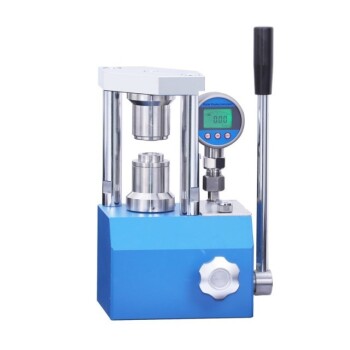
A precision battery crimping press ensures experimental reproducibility by applying constant, uniform sealing pressure to the coin cell assembly. This mechanical consistency guarantees that the internal components—specifically the lithium foil, electrolyte, and cathode—maintain tight physical contact, eliminating variable contact resistance that otherwise skews data.
Inconsistent assembly pressure is a hidden variable that ruins experimental validity. A precision crimper eliminates this variable by standardizing the physical interface between components, ensuring that your data reflects the intrinsic chemistry of the materials rather than the quality of the assembly.
The Critical Role of Uniform Pressure
Maintaining Component Contact
In lithium metal coin cells, particularly those utilizing Gel Polymer Electrolyte systems, the stack of components must act as a single, cohesive unit.
A precision press applies specific force to ensure the lithium foil, the gel electrolyte, and the cathode remain in tight physical contact. This prevents the formation of gaps or loose interfaces that can occur with manual or inconsistent crimping methods.
Simulating Operational Stack Pressure
Laboratory tests aim to predict real-world performance. A precision press allows researchers to simulate the stack pressure found in actual battery operating environments.
By replicating these conditions during the sealing process, the resulting data is far more predictive of how the cell will behave in a commercial pack compared to cells assembled with variable pressure.
Impact on Electrochemical Data Integrity
Stabilizing Interfacial Resistance
The most significant threat to reproducibility in coin cells is fluctuating interfacial resistance.
If the contact between the active material layer and the current collector (or the lithium and the separator) is loose, impedance increases unpredictably. A precision press ensures this contact is uniform, minimizing ohmic internal resistance and stabilizing voltage profiles.
Ensuring True Material Characterization
When testing new materials, such as Melem-PDI coated electrodes, you must be certain that performance metrics result from the material itself.
Standardized assembly pressure ensures that cycle stability and specific capacity data reflect the intrinsic electrochemical performance of the active material. Without this mechanical precision, degradation caused by poor assembly could be mistaken for material failure.
Common Pitfalls to Avoid
The Risk of Over-Compression
While tight contact is essential, simply maximizing pressure is not the solution.
Excessive force can alter the porosity of electrode layers or crush the separator. This damage restricts electrolyte wetting and ion transport, which can artificially lower capacity and cycle life.
Calibration Drift
A "precision" press is only precise if it remains calibrated.
Over time, mechanical wear can lead to drift in the applied pressure. It is critical to verify that the press is actually delivering the set force to maintain reproducibility across different batches of cells.
Making the Right Choice for Your Research
To maximize the reliability of your data, align your assembly process with your specific research goals:
- If your primary focus is Gel Polymer or Solid-State Electrolytes: Prioritize a press that delivers high, unwavering pressure to ensure the rigid or semi-rigid components maintain an unbroken interface with the lithium anode.
- If your primary focus is Long-Term Cycle Stability: Use the press to eliminate assembly variables, ensuring that any capacity fade observed is strictly due to electrochemical degradation, not mechanical relaxation of the casing.
Ultimately, a precision crimper transforms the battery assembly process from a variable art into a controlled science.
Summary Table:
| Feature | Impact on Reproducibility | Benefit to Research |
|---|---|---|
| Uniform Pressure | Eliminates gaps between internal components | Consistent interfacial resistance across batches |
| Force Calibration | Prevents over-compression/separator damage | Protects material porosity and ion transport |
| Mechanical Consistency | Standardizes physical stack pressure | Ensures data reflects chemistry, not assembly skill |
| Sealing Integrity | Prevents electrolyte leakage/contamination | Increases long-term cycle stability and data validity |
Elevate Your Battery Research with KINTEK Precision Solutions
Inconsistent assembly is the hidden enemy of data integrity. At KINTEK, we specialize in comprehensive laboratory pressing solutions designed to transform battery assembly from a variable art into a controlled science.
Whether you are working on liquid electrolytes or advanced solid-state systems, our range of manual, automatic, heated, and glovebox-compatible models—alongside our specialized isostatic presses—ensures your lithium metal cells meet the highest standards of mechanical precision.
Ready to eliminate assembly variables and stabilize your electrochemical data?
Contact KINTEK today to find the perfect press for your lab
References
- Mingnan Li, Zhanhu Guo. Balancing Solvation Ability of Polymer and Solvent in Gel Polymer Electrolytes for Efficient Lithium Metal Batteries. DOI: 10.1002/anie.202513450
This article is also based on technical information from Kintek Solution Knowledge Base .
Related Products
- Lab Button Battery Tablet Press Sealing Mold
- Button Battery Sealing Press Machine for Lab
- Laboratory Hydraulic Press Lab Pellet Press Button Battery Press
- Warm Isostatic Press for Solid State Battery Research Warm Isostatic Press
- Lab Infrared Press Mold for Laboratory Applications
People Also Ask
- How does a sealed battery mold facilitate the assembly and testing of asymmetric supercapacitors using VO2?
- Why use standardized CR2032 components & high-precision presses? Ensure reliability in lithium metal battery research.
- Why is a laboratory battery sealing press essential for desolvation energy testing? Ensure Reliable Kinetic Data
- What is the function of specialized battery molds and sealing consumables? Optimize Your In-situ XRD Testing Today
- What role does a laboratory sealing press play in thermal analysis of solid dispersion films? Ensure Data Integrity