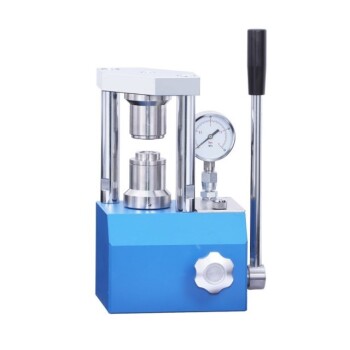
The servo pressurization and stabilization system acts as the foundation for accurate simulation by delivering precise control over seepage pressure. Its primary function is to maintain a constant, high-pressure environment—specifically within a range of 5.8 to 6.5 MPa—to establish a stable hydraulic gradient. This ensures the initial background stress state mimics real-world conditions before any mining activity is simulated.
Core Takeaway: This system ensures experimental validity by locking in a stable "pre-mining" stress state. Without this precise stabilization, subsequent simulations of mining disturbances would lack the necessary baseline accuracy.
Creating the Baseline Environment
Precise Pressure Regulation
The system allows researchers to exert exact control over seepage pressure. This control is vital for maintaining a consistent hydraulic gradient throughout the test material.
Replicating Deep-Earth Stress
To simulate deep mining conditions, the system holds pressure constant within a specific high-range window of 5.8 to 6.5 MPa. This replicates the intense background stress naturally found in subterranean environments.
Enabling Accurate Disturbance Simulation
The Prerequisite for Mining Activity
You cannot accurately simulate the settlement caused by mining without a stable starting point. This system ensures the "ground" is statically loaded before the actual experiment begins.
Facilitating Controlled Release
Once stability is confirmed, the simulation proceeds by releasing oil pressure in hydraulic pillows. This release mimics the physical disturbance of mining, but the validity of this step relies entirely on the stability established by the servo system first.
Critical Factors for Success
Sensitivity to Fluctuations
The system's value lies entirely in its ability to hold the 5.8 to 6.5 MPa range without deviation. Even minor fluctuations in pressure can disrupt the hydraulic gradient, rendering the initial stress state inaccurate.
Dependency on Calibration
The transition from the stabilization phase to the mining disturbance phase must be seamless. Any error in the initial pressurization can skew the data observed during the subsequent pressure release.
Ensuring Experimental Fidelity
To maximize the effectiveness of this system in your simulation work:
- If your primary focus is experimental setup: Ensure your equipment is calibrated to maintain the strict 5.8 to 6.5 MPa window to guarantee a valid baseline.
- If your primary focus is analyzing settlement data: Verify that the initial hydraulic gradient was stable prior to the release of oil pressure to confirm the data reflects true mining disturbance.
By locking in the initial stress state, the servo system transforms a simple pressure test into a realistic simulation of geological behavior.
Summary Table:
| Feature | Specification/Role | Impact on Simulation |
|---|---|---|
| Pressure Range | 5.8 to 6.5 MPa | Replicates deep-earth background stress |
| Primary Function | Stabilization | Establishes a valid "pre-mining" baseline |
| Control Mechanism | Servo-Regulated Seepage | Maintains consistent hydraulic gradient |
| Disturbance Method | Hydraulic Pillow Release | Accurately mimics mining-induced settlement |
Optimize Your Mining Research with Precision Engineering
Ensure your geological simulations yield accurate, repeatable data by establishing a perfect baseline. KINTEK specializes in comprehensive laboratory pressing solutions, offering the precise control needed for deep-earth stress replication.
Whether you require manual, automatic, heated, or multifunctional models—or specialized cold and warm isostatic presses for battery and materials research—our equipment is designed to meet the most rigorous scientific standards.
Ready to elevate your lab's capabilities? Contact KINTEK today to find the perfect stabilization solution for your research needs!
References
- Xu Han, Jian Zhang. Simulation test on shaft deformation induced by mining subsidence under similar gravity field in deep soil strata. DOI: 10.1007/s42452-024-05779-4
This article is also based on technical information from Kintek Solution Knowledge Base .
Related Products
- Manual Laboratory Hydraulic Press Lab Pellet Press
- Electric Lab Cold Isostatic Press CIP Machine
- Laboratory Hydraulic Press Lab Pellet Press Machine for Glove Box
- Warm Isostatic Press for Solid State Battery Research Warm Isostatic Press
- Automatic Heated Hydraulic Press Machine with Hot Plates for Laboratory
People Also Ask
- How does a laboratory manual hydraulic press assist in powder canning? Maximize Density and Structural Integrity
- What is the primary objective of using a laboratory manual hydraulic press at 20 MPa? Achieve Perfect Green Body Shaping
- What is the primary purpose of manual lab hydraulic pellet presses? Achieve High-Precision Sample Preparation for Spectroscopy
- What is the primary purpose of a manual lab hydraulic pellet press? Ensure Accurate Sample Prep for XRF and FTIR
- How do lab pellet presses support customization and flexibility? Optimize Your Sample Prep for Any Material