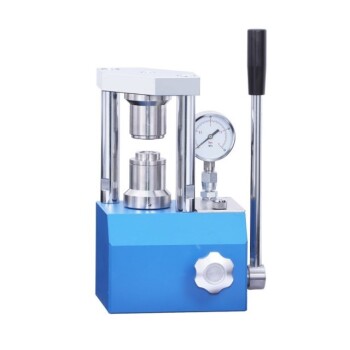
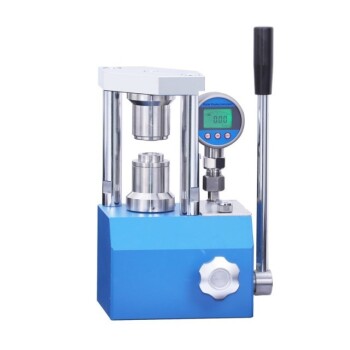
Calendering machines and lab presses improve volumetric energy density primarily by applying precise vertical pressure to the electrode sheet. By physically compressing the material, these machines force active particles closer together, which directly reduces the thickness of the electrode without reducing the amount of active energy-storing material.
The core mechanism at work is the reduction of porosity. By minimizing the void space (air gaps) within the electrode, you maximize the active material present per unit of volume while simultaneously lowering the electrical resistance of the cell.
The Mechanics of Densification
Reducing Electrode Porosity
Before processing, an electrode sheet contains a significant amount of empty space, or "porosity."
A calendering machine applies force to eliminate this excess void space. This creates a denser, more cohesive structure.
Tighter Particle Packing
The vertical pressure causes the active material particles to rearrange and pack more tightly.
This physical compaction is the fundamental driver of increased density. It ensures that the available volume is occupied by material that stores energy, rather than by air.
Reducing Electrode Thickness
As particles pack tighter, the overall thickness of the electrode sheet decreases.
Since volumetric energy density is a measure of energy stored relative to volume, reducing thickness (volume) while keeping the energy content constant automatically increases the energy density.
Enhancing Electrical Performance
Improving Electronic and Ionic Contact
Density is not the only benefit; the process also improves the internal connectivity of the battery.
Compression forces particles into better contact with one another. This enhances the pathways required for both electronic current and ionic movement.
Lowering Interfacial Impedance
The process specifically improves the contact between the active particles and the current collector (the metal foil).
By ensuring a solid physical connection, the machine significantly lowers interfacial impedance (resistance). This means energy flows more efficiently in and out of the cell.
Understanding the Critical Variables
Balancing Pressure and Porosity
While the goal is to reduce porosity, the process relies on applying the correct amount of vertical pressure.
The objective is to achieve a specific target density. This requires calibrating the machine to reduce thickness to a precise degree, ensuring the material is compact but structurally sound.
Making the Right Choice for Your Goal
To maximize the utility of your calendering process, focus on these objectives:
- If your primary focus is Maximum Energy Density: Calibrate your equipment to apply sufficient pressure to minimize electrode thickness and porosity as much as the material allows.
- If your primary focus is Electrical Efficiency: Ensure the compression is uniform to maximize particle-to-collector contact, which is the key to lowering interfacial impedance.
Effective calendering turns a porous, resistant composite into a dense, highly conductive energy storage medium.
Summary Table:
| Feature | Impact on Electrode | Benefit to Battery Performance |
|---|---|---|
| Porosity Reduction | Minimizes void space/air gaps | Increases active material per unit volume |
| Thickness Control | Decreases overall sheet volume | Directly boosts volumetric energy density |
| Particle Packing | Forces active particles closer | Enhances electronic and ionic conductivity |
| Interfacial Contact | Strengthens bond with current collector | Lowers impedance and improves efficiency |
Maximize Your Battery Research with KINTEK Precision
Achieve the ultimate volumetric energy density and superior electrical performance with KINTEK’s industry-leading laboratory pressing solutions. Whether you are refining electrode porosity or optimizing particle contact, our comprehensive range of manual, automatic, heated, and multifunctional lab presses, as well as cold and warm isostatic presses, provides the precision your battery research demands.
Why choose KINTEK?
- Glovebox-compatible models for sensitive material processing.
- Precise pressure control to ensure uniform electrode thickness.
- Expert-grade durability designed for high-stakes R&D environments.
Elevate your energy storage innovations today. Contact our specialists at KINTEK to find the perfect pressing solution for your lab!
References
- Alexis Luglio, Ryan Brow. Maximizing calendering effects through the mechanical pulverization of Co-free nickel-rich cathodes in lithium-ion cells. DOI: 10.1557/s43577-025-00936-5
This article is also based on technical information from Kintek Solution Knowledge Base .
Related Products
- Manual Button Battery Sealing Machine for Battery Sealing
- Button Battery Sealing Machine for Button Batteries
- Button Battery Sealing Press Machine for Lab
- Warm Isostatic Press for Solid State Battery Research Warm Isostatic Press
People Also Ask
- Why is a laboratory hydraulic press or battery sealing machine essential? Ensure Coin Cell Data Integrity
- How do laboratory battery sealing machines ensure performance consistency? Master Your Lithium and LFP Battery Assembly
- Why is stable pressure control necessary when assembling SC-NCM83/PLM-3/Li batteries? Optimize Solid-State Interfaces
- How does the mechanical pressure provided by a laboratory crimper affect the performance of assembled 2032-type coin cells?
- What role does a laboratory press perform for CR2032 coin cell assembly? Ensure Precision in Battery Research