
The key to preventing cracks during firing lies not in the furnace, but in the initial pressing stage. Cold Isostatic Pressing (CIP) minimizes distortion by applying pressure uniformly from all directions. This creates a part with consistent density throughout, eliminating the internal stress points that would otherwise tear the component apart during the intense shrinkage of firing.
The core problem with traditional pressing is uneven density, which causes different parts of a component to shrink at different rates during firing, leading to stress, warping, and cracking. CIP solves this by using fluid pressure to compact material powder uniformly, ensuring the part shrinks predictably and maintains its integrity.
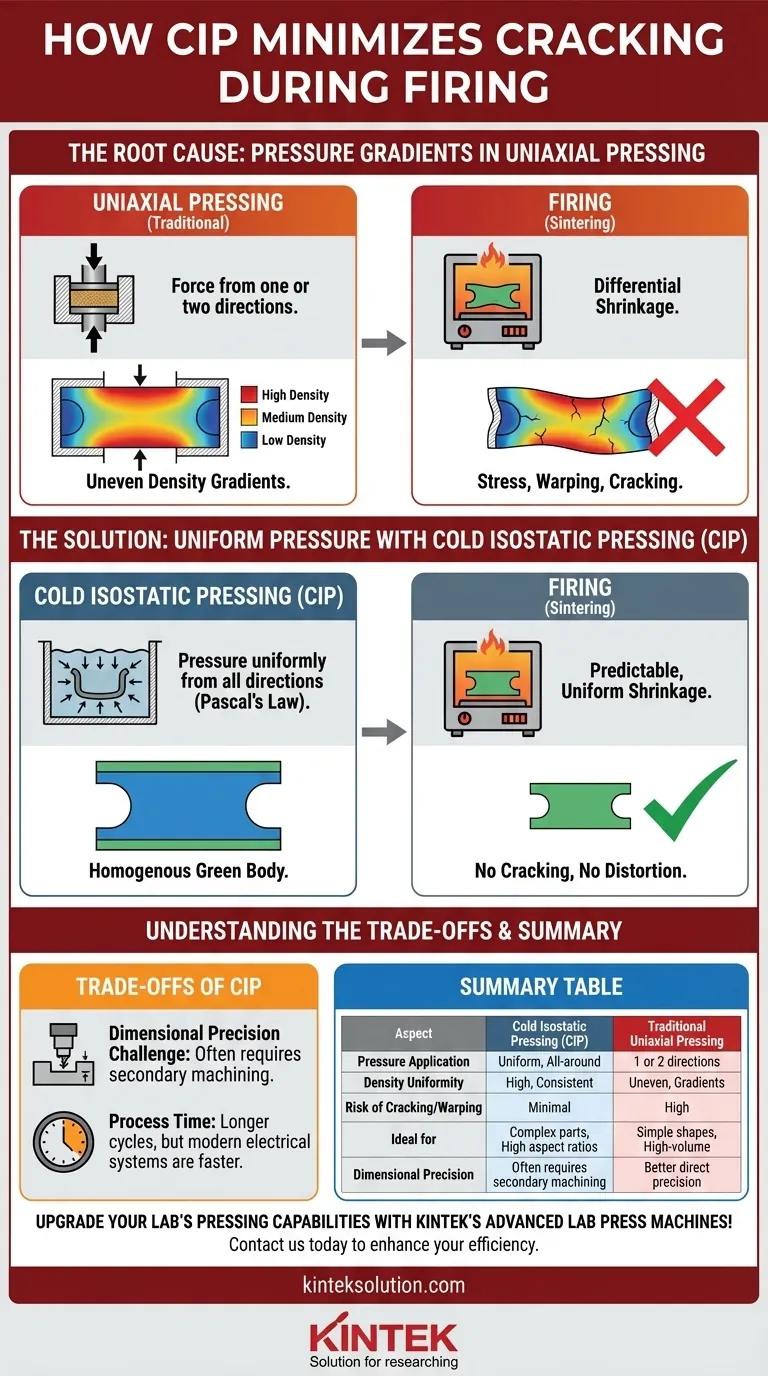
The Root Cause of Firing Defects: Pressure Gradients
To understand why CIP is so effective, we must first examine the shortcomings of its most common alternative, uniaxial die pressing.
The Flaw in Uniaxial Pressing
In uniaxial pressing, force is applied from one or two directions, typically from a top and bottom punch compressing powder inside a rigid die.
This method creates significant density gradients. The powder directly under the punch becomes very dense, while the powder near the middle and at the die walls is less compacted due to internal friction.
How Uneven Density Causes Cracks
When this non-uniform "green" body is fired (a process called sintering), the material consolidates and shrinks.
Denser regions shrink less, while less dense regions shrink more. This differential shrinkage creates immense internal stress within the component. If the stress exceeds the material's strength, it relieves itself by forming cracks or causing the part to warp.
How CIP Achieves Uniformity
Cold Isostatic Pressing fundamentally changes how pressure is applied, directly addressing the root cause of firing defects.
The Principle of Isostatic Pressure
CIP involves placing the powder in a flexible, sealed mold and submerging it in a fluid pressure chamber. The pressure of the fluid is then increased, compacting the powder.
Based on Pascal's Law, this pressure is transmitted equally and instantly to all surfaces of the mold. There is no single direction of force, only a uniform, all-around "squeeze."
Creating a Homogenous Green Body
Because the pressure is applied isostatically (from all sides), friction is minimized and the powder compacts to a highly uniform density throughout its entire volume. There are no significant high-density or low-density regions.
The Result: Predictable Shrinkage
When a homogenous green body from a CIP process is fired, it shrinks uniformly and predictably. With no significant internal stress building up from differential shrinkage, the risks of cracking, distortion, and warping are virtually eliminated.
This makes CIP the ideal method for parts with complex geometries, high aspect ratios (long and thin), or those made from advanced materials that are sensitive to internal stresses.
Understanding the Trade-offs
While CIP provides superior uniformity, it is not without its limitations. Objectivity requires acknowledging the challenges.
The Challenge of Dimensional Precision
Achieving tight dimensional control directly out of the press can be difficult. The final shape depends entirely on the flexible mold, which can deform slightly under pressure.
Even with a well-designed mold, CIP parts often require secondary machining or grinding to meet very tight final tolerances. The uniformity is in the material's density, not necessarily its net-shape precision.
Process Time and Complexity
Traditional uniaxial pressing is extremely fast and easily automated for high-volume production. CIP cycles are inherently longer.
However, modern Electrical CIP systems can automate the process and significantly reduce cycle times compared to older manual systems, making it more viable for series production.
Making the Right Choice for Your Goal
Selecting the correct pressing method depends entirely on the specific requirements of your component.
- If your primary focus is high-volume production of simple shapes: Traditional uniaxial die pressing is often faster and more cost-effective.
- If your primary focus is structural integrity for complex parts: CIP is the superior choice for preventing firing defects and ensuring uniform material properties.
- If your primary focus is minimizing post-processing for high-precision components: Be aware that CIP parts often require a final machining step to achieve tight tolerances.
By understanding how pressure application impacts internal density, you can confidently choose the process that ensures your components are both strong and dimensionally sound.
Summary Table:
| Aspect | Cold Isostatic Pressing (CIP) | Traditional Uniaxial Pressing |
|---|---|---|
| Pressure Application | Uniform from all directions | From one or two directions |
| Density Uniformity | High and consistent | Uneven with gradients |
| Risk of Cracking/Warping | Minimal due to uniform shrinkage | High due to differential shrinkage |
| Ideal for | Complex geometries, high aspect ratios | Simple shapes, high-volume production |
| Dimensional Precision | Often requires secondary machining | Better direct precision |
Upgrade your lab's pressing capabilities with KINTEK's advanced lab press machines! Whether you need automatic lab presses, isostatic presses, or heated lab presses, our solutions deliver uniform density and reduced firing defects for complex parts. Contact us today to discuss how we can enhance your laboratory's efficiency and material integrity.
Visual Guide
Related Products
- Electric Lab Cold Isostatic Press CIP Machine
- Automatic Lab Cold Isostatic Pressing CIP Machine
- Electric Split Lab Cold Isostatic Pressing CIP Machine
- Manual Cold Isostatic Pressing CIP Machine Pellet Press
- Lab Isostatic Pressing Molds for Isostatic Molding
People Also Ask
- What role do electric lab cold isostatic presses play in industrial contexts? Bridge R&D and Manufacturing with Precision
- What are the applications of electric lab cold isostatic presses in research settings? Advance Material R&D with High-Pressure CIPs
- How does electrical Cold Isostatic Pressing (CIP) contribute to cost savings? Unlock Efficiency and Reduce Expenses
- What are some research applications of electric lab CIPs? Unlock Uniform Powder Densification for Advanced Materials
- What are the characteristics of standard off-the-shelf electric lab CIP solutions? Achieve Immediate, Cost-Effective Processing








