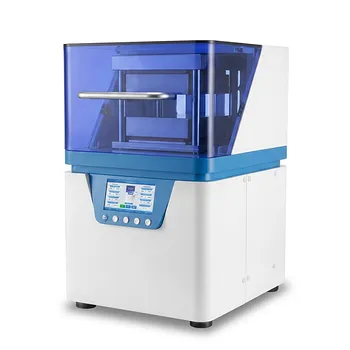
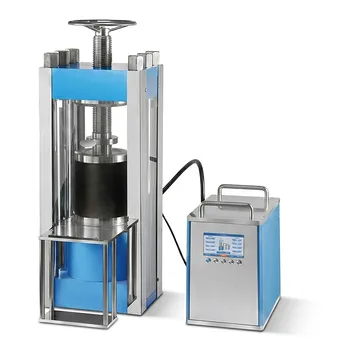
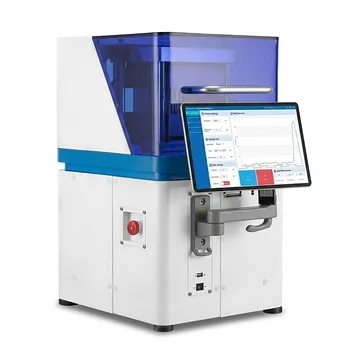
Laboratory high-pressure hot-pressing improves paper performance by heating lignin above its glass transition temperature while simultaneously applying intense physical force. This environment makes high-yield pulp fibers plastic, allowing them to conform to one another and increase their contact area. Consequently, the fiber network forms significantly more hydrogen and covalent bonds, drastically increasing both dry and wet strength without the need for additional chemical additives.
This process leverages laboratory equipment to transform rigid wood fibers into a plastic state where lignin acts as a natural structural adhesive. By controlling the precise intersection of heat and pressure, manufacturers can achieve a "wood welding" effect that fuses fibers at the molecular level.
The Thermal Activation of Lignin
Reaching the Softening Point
Lignin is a natural polymer that remains rigid at room temperature but becomes mobile when heated above its softening point, typically exceeding 100°C. Laboratory equipment uses precise thermal controls to reach this threshold, triggering a transition from a glassy to a rubbery state.
Inducing Fiber Plasticity
Once the lignin softens, the high-yield pulp fibers lose their natural stiffness and become highly plastic. This allows the fibers to deform and wrap around one another during the pressing cycle, creating a much denser and more integrated network.
The Mechanical Force of High Pressure
Regulating the Nip Load
Laboratory systems utilize hydraulic controls to apply precise nip loads, often reaching 6 MPa or 8 MPa. This extreme pressure is a prerequisite for forcing the softened lignin to flow toward the specific points where fibers touch.
Cross-Interface Interdiffusion
Under high pressure, softened lignin polymers undergo interdiffusion, migrating across the boundaries between adjacent fibers. This molecular-level movement creates physical entanglements and covalent bonds that mimic the natural structure of solid wood.
Mechanisms of Strength Improvement
Maximizing Effective Contact Area
By applying constant pressure, the equipment forces the fibers into the microscopic rough structures of the substrate, effectively excluding air. This maximizes the contact area, which is the primary driver for the formation of dense hydrogen bond networks.
Achievement of Industrial-Grade Wet Strength
The fusion of lignin across fiber interfaces creates a water-resistant bond often referred to as wood welding. This process can result in a wet strength that reaches 50% of the dry strength, a feat rarely possible without expensive chemical resins.
Understanding the Trade-offs
The Risk of Thermal Degradation
While heat is necessary for softening, excessive temperatures or prolonged exposure can lead to the thermal decomposition of cellulose. This results in a loss of paper brightness and can make the final product brittle.
Managing Internal Stress
If pressure is released too quickly or applied unevenly, internal stresses can become trapped within the solidified lignin layer. This often leads to microscopic cracking or "spring-back," where the fibers attempt to return to their original shape, weakening the sheet.
How to Apply This to Your Research
- If your primary focus is maximizing wet strength: Prioritize higher temperatures (above 120°C) and extended dwell times to ensure full lignin interdiffusion across fiber boundaries.
- If your primary focus is maintaining fiber flexibility: Focus on precise hydraulic control at lower pressure thresholds (around 6 MPa) to increase contact area without crushing the bulk of the fiber wall.
- If your primary focus is chemical reduction: Use the highest possible mechanical nip load to drive "wood welding," which replaces the need for synthetic wet-strength agents.
By mastering the transition of lignin from a rigid binder to a flowable adhesive, you can engineer paper products with structural properties that rival traditional composite materials.
Summary Table:
| Feature | Mechanism | Impact on Paper Performance |
|---|---|---|
| Thermal Control | Heats lignin above glass transition (>100°C) | Transitions fibers to a plastic state for better conformation |
| High Pressure | Applies 6-8 MPa nip loads | Drives interdiffusion and "wood welding" at fiber interfaces |
| Molecular Fusion | Maximizes contact area & hydrogen bonding | Increases dry/wet strength without chemical additives |
| Process Precision | Regulated dwelling and cooling cycles | Minimizes thermal degradation and prevents internal stress |
Elevate Your Material Research with KINTEK Precision
Unlock the full potential of your pulp and paper studies with KINTEK’s industry-leading thermal and hydraulic technology. KINTEK specializes in comprehensive laboratory pressing solutions, offering manual, automatic, heated, multifunctional, and glovebox-compatible models, as well as cold and warm isostatic presses.
Whether you are refining "wood welding" techniques to reduce chemical usage or advancing next-generation battery research, our equipment delivers the exact pressure and temperature control necessary for superior results.
Ready to enhance your lab's efficiency? Contact us today to find your solution!
References
- Tove Joelsson, Per Engstrand. Unique steel belt press technology for high strength papers from high yield pulp. DOI: 10.1007/s42452-021-04549-w
This article is also based on technical information from Kintek Solution Knowledge Base .
Related Products
- Automatic High Temperature Heated Hydraulic Press Machine with Heated Plates for Lab
- Heated Hydraulic Press Machine with Heated Plates for Vacuum Box Laboratory Hot Press
- Automatic Hydraulic Hot Press with Large Plate and Precision Temperature Control for Advanced Material Sample Preparation and Industrial Research
- Heated Hydraulic Press Machine With Heated Plates For Vacuum Box Laboratory Hot Press
- Automatic Hydraulic Heat Press Machine with Multi Stage Programmable Control and Integrated Water Cooling Plate Size 180x180mm
People Also Ask
- What are the advantages of adding a heating element to a hydraulic press? Unlock Advanced Material Synthesis
- How does a heated laboratory hydraulic press function in simulating TM coupling? Advanced Nuclear Waste Research
- What role does a heated hydraulic press play in material testing and research? Essential Insights for Lab Innovation
- Why is a laboratory hydraulic press with heating plates required for PLA/TEC films? Achieve Precise Sample Integrity
- How does a laboratory heated hydraulic press facilitate PBN sample prep for WAXS? Achieve Precise X-Ray Scattering