
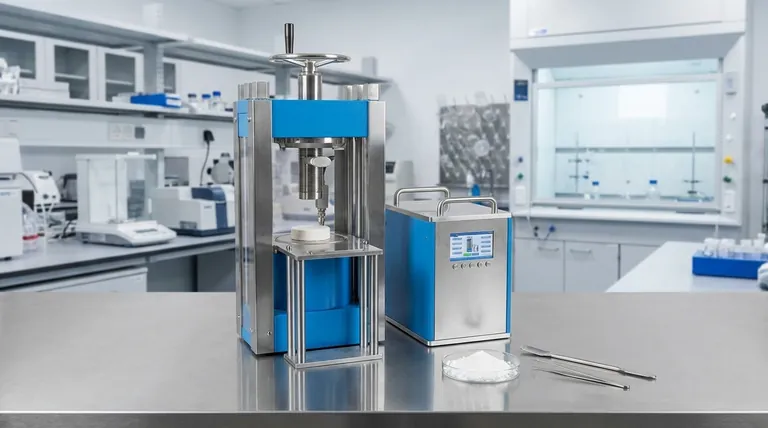
Preparing samples as dense pellets fundamentally improves X-ray Diffraction (XRD) quality by standardizing the physical geometry and density of the material. Using a laboratory press creates an exceptionally flat surface and a uniform internal structure, which directly minimizes geometrical errors and ensures that the resulting diffraction pattern accurately represents the bulk crystal structure.
The Core Takeaway In XRD analysis, the quality of your data is often limited by the physical state of your sample, not the capability of the diffractometer. Pressing a pellet transforms a loose, irregular powder into a consistent solid, reducing artifacts caused by surface roughness and particle segregation to yield definitive phase identification.
Optimizing Geometry for Accurate Diffraction
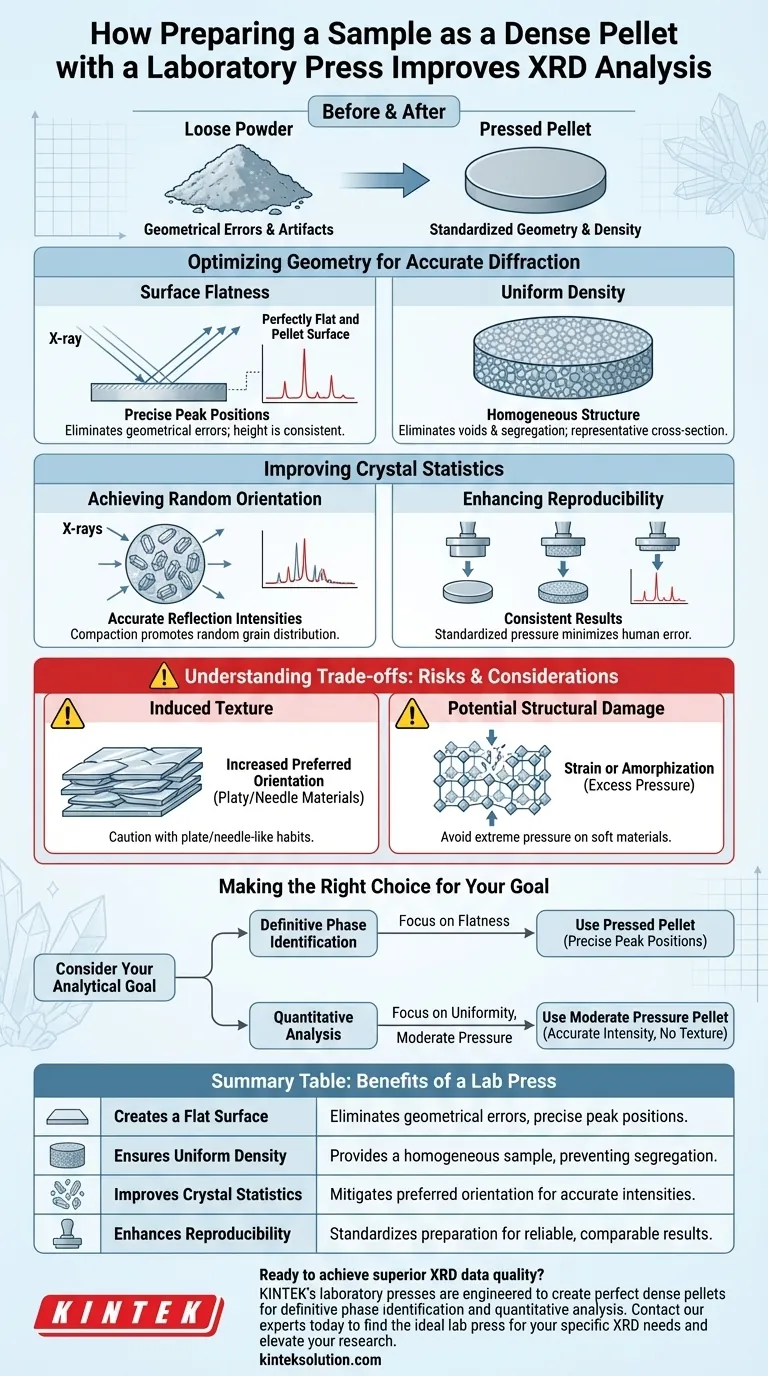
The Criticality of Surface Flatness
The primary advantage of using a laboratory press is the creation of a perfectly flat sample surface. In XRD, the precise position of the X-ray peaks is mathematically dependent on the geometry of the X-ray beam relative to the sample surface.
If a sample surface is rough or uneven (common with loose powders), it introduces geometrical errors. These errors cause peak shifts, making it difficult to assign the correct unit cell parameters or identify phases. A pressed pellet eliminates this variable, ensuring the sample height is uniform and consistent.
Uniform Density and Homogeneity
Loose powders are prone to segregation, where particles settle unevenly based on size or density. Pressing the sample compresses the material into a solid form with uniform density.
This compaction creates a homogeneous representation of the material. By eliminating void spaces and locking particles in place, you ensure that the X-ray beam interacts with a representative cross-section of the bulk material, rather than a segregated surface layer.
Improving Crystal Statistics
Achieving Random Orientation
For accurate XRD intensity data, the crystallites (grains) within the powder must be oriented randomly. If they align in a specific direction—a phenomenon known as preferred orientation—certain diffraction peaks will be artificially enhanced while others disappear.
A well-prepared pellet helps mitigate this by compacting the grains into a dense matrix. This forces a more random distribution of grain orientations compared to loose packing, providing reflection intensities that are true to the material's structure.
Enhancing Reproducibility
Pressed pellets minimize the "human factor" in sample preparation. Packing loose powder into a holder can vary significantly between operators.
By using a press with a defined pressure, you standardize the packing force. This leads to highly reproducible results, which is essential when comparing different batches of synthesized materials, such as solid-state electrolytes.
Understanding the Trade-offs
The Risk of Induced Texture
While pellets generally improve randomization, you must be cautious with materials that have plate-like or needle-like habits (e.g., clays or micas).
Applying excessive pressure to these specific materials can force the crystals to lie flat against the surface. In this specific context, pressing can actually increase preferred orientation rather than reduce it.
Potential for Structural Damage
It is vital to optimize the pressure used in the laboratory press. Extreme pressure can damage the crystal lattice of softer materials.
If the pressure is too high, you may induce strain in the crystals or even convert the surface layer to an amorphous state. This results in peak broadening or a loss of intensity, masking the true crystallinity of the powder.
Making the Right Choice for Your Goal
To maximize the quality of your XRD analysis, consider your specific analytical goals before pressing:
- If your primary focus is definitive phase identification: Use a pressed pellet to ensure precise peak positions through superior surface flatness.
- If your primary focus is quantitative analysis: Ensure you use moderate pressure to create a uniform density without inducing preferred orientation in platy minerals.
Sample preparation is the foundation of diffraction science; a stable, flat, and dense pellet is often the single best step toward high-fidelity data.
Summary Table:
| Benefit of Using a Lab Press for XRD | Key Outcome |
|---|---|
| Creates a Flat Surface | Eliminates geometrical errors, ensuring precise peak positions. |
| Ensures Uniform Density | Provides a homogeneous sample, preventing particle segregation. |
| Improves Crystal Statistics | Mitigates preferred orientation for accurate reflection intensities. |
| Enhances Reproducibility | Standardizes sample preparation for reliable, comparable results. |
Ready to achieve superior XRD data quality?
KINTEK's laboratory presses—including automatic, isostatic, and heated models—are engineered to create the perfect dense pellets your analysis demands. Our presses deliver the consistent pressure and flatness required for definitive phase identification and quantitative analysis, helping researchers in materials science, chemistry, and geology unlock accurate insights from their crystalline powders.
Contact our experts today to find the ideal lab press for your specific XRD sample preparation needs and elevate your research.
Visual Guide
Related Products
- Laboratory Hydraulic Split Electric Lab Pellet Press
- Manual Laboratory Hydraulic Pellet Press Lab Hydraulic Press
- Automatic Laboratory Hydraulic Press Lab Pellet Press Machine
- Manual Laboratory Hydraulic Press Lab Pellet Press
- Laboratory Hydraulic Pellet Press for XRF KBR FTIR Lab Press
People Also Ask
- What are the emerging trends in the design and materials of lab pellet presses? Modernize Your Lab Efficiency
- What are common lab pellet press issues? Expert Troubleshooting Guide for Reliable Material Research
- How do lab pellet presses support customization and flexibility? Optimize Your Sample Prep for Any Material
- What are the common operational types of lab pellet presses? Choosing the Right Manual, Automatic, or Hydraulic System
- Why use a laboratory pellet press for solid-state battery evaluation? Ensure Accuracy in Interface Stability Testing



















