
In short, the primary benefit is efficiency. An adjustable top pressing surface, typically mounted on a hardened steel screw thread, allows you to quickly and precisely align the press with your sample or die set. This dramatically reduces the setup time for each operation, saving significant time and effort, especially when processing multiple samples in succession.
An adjustable top pressing surface transforms a press from a fixed tool into a flexible one. Instead of spending valuable time adjusting your sample setup for each use, you adjust the press itself, streamlining your entire workflow.
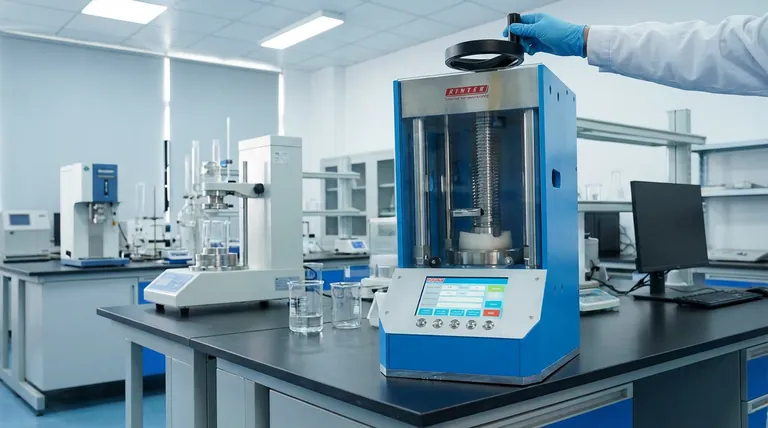
The Problem with Fixed Pressing Surfaces
To understand the value of an adjustable surface, it is helpful to consider the alternative. Presses without this feature create common, time-consuming frustrations.
The Inefficiency of Spacers
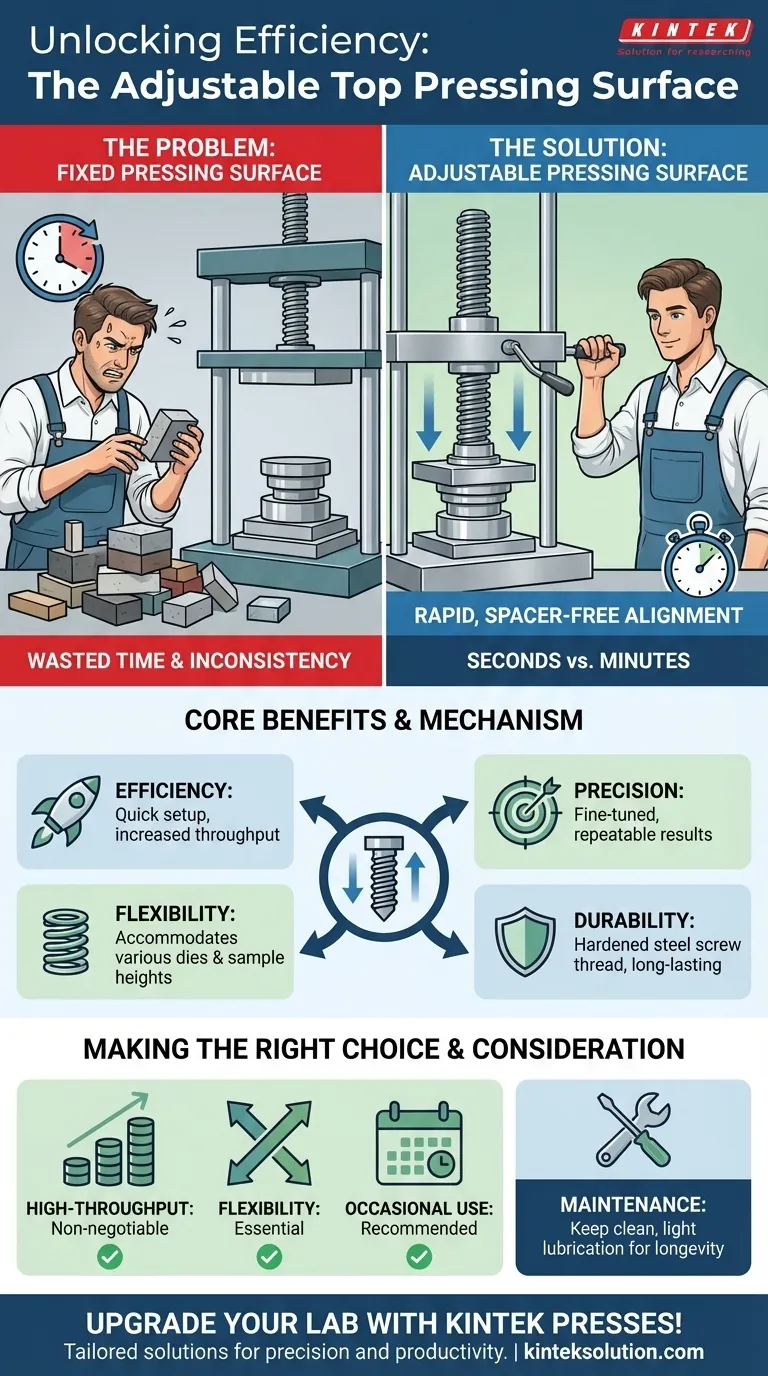
With a fixed press, there is often a large vertical gap between the top pressing plate and your die set. To close this gap, you must manually insert and stack spacer blocks or rings.
Finding the right combination of spacers is a process of trial and error that must be repeated for every sample.
Inconsistent Setup and Results
Different die sets or variations in sample volume require different spacer configurations. This introduces variability and makes it difficult to achieve a consistent, repeatable process, especially between different operators.
Wasted Operator Time
The minutes spent fumbling with heavy, awkward spacer blocks add up. In a lab or production environment, this wasted time directly reduces throughput and increases operator fatigue.
How an Adjustable Surface Solves the Problem
The adjustable surface eliminates these issues with a simple, elegant mechanical solution.
The Hardened Steel Screw Thread
The core mechanism is a robust screw thread. Turning the handle or knob raises or lowers the top pressing surface, allowing for continuous, fine-tuned vertical adjustment.
The use of hardened steel ensures the mechanism is durable, resists wear, and can withstand the high forces involved in pressing without deforming.
Rapid, Spacer-Free Alignment
Instead of stacking blocks, the operator simply turns the screw to lower the pressing surface until it rests perfectly on the die set plunger. This entire process takes a few seconds.
This removes the need to buy, store, or handle a collection of spacer rings, simplifying the workspace and the entire operation.
Maximizing Throughput
For any application that involves pressing multiple pellets, such as preparing samples for XRF or FTIR spectroscopy, this speed is transformative. The time saved between each sample directly translates to higher productivity.
Understanding the Key Consideration
While overwhelmingly beneficial, it's a mechanical component that has one primary consideration.
The Importance of Maintenance
As a moving part, the screw thread is a point of wear. To ensure a long life and smooth operation, it should be kept clean from debris and sample powder.
Depending on the manufacturer's guidance, it may require occasional light lubrication to maintain its precision and ease of use. This is a minor task that protects a critical feature.
Making the Right Choice for Your Goal
The value of this feature depends on your specific workflow and needs.
- If your primary focus is high-throughput sample preparation: An adjustable surface is a non-negotiable feature that pays for itself in saved time and increased productivity.
- If your primary focus is flexibility with varied samples: This feature is essential for accommodating different die sets and sample heights without the frustration of managing spacers.
- If your primary focus is occasional, single-type use: While a fixed press could work, the quality-of-life improvement and process consistency offered by an adjustable surface are still highly recommended.
Ultimately, this feature empowers you to adapt the equipment to your work, not force your work to adapt to the equipment.
Summary Table:
| Benefit | Description |
|---|---|
| Efficiency | Quickly aligns press with samples, reducing setup time and increasing throughput. |
| Precision | Allows fine-tuned vertical adjustments for consistent, repeatable results. |
| Flexibility | Accommodates various die sets and sample heights without spacers. |
| Durability | Hardened steel screw thread ensures long-lasting performance under high forces. |
Upgrade your lab's efficiency with KINTEK's advanced lab press machines! Whether you're handling high-throughput sample preparation or need flexibility for varied samples, our automatic lab presses, isostatic presses, and heated lab presses are designed to save you time and ensure precision. Contact us today to learn how we can tailor a solution to meet your laboratory needs and boost your productivity!
Visual Guide
Related Products
- Automatic High Temperature Heated Hydraulic Press Machine with Heated Plates for Lab
- Split Automatic Heated Hydraulic Press Machine with Heated Plates
- Warm Isostatic Press for Solid State Battery Research Warm Isostatic Press
- Laboratory Manual Heated Hydraulic Press Machine with Hot Plates
- Manual Laboratory Hydraulic Press Lab Pellet Press
People Also Ask
- Function of a Laboratory Hydraulic Press with Heated Platens in SSE? Enhance Battery Density & Conductivity
- What are the requirements for electrode pressing with high-viscosity ionic liquids like EMIM TFSI? Optimize Performance
- How does a laboratory heated hydraulic press facilitate PBN sample prep for WAXS? Achieve Precise X-Ray Scattering
- What are the industrial applications of heated hydraulic presses? Master Heat & Force for Precision Manufacturing
- Why is a laboratory hydraulic press with heating plates required for PLA/TEC films? Achieve Precise Sample Integrity



















