
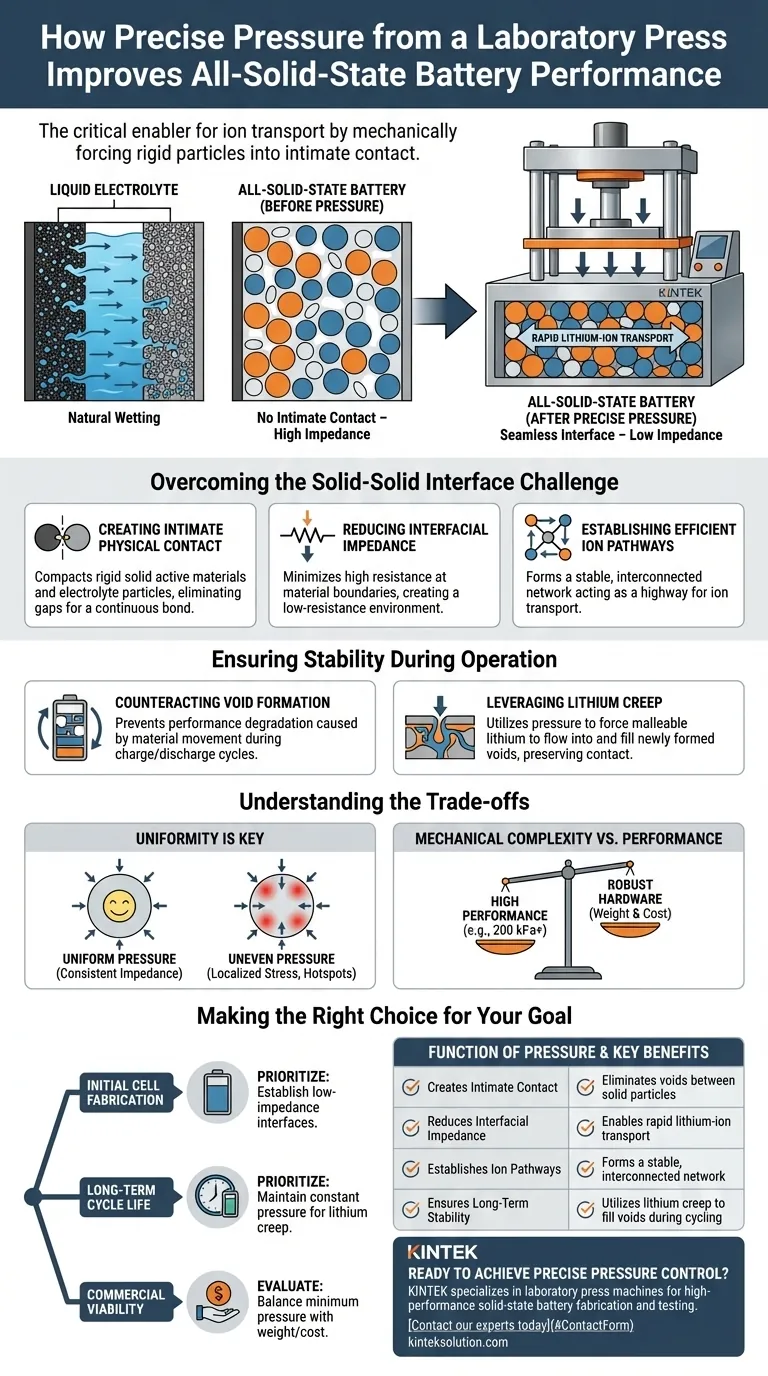
The application of precise pressure from a laboratory press acts as the critical enabler for ion transport in all-solid-state batteries. By mechanically forcing rigid cathode and electrolyte particles into intimate contact, this pressure creates the necessary physical pathways to drastically reduce interfacial impedance and allow the battery to function electrochemically.
Core Takeaway: Liquid electrolytes naturally wet electrode surfaces, but solid electrolytes do not. External pressure serves as a mechanical substitute for this "wetting" action, eliminating microscopic voids to ensure a seamless, low-impedance interface required for efficient lithium-ion transport and long-term cycle stability.

Overcoming the Solid-Solid Interface Challenge
Creating Intimate Physical Contact
Unlike conventional batteries where liquid electrolytes flow into porous electrodes, solid-state batteries rely on rigid materials. Without external force, these solid active materials and electrolyte particles remain loosely connected, creating gaps.
A laboratory press applies the force needed to compact these layers. This ensures that the cathode, anode, and electrolyte layers establish a continuous, seamless bond.
Reducing Interfacial Impedance
The primary barrier to performance in solid-state batteries is high resistance at the material boundaries.
By eliminating physical gaps, applied pressure significantly minimizes interfacial impedance. This creates a low-resistance environment where lithium ions can move rapidly between the electrode and the electrolyte.
Establishing Efficient Ion Pathways
For a battery to operate, ions must travel from particle to particle without interruption.
Pressure consolidates the material structure to form a stable, interconnected network. This network acts as the highway for ion transport, which is the fundamental requirement for the battery's charge and discharge capabilities.
Ensuring Stability During Operation
Counteracting Void Formation
During the charge and discharge cycles, lithium is continuously stripped and deposited at the anode. This movement can physically remove material, leaving behind voids or gaps at the interface.
If left unchecked, these voids break the electrical contact, causing resistance to spike and performance to degrade rapidly.
Leveraging Lithium Creep
Precise pressure creates a self-healing mechanism during these cycles.
By maintaining constant force, the system utilizes the creep properties of lithium metal. The pressure forces the malleable lithium to flow into and fill newly formed voids, preserving the critical contact area throughout the battery's lifespan.
Understanding the Trade-offs
The Necessity of Uniformity
Applying pressure is not simply about squeezing the battery as hard as possible; the distribution of force must be perfectly uniform.
Uneven pressure creates localized stress points (hotspots) while leaving other areas with poor contact. This inconsistency leads to varied impedance across the cell, potentially causing uneven current distribution and premature failure.
Mechanical Complexity vs. Performance
While high pressure (such as 200 kPa or higher) improves electrochemical performance, it introduces mechanical engineering challenges.
The requirement to maintain this state implies that the final battery pack—or the testing rig—must be robust enough to apply this force permanently. This adds weight and complexity compared to liquid-based systems that do not require such significant external compression.
Making the Right Choice for Your Goal
If your primary focus is Initial Cell Fabrication:
- Prioritize pressure to establish the initial low-impedance interfaces required to activate the cell's electrochemical potential.
If your primary focus is Long-Term Cycle Life:
- Focus on maintaining constant, regulated pressure to utilize lithium creep and prevent contact loss due to volume expansion and contraction.
If your primary focus is Commercial Viability:
- Evaluate the minimum pressure required to achieve acceptable impedance, balancing performance against the weight and cost of the compression hardware.
The success of an all-solid-state battery relies not just on the chemistry of the materials, but on the mechanical precision used to hold them together.
Summary Table:
| Function of Pressure | Key Benefit |
|---|---|
| Creates Intimate Contact | Eliminates voids between solid particles |
| Reduces Interfacial Impedance | Enables rapid lithium-ion transport |
| Establishes Ion Pathways | Forms a stable, interconnected network |
| Ensures Long-Term Stability | Utilizes lithium creep to fill voids during cycling |
Ready to achieve the precise pressure control critical for your all-solid-state battery research?
KINTEK specializes in laboratory press machines, including automatic and heated lab presses, designed to deliver the uniform, consistent pressure required for fabricating and testing high-performance solid-state batteries. Our equipment helps researchers like you overcome interfacial challenges and ensure long-term cycle stability.
Contact our experts today to discuss how our lab presses can optimize your battery development process.
Visual Guide
References
- Zhan Wu, Jun Zhang. Lithium Difluorophosphate Additive Engineering Enabling Stable Cathodic Interface for High‐Performance Sulfide‐Based All‐Solid‐State Lithium Battery. DOI: 10.1002/eem2.12871
This article is also based on technical information from Kintek Solution Knowledge Base .
Related Products
- Laboratory Hydraulic Press 2T Lab Pellet Press for KBR FTIR
- Laboratory Hydraulic Press Lab Pellet Press Button Battery Press
- Laboratory Hydraulic Press Lab Pellet Press Machine for Glove Box
- Laboratory Split Manual Heated Hydraulic Press Machine with Hot Plates
- Laboratory Hydraulic Pellet Press for XRF KBR FTIR Lab Press
People Also Ask
- What is the role of a laboratory pressure machine and KBr in FTIR? Master Sample Preparation for Flame Retardants
- What is the role of a laboratory hydraulic press in high-loading NCM811 cathode prep for solid-state batteries?
- Why is a laboratory hydraulic press necessary for sample preparation? Precise Pelleting for Spiro Heterocyclic Analysis
- What role does a laboratory hydraulic press play in reaction pellets? Optimizing Lunar Soil and Metal Fuel Density
- What role does a laboratory hydraulic press play in perovskite R&D? Essential for High-Density Material Synthesis



















