
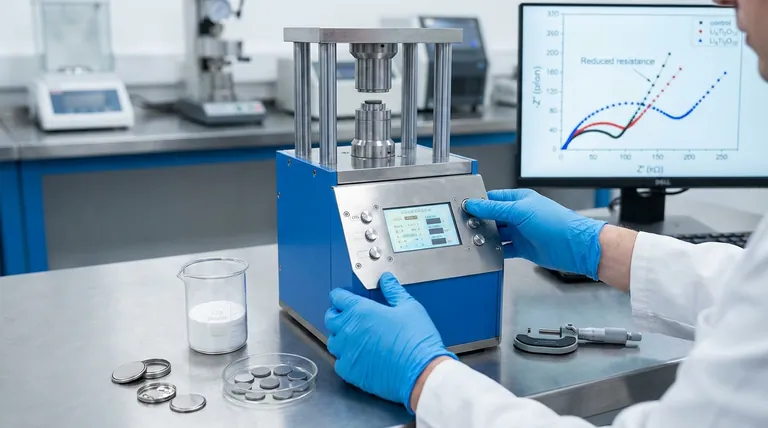
The compaction of a Li4Ti5O12 (LTO) electrode using a laboratory press machine reduces internal resistance by mechanically forcing the active material into a denser state. This process eliminates physical voids between particles and ensures a robust electrical connection with the current collector, creating a highly efficient network for electron transport.
Core Insight: Compaction is not merely a shaping step; it is a critical conditioning process that transforms a loose, resistive powder matrix into a cohesive, conductive composite. By physically bridging the gaps between particles, you directly enable the high-rate capability and long-term stability required for high-performance batteries.
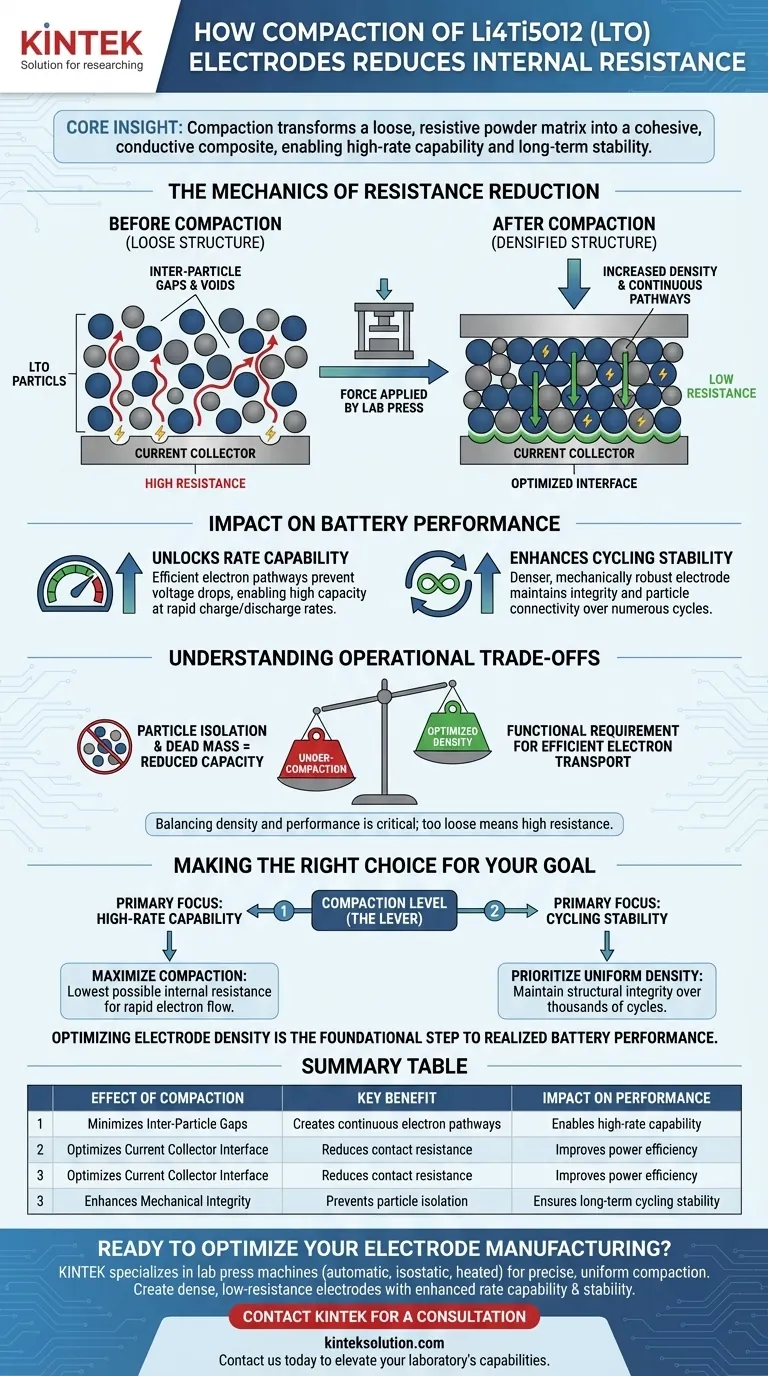
The Mechanics of Resistance Reduction
Minimizing Inter-Particle Gaps
Before compaction, the active material (LTO) often exists as a loosely packed structure with significant void space.
The laboratory press applies force to physically increase the material's density. This action compresses the active material, minimizing the gaps between individual particles.
By forcing these particles into closer proximity, you establish a continuous conductive pathway, allowing electrons to move through the material with minimal obstruction.
Optimizing the Current Collector Interface
A significant portion of a battery's internal resistance originates at the interface between the electrode material and the metal current collector.
Compaction ensures a more intimate connection between the LTO particles and the current collector foil.
This enhanced physical contact reduces contact resistance, ensuring that electrons can efficiently enter and exit the external circuit without energy loss as heat.
Impact on Battery Performance
Unlocking Rate Capability
Internal resistance is the primary bottleneck for power delivery.
By lowering resistance through compaction, the electrode improves its rate capability.
This means the battery can deliver high capacity even at rapid charge and discharge rates, as the efficient electron pathways prevent significant voltage drops under load.
Enhancing Cycling Stability
Performance is not just about a single cycle; it is about longevity.
The pressing process enhances cycling stability, resulting in better capacity retention over numerous cycles.
A denser, mechanically compacted electrode maintains its structural integrity better than a loose one, ensuring consistent performance over the battery's lifespan.
Understanding the Operational Trade-offs
The Necessity of Mechanical Integrity
While the primary goal is often electrical, the mechanical implications are equally vital.
Failing to apply sufficient compaction results in a mechanically weak electrode that may suffer from particle isolation.
If particles are not physically held together, they cannot participate in the electrochemical reaction, leading to "dead mass" and reduced overall capacity.
Balancing Density and Performance
The reduction of internal resistance is directly tied to the density achieved during pressing.
However, it is critical to view density as a functional requirement for electron transport efficiency.
If the material is too loose (low density), the electrical resistance remains too high to support practical application, rendering the theoretical capacity of the LTO material inaccessible.
Making the Right Choice for Your Goal
The level of compaction is a lever you pull to dictate the final behavior of your cell.
- If your primary focus is High-Rate Capability: Maximize compaction to ensure the lowest possible internal resistance, allowing for rapid electron flow during fast charging or discharging.
- If your primary focus is Cycling Stability: Prioritize a uniform and dense press to maintain structural integrity and particle connectivity over thousands of cycles.
Optimizing electrode density is the foundational step in converting raw material potential into realized battery performance.
Summary Table:
| Effect of Compaction | Key Benefit | Impact on Performance |
|---|---|---|
| Minimizes Inter-Particle Gaps | Creates continuous electron pathways | Enables high-rate capability |
| Optimizes Current Collector Interface | Reduces contact resistance | Improves power efficiency |
| Enhances Mechanical Integrity | Prevents particle isolation | Ensures long-term cycling stability |
Ready to optimize your electrode manufacturing and achieve superior battery performance? KINTEK specializes in lab press machines (including automatic, isostatic, and heated lab presses) designed to deliver the precise, uniform compaction your research demands. Our equipment helps you create dense, low-resistance electrodes with enhanced rate capability and cycling stability. Contact us today to discuss how our presses can elevate your laboratory's capabilities and bring your battery innovations to life.
Contact KINTEK for a Consultation
Visual Guide
Related Products
- Laboratory Split Manual Heated Hydraulic Press Machine with Hot Plates
- 24T 30T 60T Heated Hydraulic Lab Press Machine with Hot Plates for Laboratory
- Laboratory Hydraulic Press Lab Pellet Press Machine for Glove Box
- Automatic Laboratory Hydraulic Press Lab Pellet Press Machine
- Automatic Heated Hydraulic Press Machine with Hot Plates for Laboratory
People Also Ask
- Why is a laboratory hydraulic press with heating plates required for PLA/TEC films? Achieve Precise Sample Integrity
- What role does a laboratory heated hydraulic press play in LTCC? Essential for High-Density Ceramic Lamination
- Why reduce load when applying composite strengthening tabs? Protect Specimen Integrity and Data Accuracy
- Why is a laboratory heated hydraulic press required? Ensure Precise Vulcanization for NBR/EPDM Nanocomposites
- Why Use a Laboratory Heated Hydraulic Press for SSAB CCM? Optimize Solid-State Battery Interfacial Bonding



















