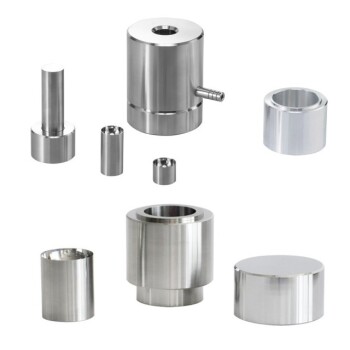
Compression molding is the primary method for consolidating Ultra-High Molecular Weight Polyethylene (UHMWPE) because the material’s extreme viscosity prevents it from being processed via conventional techniques like injection molding. Instead of injecting a liquid melt, this process places micron-sized resin powder into a large press and subjects it to high temperature and pressure for an extended period—often exceeding 24 hours—to fuse the particles into a dense, high-quality sheet.
Core Takeaway Compression molding overcomes the flow limitations of UHMWPE by utilizing time and pressure rather than fluidity. By maintaining a high-pressure environment during both heating and cooling, the process forces polymer chains to rearrange and fill internal voids, resulting in a solid, structural-grade material suitable for precision medical components.
The Engineering Challenge: Viscosity
Why Injection Molding Fails
To understand compression molding, you must first understand the material's limitations. In its molten state, UHMWPE possesses extremely high viscosity.
Unlike standard thermoplastics, it does not turn into a flowable liquid that can be easily injected into complex molds. It remains a thick, rubbery mass that resists flow.
The Powder-to-Solid Approach
Because the material cannot flow, the manufacturing strategy shifts from injection to consolidation.
The process begins with resin powder introduced directly into a mold cavity. The goal is not to flow the material into shape, but to fuse discrete powder particles into a single, cohesive block through force and thermal energy.
The Mechanics of Consolidation
The Role of Sustained Pressure
The primary reference highlights that raw polymer resin is placed in a large press under high pressure and high temperature.
This pressure is not merely for shaping; it is the driving force that compels the extremely viscous polymer chains to rearrange. This rearrangement is essential for eliminating boundaries between the original powder particles.
The Factor of Time
Consolidation is not instantaneous. The process requires a cycle time of over 24 hours.
This extended duration allows the thermal energy to penetrate the bulk material fully and gives the polymer chains sufficient time to reorganize, ensuring a uniform structure throughout the large sheet.
Ensuring Structural Integrity
Managing Thermal Shrinkage
As the UHMWPE solidifies and cools, the material naturally undergoes volume shrinkage.
A critical issue arises during this phase: the outer surface of the large-volume melt cools and solidifies first, forming a hard shell. This rigid outer layer restricts the inner core from contracting freely, which creates a risk of internal voids.
Eliminating Voids and Bubbles
To counteract this, industrial-grade pressing equipment applies continuous pressure throughout the solidification phase.
This forces the still-malleable internal material to flow and fill any shrinkage spaces that develop. This step is non-negotiable for producing medical-grade material, as it effectively eliminates air bubbles and ensures the final product is dense and void-free.
Understanding the Trade-offs
Post-Processing Requirements
Unlike molding processes that produce "net-shape" parts, compression molding UHMWPE typically results in semi-finished bulk materials, such as large sheets.
These sheets serve as raw stock. To achieve the final component geometry—such as an orthopedic joint—the material must be cut, trimmed, and shaped using lathes or precision machining equipment.
Production Efficiency vs. Material Quality
The trade-off for this high material quality is low throughput.
The requirement for >24-hour cycle times limits production speed significantly compared to standard plastics processing. However, this time investment is necessary to achieve the density required for high-stress applications.
Making the Right Choice for Your Goal
- If your primary focus is material density and structural integrity: Rely on compression molding to eliminate voids and ensure the thorough chain rearrangement necessary for load-bearing orthopedic components.
- If your primary focus is complex final geometries: Plan for a two-stage process where compression molding creates the stock material, followed by precision machining to achieve the final shape.
Success in processing UHMWPE relies on substituting the flow of injection molding with the patience and pressure of compression consolidation.
Summary Table:
| Feature | Compression Molding of UHMWPE | Conventional Injection Molding |
|---|---|---|
| Material State | Solid Resin Powder | Molten Liquid Flow |
| Primary Force | Sustained High Pressure | Injection Speed/Flow |
| Cycle Time | >24 Hours (Extended) | Seconds to Minutes |
| Final Output | Semi-finished Stock (Sheets/Blocks) | Net-shape Final Parts |
| Key Benefit | Zero-void Structural Integrity | High-volume Throughput |
Elevate Your Materials Research with KINTEK
Unlock the full potential of high-viscosity polymers like UHMWPE with KINTEK’s precision laboratory pressing solutions. Whether you are developing next-generation medical components or conducting advanced battery research, our range of equipment is designed to meet your specific needs:
- Versatile Pressing Options: Choose from manual, automatic, heated, and multifunctional models.
- Advanced Consolidation: High-performance cold and warm isostatic presses for superior material density.
- Specialized Environments: Glovebox-compatible models for sensitive research applications.
Don't let processing challenges limit your innovation. Partner with KINTEK to achieve the structural integrity your research demands.
References
- D. POKORNÝ, Petr Fulín. Current Knowledge on the Effect of Technology and Sterilization on the Structure, Properties and Longevity of UHMWPE in Total Joint Replacement. DOI: 10.55095/achot2012/031
This article is also based on technical information from Kintek Solution Knowledge Base .
Related Products
- XRF KBR Plastic Ring Lab Powder Pellet Pressing Mold for FTIR
- Lab Polygon Press Mold
- Lab Round Bidirectional Press Mold
- Lab Isostatic Pressing Molds for Isostatic Molding
- Lab Ring Press Mold for Sample Preparation
People Also Ask
- What is the purpose of making KBr pellets for FTIR? Achieve Precise Molecular Analysis with Solid Samples
- What factors should be considered when choosing a lab press for XRF pellet preparation? Ensure Accurate and Consistent Results
- Why are pellets used in XRF analysis, and what is their limitation? Boost Accuracy and Speed in Your Lab
- How are pellets prepared for XRF analysis and what is a potential drawback? Master XRF Sample Prep and Accuracy
- What checklist of factors should be considered when choosing an XRF pellet press? Ensure Accurate Sample Preparation