
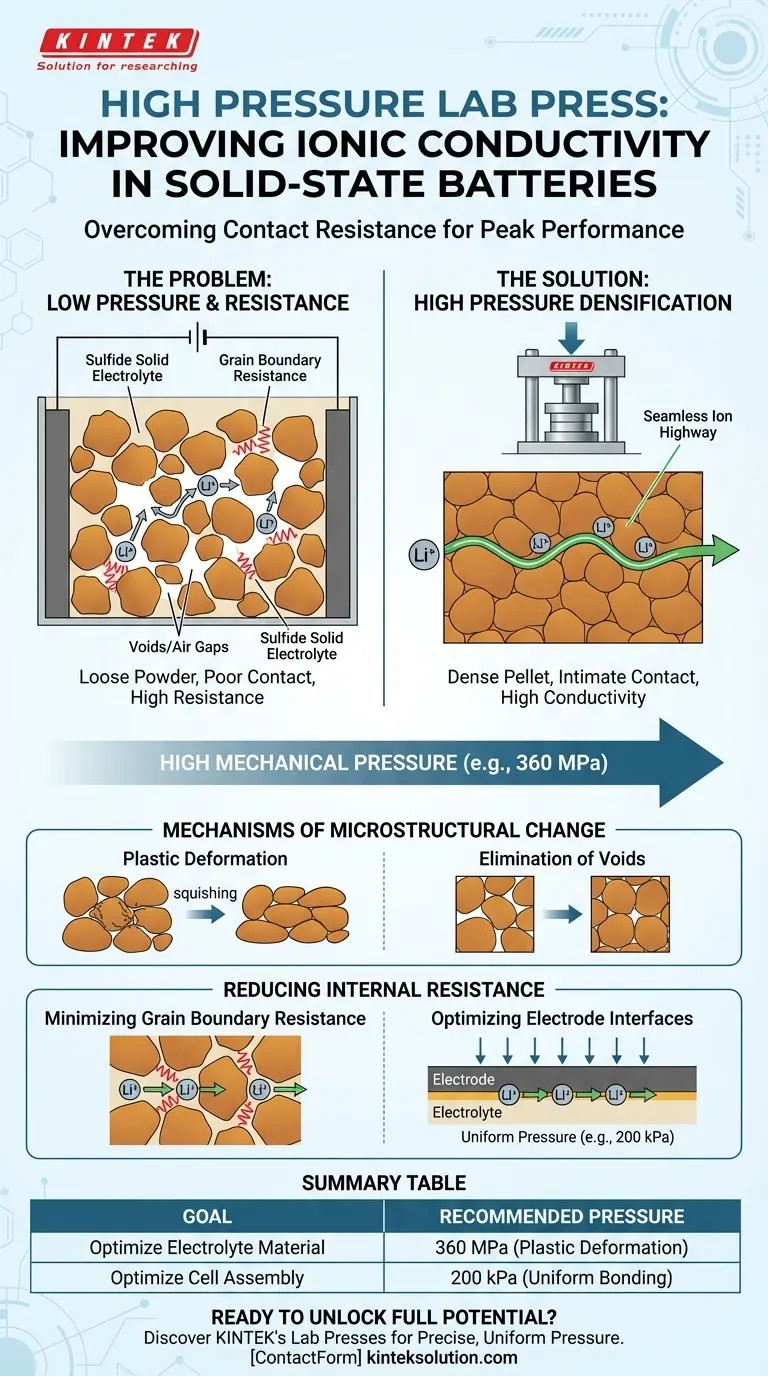
High mechanical pressure is the primary mechanism used to overcome the inherent contact resistance found in solid-state battery materials. It improves ionic conductivity by forcing solid electrolyte particles to undergo plastic deformation, which physically fills microscopic voids and creates a continuous, low-resistance pathway for lithium ions.
The Core Insight In solid-state batteries, "contact is conductivity." High pressure transforms loose, resistive powder into a dense, cohesive block. This process eliminates the air gaps that act as ionic insulators, allowing the material to function near its theoretical performance limit.
Mechanisms of Microstructural Change
Plastic Deformation of Particles
When you apply high pressure using a lab press, you are not simply packing particles closer together; you are changing their shape.
Sulfide-based solid electrolytes are malleable. Under sufficient pressure, these particles undergo plastic deformation, effectively squishing together to fill the empty spaces between them.
Elimination of Voids
The primary antagonist to ionic conductivity in a powder-based system is air.
As pressure increases, the volume of voids (air gaps) between particles drastically decreases. This densification process removes physical barriers that would otherwise block the movement of lithium ions.
Reaching Intrinsic Conductivity
The ultimate goal of applying pressure is to make a pressed pellet behave like a single, solid crystal.
At high pressures (such as 360 MPa), the material becomes so dense that the measured conductivity approaches the intrinsic bulk conductivity of the material itself. You are effectively removing the physical limitations so the chemistry can perform at its peak.
Reducing Internal Resistance
Minimizing Grain Boundary Resistance
In a low-pressure environment, ions struggle to jump from one particle to the next. This is known as grain boundary resistance.
By forcing particles into intimate contact, high pressure significantly reduces this resistance. It creates a seamless "ion highway," allowing for rapid transport across solid-phase interfaces.
Optimizing Electrode Interfaces
Conductivity challenges exist not only within the electrolyte but also where the electrolyte meets the electrode.
Applying a uniform external pressure (such as 200 kPa) creates a physically seamless bond between these layers. This minimizes interfacial impedance, ensuring that ions can move easily from the storage material into the transport medium.
Understanding the Limits
Geometry vs. Chemistry
It is critical to understand that pressure optimizes the physical geometry of the cell, not the chemical properties of the material.
Pressure reduces the extrinsic resistance caused by gaps and poor contact. However, it cannot increase conductivity beyond the material's chemical capability.
The Role of Uniformity
While high pressure is necessary for densification, the uniformity of that pressure is equally vital for layer bonding.
Uneven pressure can lead to localized areas of high resistance. To establish stable pathways, the force must be applied evenly across the mold or pressing device to ensure consistent contact throughout the battery stack.
Making the Right Choice for Your Goal
To maximize the performance of your solid-state battery fabrication, apply pressure based on the specific resistance bottleneck you are trying to solve:
- If your primary focus is optimizing the electrolyte material: Apply high pressure (e.g., 360 MPa) to induce plastic deformation and minimize grain boundary resistance within the pellet.
- If your primary focus is cell assembly and integration: Apply uniform pressure (e.g., 200 kPa) to minimize interfacial impedance and ensure a seamless bond between the electrode and electrolyte layers.
Mastering pressure application turns a collection of powders into a high-performance, unified electrochemical system.
Summary Table:
| Goal | Recommended Pressure | Key Mechanism | Outcome |
|---|---|---|---|
| Optimize Electrolyte Material | 360 MPa | Plastic deformation of particles | Minimizes grain boundary resistance, approaches intrinsic conductivity |
| Optimize Cell Assembly | 200 kPa | Uniform layer bonding | Minimizes interfacial impedance between electrode and electrolyte |
Ready to Unlock the Full Potential of Your Solid-State Battery Research?
Achieving precise, uniform high pressure is critical for transforming powder materials into high-performance, unified electrochemical systems. KINTEK specializes in providing reliable lab press machines—including automatic, isostatic, and heated lab presses—designed to meet the exacting demands of laboratory battery fabrication.
Let our expertise help you eliminate voids, reduce internal resistance, and reach the intrinsic conductivity of your materials. Contact us today to discuss how our presses can enhance your research and development process!
Visual Guide
References
- Yuju Jeon, Zheng Chen. Lithium diffusion-controlled Li-Al alloy negative electrode for all-solid-state battery. DOI: 10.1038/s41467-025-64386-y
This article is also based on technical information from Kintek Solution Knowledge Base .
Related Products
- 24T 30T 60T Heated Hydraulic Lab Press Machine with Hot Plates for Laboratory
- Manual Heated Hydraulic Lab Press with Integrated Hot Plates Hydraulic Press Machine
- Laboratory Hydraulic Pellet Press for XRF KBR FTIR Lab Press
- Lab Infrared Press Mold for Laboratory Applications
- Laboratory Hydraulic Press Lab Pellet Press Machine for Glove Box
People Also Ask
- Function of a Laboratory Hydraulic Press with Heated Platens in SSE? Enhance Battery Density & Conductivity
- Why is a laboratory hydraulic press with heating plates required for PLA/TEC films? Achieve Precise Sample Integrity
- What role does a laboratory heated hydraulic press play in LTCC? Essential for High-Density Ceramic Lamination
- What is the primary function of a laboratory heated hydraulic press? Mastering Thermoplastic Carbon Fiber Composites
- What is the critical role of a laboratory heated hydraulic press? Mastering PVC Sample Prep for Testing



















