
The hydraulic operation of a KBr Pellet Press functions by utilizing confined fluid dynamics to deliver high-tonnage, uniform pressure to a sample mixture. This mechanism is the driving force that transforms loose powder into a dense, transparent disc essential for accurate spectroscopic analysis. By replacing variable manual force with controlled hydraulic power, the press ensures the structural integrity required for precise Fourier Transform Infrared (FTIR) readings.
The core value of hydraulic operation lies in reproducibility. While basic compression consolidates material, hydraulic systems provide the precise, even force distribution necessary to eliminate air pockets and create optically clear pellets, ensuring that variances in your data are due to the sample, not the preparation method.
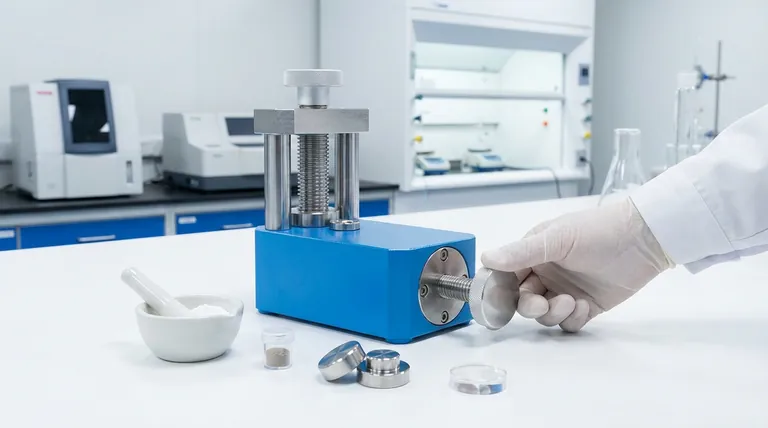
The Mechanics of Quality: Why Controlled Pressure Matters
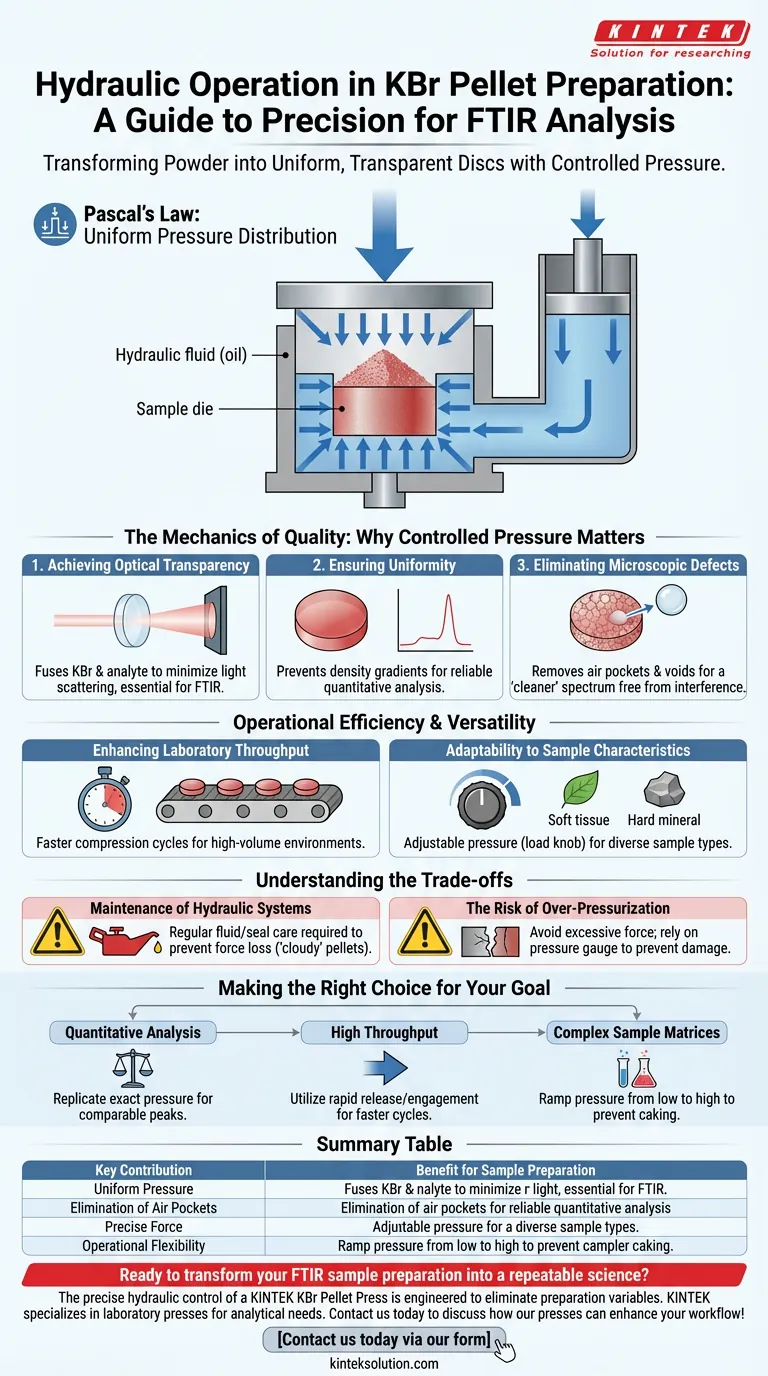
Achieving Optical Transparency
For FTIR analysis, the sample medium must be transparent to infrared radiation. Hydraulic presses apply sufficient force to fuse the Potassium Bromide (KBr) powder and the analyte into a single, cohesive solid.
This transformation is critical because it minimizes light scattering. Without the massive, steady pressure provided by the hydraulic cylinder, the pellet often remains opaque or granular, leading to poor spectral resolution.
Ensuring Uniformity via Pascal’s Law
The hydraulic cylinder operates on Pascal’s law, using fluid (typically oil) to transmit pressure equally in all directions. This ensures that the force applied to the sample die is perfectly distributed across the entire surface area of the pellet.
This uniform compression prevents density gradients within the pellet. A sample with inconsistent density will yield erratic absorption peaks, rendering quantitative analysis unreliable.
Eliminating Microscopic Defects
Air pockets and voids are the enemies of spectroscopy. The intense pressure of a hydraulic system forces air out of the matrix, preventing the formation of bubbles that can disrupt the path of the IR beam.
By compacting the powder into a solid, the press also reduces the risk of sample oxidation or moisture absorption that can occur in loose powders. This results in a "cleaner" spectrum free from environmental interference.
Operational Efficiency and Versatility
Enhancing Laboratory Throughput
Hydraulic presses are significantly faster than manual alternatives, particularly in high-volume environments. The mechanical advantage allows for rapid compression cycles, making them ideal for laboratories processing large batches of samples daily.
This speed is especially noticeable in hand-fed systems. The ability to switch samples quickly and reach target pressure immediately streamlines the workflow without sacrificing pellet quality.
Adaptability to Sample Characteristics
Not all samples require the same compression force; biological tissues behave differently than geological minerals. Hydraulic systems typically feature a load knob or valve, allowing the user to dial in the exact pressure required.
This operational flexibility allows the user to prepare a wide variety of sample types. You can apply lighter pressure for soft, moisture-sensitive samples or maximum tonnage for hard, recalcitrant materials.
Understanding the Trade-offs
Maintenance of Hydraulic Systems
Unlike simple mechanical screw presses, hydraulic units rely on fluids and seals. Over time, seals may degrade or oil may leak, requiring regular maintenance to ensure the press holds pressure correctly.
Failure to maintain the hydraulic fluid levels can lead to a loss of force. This results in "cloudy" pellets that fracture easily, wasting both time and expensive sample material.
The Risk of Over-Pressurization
While hydraulic presses offer immense power, applying too much pressure can be detrimental. Excessive force can cause the KBr crystal structure to deform in a way that affects optical properties, or even fracture the steel die set.
Users must rely on the pressure gauge to replicate specific conditions. A lack of attention to the load settings can lead to damaged equipment or inconsistent pellet thickness between batches.
Making the Right Choice for Your Goal
To maximize the utility of a KBr Pellet Press, align the hydraulic settings with your specific analytical objectives:
- If your primary focus is Quantitative Analysis: Prioritize the use of the load knob to document and replicate the exact pressure (tonnage) for every sample to ensure comparable absorption peak heights.
- If your primary focus is High Throughput: Utilize the rapid pressure release and engagement features to minimize cycle times between sample loads.
- If your primary focus is Complex Sample Matrices: Start with lower hydraulic pressures to settle the powder, then ramp up to full tonnage to prevent uneven caking or stratification.
By leveraging the precise control of hydraulic operation, you convert sample preparation from a manual art into a rigorous, repeatable science.
Summary Table:
| Key Contribution | Benefit for Sample Preparation |
|---|---|
| Uniform Pressure Distribution | Creates pellets with consistent density, eliminating erratic absorption peaks. |
| Elimination of Air Pockets | Produces optically transparent pellets for clean, high-resolution spectra. |
| Precise, Reproducible Force | Ensures reliable quantitative analysis by making sample preparation a repeatable science. |
| Operational Flexibility | Adapts pressure settings for different sample types, from soft tissues to hard minerals. |
Ready to transform your FTIR sample preparation into a repeatable science?
The precise hydraulic control of a KINTEK KBr Pellet Press is engineered to eliminate preparation variables, giving you confidence that your spectral data reflects your sample's true properties—not inconsistencies in pellet quality.
KINTEK specializes in laboratory presses, including automatic, isostatic, and heated lab presses, serving the precise needs of analytical laboratories like yours.
Contact us today via our form to discuss how our hydraulic pellet presses can enhance the accuracy and throughput of your spectroscopy workflow!
Visual Guide
Related Products
- Laboratory Hydraulic Press 2T Lab Pellet Press for KBR FTIR
- XRF KBR Plastic Ring Lab Powder Pellet Pressing Mold for FTIR
- XRF KBR Steel Ring Lab Powder Pellet Pressing Mold for FTIR
- Laboratory Hydraulic Pellet Press for XRF KBR FTIR Lab Press
- Automatic Laboratory Hydraulic Press for XRF and KBR Pellet Pressing
People Also Ask
- What is the role of a laboratory pressure machine and KBr in FTIR? Master Sample Preparation for Flame Retardants
- What is the role of a laboratory hydraulic press in high-loading NCM811 cathode prep for solid-state batteries?
- Why is a laboratory hydraulic press necessary for sample preparation? Precise Pelleting for Spiro Heterocyclic Analysis
- What role does a laboratory hydraulic press play in reaction pellets? Optimizing Lunar Soil and Metal Fuel Density
- What are the common uses of a laboratory hydraulic press? Precision Solutions for Materials Testing and R&D



















