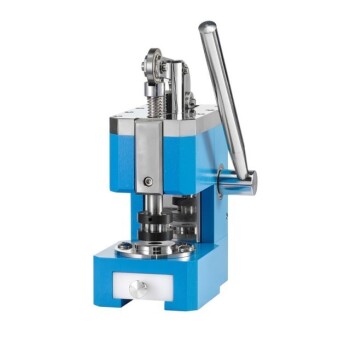
Laboratory-scale processing equipment facilitates grain refinement by utilizing localized, continuous compression to introduce high-density shear strain into the titanium alloy. Unlike traditional methods that may result in uneven deformation, this targeted mechanical pressure acts as a catalyst for dynamic recrystallization, effectively transforming the material's microstructure from coarse and irregular to uniform and ultra-fine.
The core mechanism driving this refinement is the application of high-density shear strain through continuous compression. This forces the material to undergo dynamic recrystallization, converting original coarse, lamellar structures into a spherical, ultra-fine grain architecture that significantly enhances mechanical performance.
The Mechanics of Refinement
Generating High-Density Shear Strain
The primary driver of grain refinement in this context is high-density shear strain. Laboratory-scale equipment achieves this not through simple crushing, but by applying mechanical pressure in a way that forces the material layers to slide past one another intensely. This shear action is critical for breaking down the existing crystal lattice structure.
Localized and Continuous Compression
The process relies on localized and continuous compression rather than a single, high-impact blow. By focusing the pressure on specific zones continuously, the equipment ensures that the strain is distributed effectively throughout the blank. This prevents the formation of stress risers and ensures the energy is used for microstructural change rather than macroscopic fracture.
Microstructural Evolution
Triggering Dynamic Recrystallization
The mechanical pressure and resulting shear strain provide the necessary energy to trigger dynamic recrystallization. During this phase, new, strain-free grains begin to nucleate and grow to replace the deformed microstructure. This is the pivotal moment where the material properties are reset and enhanced.
Breaking Down Coarse Lamellar Structures
Titanium alloy blanks typically start with a coarse lamellar (layered) microstructure. This structure is often associated with lower ductility and anisotropic mechanical properties. The processing equipment effectively fragments these coarse layers, removing the legacy defects associated with the raw material.
Achieving Spherical Ultra-Fine Grains
The end result of this dynamic recrystallization is a transformation into a uniform, spherical ultra-fine grain structure. These spherical grains provide superior mechanical performance compared to the original elongated forms. The uniformity ensures consistent behavior of the alloy under load, which is critical for high-performance applications.
Critical Process Constraints
The Necessity of Localized Application
It is important to recognize that this level of refinement relies heavily on the localized nature of the compression. Traditional bulk processing methods often fail to achieve the same degree of ultra-fine uniformity because they cannot sustain the necessary high-density shear strain across the entire volume of the material.
Dependency on Continuous Pressure
The transformation is not instantaneous; it requires continuous compression to drive the recrystallization process to completion. Interrupted or insufficient pressure may lead to a partially recrystallized structure, resulting in a hybrid microstructure that fails to maximize the mechanical potential of the alloy.
Making the Right Choice for Your Goal
To maximize the benefits of laboratory-scale processing for your titanium projects, consider your specific performance targets:
- If your primary focus is mechanical uniformity: Prioritize equipment that delivers consistent, continuous compression to ensure the complete elimination of coarse lamellar structures.
- If your primary focus is material strength and ductility: Target processing parameters that maximize high-density shear strain to achieve the smallest possible spherical grain size through dynamic recrystallization.
By leveraging high-density shear strain to drive dynamic recrystallization, you turn a coarse, standard alloy into a high-performance material with a uniform, ultra-fine microstructure.
Summary Table:
| Mechanism | Action | Resulting Microstructure |
|---|---|---|
| High-Density Shear Strain | Forced sliding of material layers | Breakdown of existing crystal lattice |
| Continuous Compression | Localized, sustained pressure application | Uniform strain distribution across the blank |
| Dynamic Recrystallization | Nucleation of new, strain-free grains | Transformation from lamellar to spherical grains |
| Grain Refinement | Fragmentation of coarse structures | Ultra-fine, high-performance architecture |
Elevate Your Material Research with KINTEK Precision
Ready to transform your titanium alloys into high-performance materials? KINTEK specializes in comprehensive laboratory pressing solutions designed for the most demanding research environments. Whether you are focused on battery research or advanced metallurgy, our range of manual, automatic, heated, and multifunctional presses—including specialized cold and warm isostatic models—provides the continuous, localized pressure necessary to achieve superior grain refinement.
Unlock the full potential of your alloy microstructure today. Contact our experts now to find the perfect pressing solution for your lab’s specific needs!
References
- F. Z. Utyashev, Р. З. Валиев. Rational Methods of Plastic Deformation Providing Formation of Ultrafine-Grained Structure in Large-Sized Products. DOI: 10.17586/2687-0568-2024-6-1-12-23
This article is also based on technical information from Kintek Solution Knowledge Base .
Related Products
- Lab Cylindrical Press Mold for Laboratory Use
- Automatic High Temperature Heated Hydraulic Press Machine with Heated Plates for Lab
- Automatic Laboratory Hydraulic Press for XRF and KBR Pellet Pressing
- Laboratory Hydraulic Pellet Press for XRF KBR FTIR Lab Press
- Split Automatic Heated Hydraulic Press Machine with Heated Plates
People Also Ask
- What is the purpose of incorporating cartridge heaters into a lab press mold for MLCC block compression? Optimize Results
- Why is precise cooling management of the lab press mold necessary? Protect Core Integrity in Thermoforming
- What is the function of a pressing tool in thermoplastic panels? Master Precision Shaping & Fusion Bonding
- Why is a high-performance laboratory molding press critical for in-situ electrolyte formation? Unlock Battery Success
- How does the geometry of laboratory molds influence mycelium-based composites? Optimize Density and Strength