
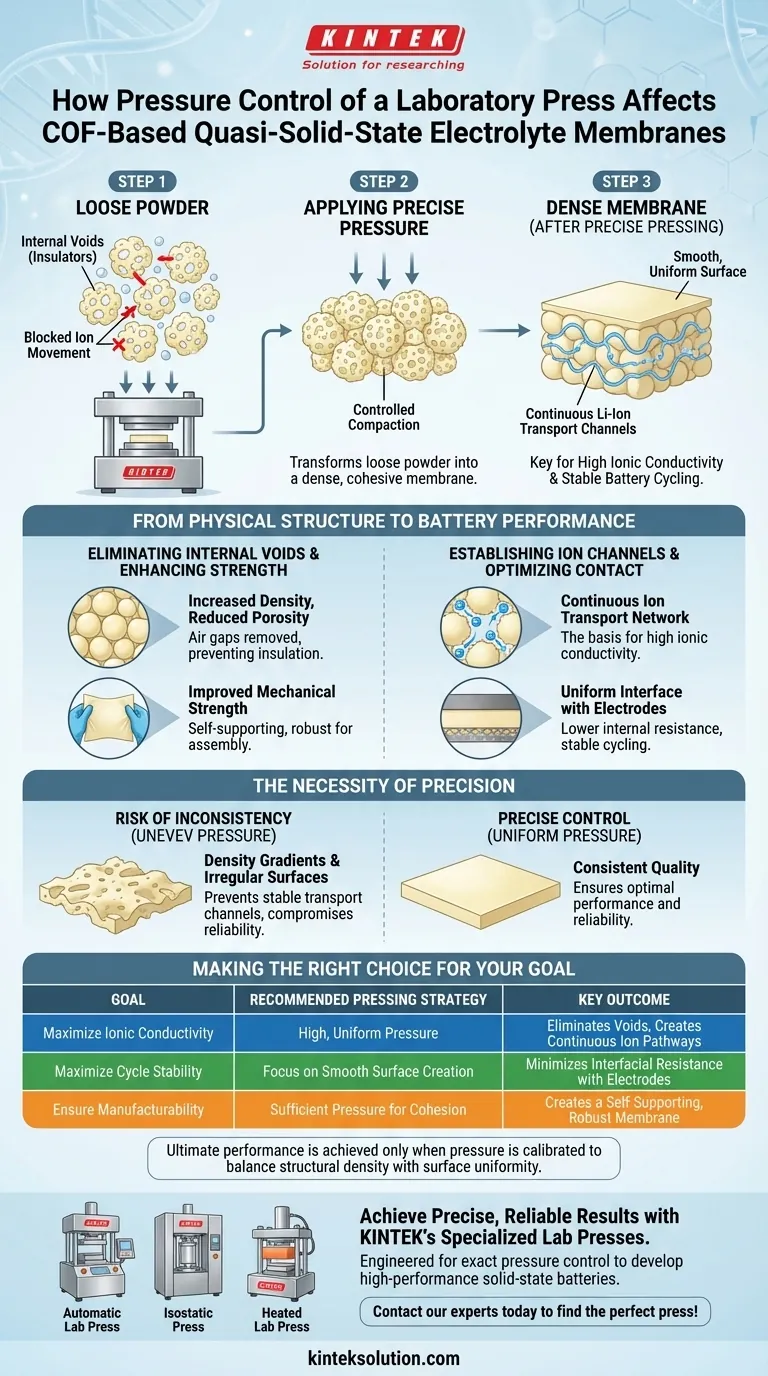
Precise pressure control is the primary determinant of whether a COF-based quasi-solid-state electrolyte functions effectively or fails. It directly governs the compaction of powder particles and the elimination of internal voids, creating the continuous pathways necessary for lithium-ion transport.
The application of controlled pressure transforms loose powder into a dense, cohesive membrane, establishing the structural integrity and surface uniformity required for high ionic conductivity and stable battery cycling.
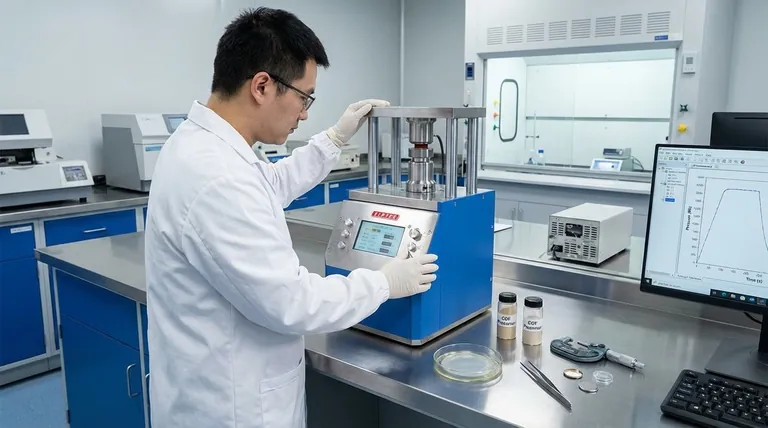
The Role of Compaction in Electrolyte Function
Eliminating Internal Voids
The fundamental purpose of the laboratory press in this context is to increase the density of the membrane.
By applying specific force, you mechanically eliminate the empty spaces (voids) between powder particles.
This reduction in porosity is essential because air gaps act as insulators that block ion movement.
Enhancing Mechanical Strength
A self-supporting solid-state electrolyte must be robust enough to handle during cell assembly.
Pressure bonds the particles together, creating a cohesive structure with improved mechanical strength.
Without adequate compaction, the membrane would remain fragile and prone to crumbling, making it unusable in practical applications.
From Physical Structure to Battery Performance
Establishing Ion Transport Channels
The physical compaction of the material has a direct electrochemical consequence: the creation of continuous lithium-ion transport channels.
When particles are pressed into close contact, ions can move freely from one particle to the next without interruption.
This continuous network is the basis for achieving high ionic conductivity, which is the most critical metric for battery performance.
Optimizing Interfacial Contact
Pressure control is also responsible for creating a smooth, uniform surface on the membrane.
A uniform surface ensures better contact between the electrolyte and the electrodes when the battery is assembled.
This improved interfacial contact lowers the overall internal resistance of the cell, leading to better efficiency and stable cycling performance.
The Necessity of Precision
The Risk of Inconsistency
The references emphasize that pressure control must be precise, not just high.
If pressure is applied unevenly or inaccurately, the membrane may develop density gradients or irregular surfaces.
These irregularities prevent the formation of stable transport channels, compromising the reliability of the final battery cell.
Making the Right Choice for Your Goal
To maximize the performance of your COF-based electrolyte, tailor your pressing strategy to your specific performance targets.
- If your primary focus is Ionic Conductivity: Prioritize high, uniform pressure to fully eliminate inter-particle voids and establish continuous transport pathways.
- If your primary focus is Cycle Stability: Focus on creating a perfectly smooth surface to minimize interfacial resistance with the electrodes.
- If your primary focus is Manufacturability: Ensure sufficient pressure to achieve a self-supporting membrane with the mechanical strength to withstand handling.
Ultimate performance is achieved only when pressure is calibrated to balance structural density with surface uniformity.
Summary Table:
| Goal | Recommended Pressing Strategy | Key Outcome |
|---|---|---|
| Maximize Ionic Conductivity | High, uniform pressure | Eliminates voids, creates continuous ion pathways |
| Maximize Cycle Stability | Focus on smooth surface creation | Minimizes interfacial resistance with electrodes |
| Ensure Manufacturability | Sufficient pressure for cohesion | Creates a self-supporting, robust membrane |
Achieve precise, reliable results for your COF-based electrolyte research with KINTEK's specialized lab presses. Our automatic lab presses, isostatic presses, and heated lab presses are engineered to deliver the exact pressure control your laboratory needs to develop high-performance solid-state batteries. Ensure your membranes have the density, strength, and surface uniformity for superior ionic conductivity and stable cycling. Contact our experts today to find the perfect press for your application!
Visual Guide
Related Products
- Warm Isostatic Press for Solid State Battery Research Warm Isostatic Press
- Carbide Lab Press Mold for Laboratory Sample Preparation
- Automatic Laboratory Hydraulic Press for XRF and KBR Pellet Pressing
- Laboratory Hydraulic Press 2T Lab Pellet Press for KBR FTIR
- Automatic Lab Cold Isostatic Pressing CIP Machine
People Also Ask
- Why must composite cathodes be sealed in vacuum lamination bags for WIP? Ensure Battery Stability and Density
- What is the function of elastic molds in warm isostatic pressing? Achieve Uniform Density in Composite Particles
- How do sacrificial volume materials (SVM) maintain microchannels in isostatic pressing? Ensure Structural Integrity
- What is the process involved in warm isostatic pressing? Mastering Uniform Density with WIP Technology
- How does Warm Isostatic Pressing differ from traditional pressing methods? Unlock Uniform Density for Complex Parts



















