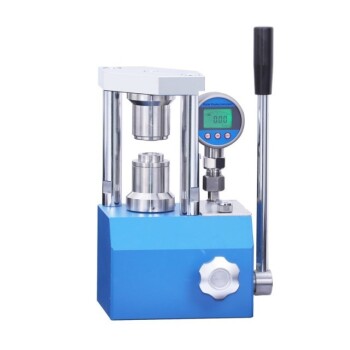
Simultaneous high-pressure pressing creates a mechanically unified battery system, significantly enhancing performance by minimizing interfacial resistance. By compressing lithium and indium foils together with the electrolyte and cathode, the process eliminates microscopic gaps and facilitates the formation of a robust indium-lithium alloy layer, which is essential for efficient ion transport.
Core Insight: The primary function of this "integrated molding" process is to transform separate battery layers into a cohesive unit. This reduces absolute impedance and ensures uniform current distribution, directly translating to higher cycling reproducibility and extended battery life.
Mechanisms of Improved Performance
Reducing Absolute Impedance
The most immediate benefit of high-pressure pressing is a significant reduction in the absolute impedance of the anode interface. When components are loosely assembled, contact resistance (ohmic resistance) is high, impeding the flow of energy. High-pressure molding forces the materials into a dense physical contact that drastically lowers this resistance.
Strengthening Mechanical Coupling
The pressing process creates a superior bond between the indium-lithium alloy layer and the solid electrolyte. This is not merely about proximity; it is about mechanical integration. By removing physical gaps at the interface, the process ensures that the active materials remain chemically and mechanically connected throughout the battery's operation.
Enhancing Cycling Reproducibility
Batteries assembled with this technique exhibit higher consistency over repeated charge and discharge cycles. Because the "molding" process stabilizes the interface from the start, the battery is less prone to the mechanical shifting or detachment that typically leads to performance variability over time.
Preventing Electrochemical Instability
Eliminating Current Hotspots
Without sufficient pressure, contact between the anode, electrolyte, and cathode is often uneven. These imperfections lead to localized high current densities—essentially "hotspots" where the current is forced through small contact points. High-pressure pressing ensures uniform contact, distributing the current load evenly across the entire surface.
Mitigating Interfacial Degradation
High-voltage environments are particularly unforgiving of poor interfacial contact. The gaps caused by low pressure allow for interfacial degradation and increased charge transfer resistance. By utilizing precision pressure (such as the 1000 psi cited for specific coin cell applications), engineers can prevent the non-uniform distributions that accelerate material failure.
Understanding the Precision Required
The Necessity of Controlled Force
While pressure is vital, it must be precise and uniform to be effective. The goal is to achieve "dense physical contact" without damaging the structural integrity of the separator or the solid electrolyte film.
One-Time vs. Continuous Application
The primary benefit described is achieved through a "one-time" high-pressure pressing during the manufacturing (encapsulation) phase. This creates the initial conditions required for the indium-lithium alloy to function correctly, setting the baseline for the battery's future performance.
Making the Right Choice for Your Design
When engineering battery assembly protocols involving lithium and indium foils, consider your primary performance metrics:
- If your primary focus is Efficiency: Utilize high-pressure pressing to minimize ohmic resistance and absolute impedance, ensuring maximum energy throughput.
- If your primary focus is Longevity: Rely on the integrated molding process to eliminate interfacial gaps, which prevents localized degradation and ensures high cycling reproducibility.
By treating the assembly as a unified molding process rather than a stacking of layers, you ensure the mechanical integrity required for high-performance electrochemical cycling.
Summary Table:
| Mechanism | Benefit | Impact on Performance |
|---|---|---|
| Integrated Molding | Eliminates microscopic gaps | Minimizes interfacial resistance and absolute impedance |
| Mechanical Coupling | Creates robust In-Li alloy layer | Ensures stable ion transport and uniform current distribution |
| Dense Physical Contact | Prevents current hotspots | Reduces material degradation and enhances safety |
| Controlled Pressure | Stabilizes the interface | Improves cycling reproducibility and extends battery life |
Elevate Your Solid-State Battery Research with KINTEK
Maximize your energy throughput and ensure high cycling reproducibility with KINTEK’s precision laboratory pressing solutions. Whether you are working with lithium-indium foils or advanced solid electrolytes, our specialized equipment provides the uniform, high-pressure control necessary for integrated molding and reduced interfacial resistance.
Why choose KINTEK?
- Comprehensive Solutions: Manual, automatic, and heated models tailored for battery assembly.
- Advanced Capabilities: Glovebox-compatible designs and cold/warm isostatic presses (CIP/WIP).
- Research-Grade Precision: Ideal for eliminating current hotspots and achieving dense physical contact.
Ready to transform your battery assembly process? Contact KINTEK today for a customized quote and see how our laboratory presses can enhance your research outcomes!
References
- Maximilian Kissel, Jürgen Janek. Quantifying the Impact of Cathode Composite Mixing Quality on Active Mass Utilization and Reproducibility of Solid‐State Battery Cells. DOI: 10.1002/aenm.202405405
This article is also based on technical information from Kintek Solution Knowledge Base .
Related Products
- Laboratory Hydraulic Press Lab Pellet Press Button Battery Press
- Warm Isostatic Press for Solid State Battery Research Warm Isostatic Press
- Button Battery Sealing Press Machine for Lab
- Lab Infrared Press Mold for Laboratory Applications
- Lab Button Battery Tablet Press Sealing Mold
People Also Ask
- How is a laboratory hydraulic press used for HAP composite gels? Master Mineral Substrate Standardization
- What role does a laboratory hydraulic press play in the preparation of piezoelectric ceramic discs for DC-PG? | KINTEK
- What role does a laboratory hydraulic press play in reaction pellets? Optimizing Lunar Soil and Metal Fuel Density
- Why is a laboratory hydraulic press required for PBAT and PLA sample preparation? Achieve Flawless Characterization
- What role does a laboratory hydraulic press play in the assembly of all-solid-state battery test cells? Expert Guide