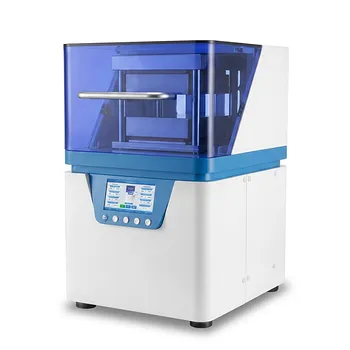
A hydraulic heat press is a sophisticated laboratory instrument used to compress powder or granular materials into uniform, dense solid forms while simultaneously applying controlled thermal energy. It is primarily employed to transform raw materials into homogenous pellets, thin films, or flattened discs required for high-precision analytical techniques and material characterization.
Core Insight: The value of a hydraulic heat press lies in its ability to apply simultaneous heat and pressure. This dual action eliminates internal air voids and ensures structural consistency, which is the absolute prerequisite for accurate, reproducible results in spectroscopic analysis and physical property testing.
The Mechanics of Sample Preparation
Consolidating Powders into Solids
The most fundamental function of the press is transforming loose powders into solid, cohesive samples. By applying significant hydraulic force, the instrument crushes and compacts the material, creating a dense "green body" or finished sample.
Ensuring Homogeneity
For accurate analysis, a sample must be representative of the whole. The press ensures the material is uniform throughout, preventing density gradients that could skew sensor readings.
Eliminating Air Pockets and Voids
Air trapped within a sample acts as a contaminant in spectroscopic analysis and a structural defect in mechanical testing. High pressure forces these air pockets out, while heat helps flow the material into a void-free state.
Key Applications in Research and Analysis
Spectroscopic Analysis (FTIR and XRF)
This is the most common laboratory application. The press compresses powders into uniform pellets or thin films, such as KBr (Potassium Bromide) pellets.
These samples must be transparent to infrared light or X-rays. A hydraulic press ensures the pellet is sufficiently dense and flat to prevent scattering, ensuring accurate spectral data.
Polymer and Rubber Vulcanization
For polymer testing, the "heat" component of the press is vital. In rubber vulcanization, the press creates a high-pressure environment (e.g., 200 kg/cm²) to fill the mold completely.
Simultaneously, the heating system maintains a specific temperature (e.g., 150°C) to trigger chemical cross-linking. This transforms the material structure from linear to 3D, creating a sample with superior mechanical properties.
Precision Film Formation
Researchers use these presses to reshape crushed composite particles into films of highly uniform thickness (e.g., 0.15 mm).
By strictly controlling temperature (e.g., 190°C) and pressure, the press ensures the film has no internal voids. This uniformity is critical when testing the thermal or mechanical limits of new composite materials.
Understanding the Operational Trade-offs
Parameter Precision is Critical
While versatile, these presses require exact settings. If the temperature is too high, you risk degrading the sample before analysis; if the pressure is too low, voids remain.
Throughput vs. Complexity
Hydraulic presses significantly increase speed compared to manual methods, especially in high-volume settings. However, introducing heat adds a variable that requires stabilization time between samples to ensure repeatability.
Making the Right Choice for Your Goal
When integrating a hydraulic heat press into your workflow, consider your primary objective:
- If your primary focus is Spectroscopic Analysis (FTIR/XRF): Prioritize pressure capability to ensure high-density, void-free pellets that provide clear optical paths.
- If your primary focus is Material Engineering (Polymers/Rubbers): Prioritize precise thermal control to ensure accurate curing and cross-linking without thermal degradation.
- If your primary focus is High-Volume Processing: Look for systems that offer fast sample switching and automated pressure/heat cycles to maximize efficiency.
Ultimately, the hydraulic heat press transforms raw, variable materials into the standardized, defect-free samples that scientific rigor demands.
Summary Table:
| Application | Key Function | Typical Requirement |
|---|---|---|
| Spectroscopy (FTIR/XRF) | Pelleting powders (e.g., KBr) | High pressure for transparency & density |
| Polymer/Rubber | Curing & Vulcanization | Precise temperature for chemical cross-linking |
| Thin Film Creation | Shaping composite particles | Uniform thickness & elimination of voids |
| Material Research | Sample Consolidation | Structural homogeneity for physical testing |
Optimize Your Sample Precision with KINTEK
High-quality analytical results start with perfect sample preparation. KINTEK specializes in comprehensive laboratory pressing solutions designed to meet the rigorous demands of modern research. Whether you are conducting advanced battery research or routine spectroscopic analysis, our range of equipment ensures absolute structural consistency:
- Versatile Press Models: Manual, automatic, heated, and multifunctional systems.
- Specialized Environments: Glovebox-compatible models and high-pressure Isostatic presses (CIP/WIP).
- Precision Control: Industry-leading thermal and hydraulic stability to eliminate voids and density gradients.
Ready to elevate your lab's efficiency and accuracy? Contact our technical experts today to find the ideal pressing solution for your specific application.
Related Products
- Automatic Hydraulic Heat Press Machine with Multi Stage Programmable Control and Integrated Water Cooling Plate Size 180x180mm
- Automatic Hydraulic Hot Press with Large Plate and Precision Temperature Control for Advanced Material Sample Preparation and Industrial Research
- Heated Hydraulic Press Machine with Heated Plates for Vacuum Box Laboratory Hot Press
- Automatic Heated Hydraulic Lab Press with Programmable Touch Screen Controls and Precision Temperature Regulation
- Automatic High Temperature Heated Hydraulic Press Machine with Heated Plates for Lab
People Also Ask
- How does a laboratory hydraulic heat press facilitate the molding of cellulose composite specimens? Precision Molding
- What is the role of a hydraulic heat press in material testing? Unlock Superior Data for Research & QC
- What is a hydraulic heat press? Discover Precision Material Bonding and Sample Preparation
- What are the industrial applications of a hydraulic heat press? Powering Lamination, Bonding, and R&D Efficiency
- What is a hydraulic hot press machine? Master Material Bonding with Precise Thermal Pressure Control