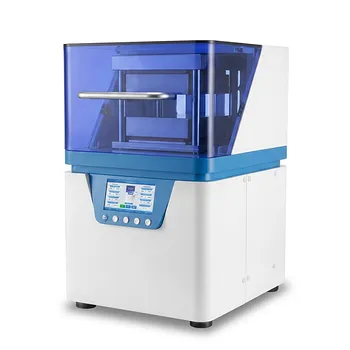
A hydraulic press is the fundamental tool used to transform loose powder samples into solid, homogeneous discs known as pellets or thin films. For both FTIR and XRF spectroscopy, the press applies significant, uniform force to a die chamber, compacting the material to ensure it is geometrically and optically suitable for analysis.
The Core Insight While the mechanical action is simple compression, the goal is distinct for each method: in FTIR, the press utilizes high pressure to make the sample optically transparent to infrared light; in XRF, it ensures the sample has the physical density and integrity to withstand X-ray bombardment.
The Role of the Press in FTIR Analysis
Creating the Potassium Bromide (KBr) Pellet
For Fourier Transform Infrared (FTIR) spectroscopy, the hydraulic press is used to create a "window" through which infrared light can pass.
Because most raw samples are too dense or opaque for direct transmission analysis, they must be diluted. The standard method involves mixing the powder sample with potassium bromide (KBr) powder.
According to standard protocols, this is typically done in a 1:100 ratio (sample to KBr).
Achieving Optical Transparency
Once the mixture is placed in a pellet die chamber, the hydraulic press applies tons of pressure.
This compression transforms the refractive KBr powder mixture into a solid, transparent film.
This step is critical because the KBr becomes transparent to infrared light, allowing the instrument to detect the specific wavelengths absorbed by the trace sample suspended within it.
Improving Signal Quality
The high, stable pressure provided by the press serves to eliminate air pockets between powder particles.
By removing air and compressing the mixture into a dense film, the process significantly reduces light scattering.
This ensures the infrared beam penetrates the sample effectively, resulting in a spectrum with a high signal-to-noise ratio and accurate molecular characterization.
The Role of the Press in XRF Analysis
Ensuring Sample Integrity
In X-ray Fluorescence (XRF) spectroscopy, the hydraulic press is used to produce general sample pellets from powdered materials.
Unlike FTIR, which focuses on transmission, XRF analyzes the radiation emitted by the sample when bombarded with X-rays.
The press compacts the material to ensure the pellet remains intact and cohesive during this energetic process.
Homogeneity for Elemental Precision
The press creates a homogeneous surface, which is vital for determining the elemental composition of the material.
By compressing the sample into a uniform flat disc, the press ensures that the geometry of the sample does not interfere with the X-ray optics.
This allows for consistent measurements of the sample's radiation without the variability caused by loose powder or uneven surfaces.
Understanding the Trade-offs
Precision vs. Pressure
While a hydraulic press is a robust tool, the quality of the pellet is sensitive to the uniformity of force applied.
If the pressure is not applied evenly or if the die is damaged, the resulting pellet may have opacity issues or cracks, leading to inaccurate spectral data.
Sample Dilution Sensitivity (FTIR)
In FTIR preparation, the press cannot correct for improper mixing ratios.
If the 1:100 ratio is ignored and the sample is too concentrated, the pellet will remain opaque or "black out" the detector, regardless of how much pressure is applied.
Environmental Factors
Some advanced setups utilize a heated hydraulic press to improve results.
Heat can help drive out moisture—which KBr readily absorbs—ensuring that water peaks do not obscure the spectral data of the actual sample.
Making the Right Choice for Your Goal
To achieve the best spectroscopic results, you must tailor your pressing technique to the specific requirements of your analytical method.
- If your primary focus is FTIR: Prioritize the 1:100 dilution ratio and sufficient pressure to achieve a glass-like transparency in the KBr pellet for maximum light transmission.
- If your primary focus is XRF: Focus on applying sufficient force to create a durable, flat surface that will not crumble or introduce geometric errors during X-ray exposure.
The hydraulic press is not just a compactor; it is a sample conditioner that standardizes the physical state of your material to match the physics of the detector.
Summary Table:
| Feature | FTIR Sample Preparation | XRF Sample Preparation |
|---|---|---|
| Primary Goal | Optical transparency (IR transmission) | Physical density and surface integrity |
| Typical Medium | Potassium Bromide (KBr) mixture | Pure sample or with binder |
| Standard Ratio | 1:100 (Sample to KBr) | High concentration / Pure powder |
| Key Outcome | Reduced light scattering/Air removal | Homogeneous surface for X-ray optics |
| Press Type | Manual or Automatic (Heated optional) | Manual, Automatic, or Isostatic |
Elevate Your Spectroscopic Accuracy with KINTEK
Precision in analysis begins with precision in preparation. KINTEK specializes in comprehensive laboratory pressing solutions designed for the rigorous demands of battery research and material science.
Whether you need to achieve glass-like transparency for FTIR or high-integrity discs for XRF, our range of manual, automatic, heated, and multifunctional presses provides the uniform force necessary for perfect pellets. We also offer cold and warm isostatic presses for specialized material density requirements.
Ready to optimize your sample preparation? Contact our laboratory experts today to find the ideal press for your application and ensure every scan delivers high-quality, reliable data.
Related Products
- Automatic Hydraulic Hot Press with Large Plate and Precision Temperature Control for Advanced Material Sample Preparation and Industrial Research
- Automatic Hydraulic Heat Press Machine with Multi Stage Programmable Control and Integrated Water Cooling Plate Size 180x180mm
- Automatic High Temperature Heated Hydraulic Press Machine with Heated Plates for Lab
- Automatic Heated Hydraulic Lab Press with Programmable Touch Screen Controls and Precision Temperature Regulation
- Manual Heated Hydraulic Lab Press with Integrated Hot Plates Hydraulic Press Machine
People Also Ask
- What are the specific features and applications of hydraulic hot press machines? Precision Solutions for Modern Labs
- How does an automatic hydraulic press operate? Achieve Precision and Consistency in Lab Pelleting
- What are the advantages and common applications of an automatic hydraulic press? Elevate Your Lab's Precision
- What is the technical significance of setting a precise dwell time? Achieve Peak Material Density and Stability
- When is an automatic hydraulic press more suitable than a manual press? Scale Your Lab with Precision & Speed