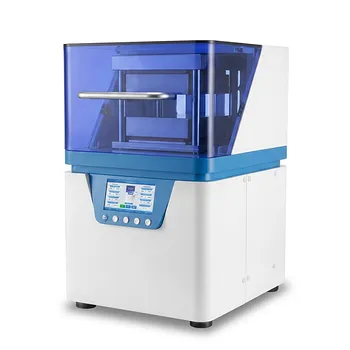
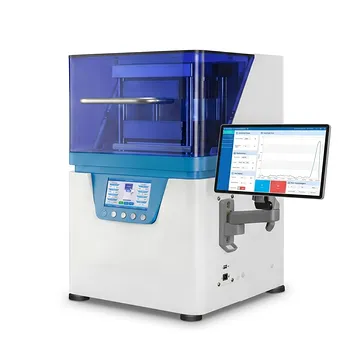
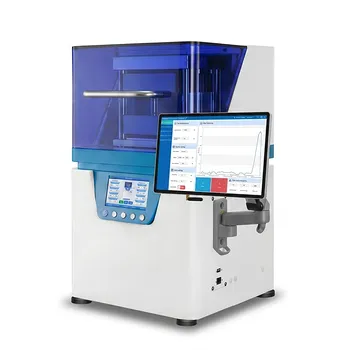
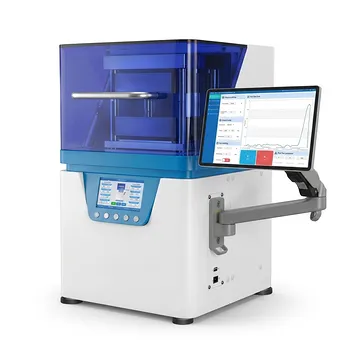
In X-ray crystallography, a hydraulic press serves a critical function: it transforms loose powder samples into a solid, stable form known as a thin pellet. This compression is not merely about storage; it is a fundamental step to ensure the material is sufficiently uniform for an accurate analysis of its molecular structure.
The Core Utility The hydraulic press eliminates physical inconsistencies such as air pockets and irregular grain distribution. By standardizing the sample density, it ensures that the resulting crystallographic data reflects the true material properties rather than artifacts of the preparation process.
The Mechanics of Sample Consolidation
Compressing into a Thin Pellet
The primary action of the hydraulic press in this context is the application of significant force to a powdered sample. The goal is to consolidate loose particles into a single, cohesive disc or thin pellet.
Eliminating Air Pockets
Loose powders naturally contain gaps and air pockets. These voids can scatter X-rays unpredictably, leading to noisy or inaccurate data. The hydraulic press forces these particles together, expelling air to create a solid mass.
Creating a Uniform Surface
For accurate crystallography, the sample surface must be flat and homogeneous. Pressing the sample ensures that the X-ray beam interacts with a consistent surface, which is essential for reproducible results.
Why Density Matters for Analysis
Enhancing Molecular Accuracy
The primary reference highlights that this form of preparation allows for a more accurate analysis of the material’s molecular structure. A dense, well-packed pellet minimizes path length variations as the X-rays traverse or reflect off the sample.
Ensuring Homogeneity
Supplementary data regarding general spectroscopic analysis (such as XRF or FTIR) reinforces the need for homogeneity. While the specific detection method differs, the requirement for a sample that is representative and consistent remains true for X-ray crystallography.
Operational Considerations and Trade-offs
The Necessity of Precise Pressure
While compression is vital, the application of force must be controlled. As noted in advanced applications like seed crystal embedding, precise pressure control is required to ensure tight mechanical contact without destroying the underlying crystal integrity.
Equipment Contamination Risks
Because the sample is pressed under high force against metal dies, there is a risk of surface contamination. It is essential to ensure the press tools are chemically inert or perfectly clean to prevent foreign elements from affecting the molecular reading.
Making the Right Choice for Your Goal
When employing a hydraulic press for X-ray crystallography, your technique should adapt to your specific analytical requirements:
- If your primary focus is structural accuracy: Ensure the pellet is pressed thin enough to prevent signal absorption issues, but solid enough to remain flat.
- If your primary focus is reproducibility: Implement strict protocols for pressure duration and intensity to ensure every sample pellet has an identical density.
The hydraulic press turns a variable powder into a constant standard, providing the physical foundation necessary for precise molecular science.
Summary Table:
| Feature | Benefit for X-ray Crystallography |
|---|---|
| Air Pocket Removal | Eliminates voids that cause X-ray scattering and noise |
| Standardized Density | Ensures consistent path length for more accurate data |
| Uniform Surface | Provides a flat, homogeneous interface for beam interaction |
| Particle Consolidation | Transforms loose powder into stable, manageable thin pellets |
Elevate Your Structural Analysis with KINTEK Precision
Don’t let poor sample preparation compromise your crystallographic data. KINTEK specializes in comprehensive laboratory pressing solutions designed for the most demanding research environments. Whether you require manual precision or the high-throughput efficiency of our automatic and heated models, our equipment delivers the exact pressure control needed for perfect pellets.
From battery research to advanced molecular science, KINTEK offers:
- Manual & Automatic Presses for versatile lab workflows.
- Heated & Multifunctional Models for complex material synthesis.
- Isostatic Presses (CIP/WIP) for uniform multi-directional density.
- Glovebox-Compatible Designs for sensitive or reactive samples.
Ready to achieve superior sample homogeneity? Contact our laboratory experts today to find the ideal pressing solution for your application.
Related Products
- Automatic Hydraulic Hot Press with Large Plate and Precision Temperature Control for Advanced Material Sample Preparation and Industrial Research
- Automatic Hydraulic Heat Press Machine with Multi Stage Programmable Control and Integrated Water Cooling Plate Size 180x180mm
- Automatic High Temperature Heated Hydraulic Press Machine with Heated Plates for Lab
- Automatic Heated Hydraulic Lab Press with Programmable Touch Screen Controls and Precision Temperature Regulation
- Manual Heated Hydraulic Lab Press with Integrated Hot Plates Hydraulic Press Machine
People Also Ask
- What are the specific features and applications of hydraulic hot press machines? Precision Solutions for Modern Labs
- How does an automatic hydraulic press operate? Achieve Precision and Consistency in Lab Pelleting
- What are the advantages and common applications of an automatic hydraulic press? Elevate Your Lab's Precision
- What is the technical significance of setting a precise dwell time? Achieve Peak Material Density and Stability
- When is an automatic hydraulic press more suitable than a manual press? Scale Your Lab with Precision & Speed