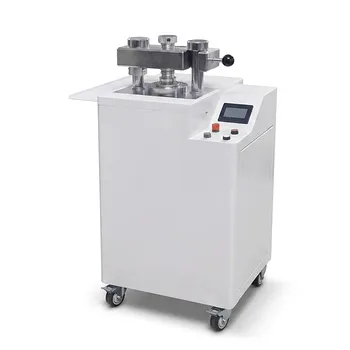
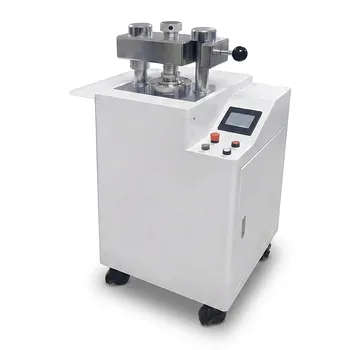
To prepare an XRF sample using a standard pellet die and an aluminum cup, you must first place the crushable aluminum cup inside the die body, fill it with your milled sample, and then assemble the die for compression. Upon applying pressure, the cup crushes to form a rigid backing that supports the sample, resulting in a stable pellet ready for the spectrometer.
Core Takeaway The aluminum cup serves a dual purpose: it acts as a container during the filling process and transforms into a structural backing during compression. This ensures the resulting pellet is robust enough to be handled and placed in the spectrometer without breaking.
The Step-by-Step Preparation Process
Correct Placement of the Cup
The process begins by placing the aluminum support cup directly into the standard XRF pellet die.
It is critical that the cup fits well within the die cavity to ensure uniform compression.
Adding the Material
Once the cup is seated, add the milled sample material directly into the cup.
The sample should be evenly distributed to ensure a flat surface on the final pellet.
Compression and Formation
After adding the sample, assemble the rest of the die components and apply the necessary load via a press.
During this phase, the aluminum cup is crushed by the pressure. This deformation binds the cup to the sample, creating a solid, supportive backing for the pellet.
Understanding the Difference: Cups vs. Rings
Standard Dies and Cups
The method described above utilizes a standard XRF pellet die specifically designed for crushable cups.
This approach creates a free-standing pellet with a metal backing, suitable for most manual loading spectrometers.
Ring Dies for Automation
It is important not to confuse the standard die method with the ring die method.
As noted in industry standards, a ring die is a specialized tool used to press samples into solid metal rings (typically 51.5 mm outer diameter).
This method is generally required for spectrometers with automated loading systems or for long-term sample archiving, as the ring offers superior edge protection compared to a crushed cup.
Important Considerations and Trade-offs
Mechanical Stability
The primary advantage of the aluminum cup method is mechanical stability.
Without a binder or a support cup, many powders would result in fragile pellets that crumble during handling.
Equipment Compatibility
Ensure your die is a standard pellet die, not a ring die, when using aluminum cups.
Attempting to use a crushable cup in a die designed for rigid steel rings can result in improper formation or damage to the sample preparation equipment.
Sample Condition
The success of this method relies on the sample being finely milled.
If the particle size is too large, the sample may not adhere properly to the aluminum backing during the crushing phase.
Making the Right Choice for Your Goal
To ensure the best analytical results, choose the preparation method that aligns with your laboratory's workflow and equipment.
- If your primary focus is standard manual analysis: Use the crushable aluminum cup method in a standard die to create robust, supported pellets quickly.
- If your primary focus is automated throughput or archiving: Use a ring die with steel rings to protect the sample edges and ensure compatibility with robotic loaders.
Correctly matching your die type to your support medium is the single most important factor in producing consistent XRF pellets.
Summary Table:
| Feature | Aluminum Support Cup Method | Steel Ring Method |
|---|---|---|
| Die Type | Standard XRF Pellet Die | Specialized Ring Die |
| Mechanism | Cup crushes to form a rigid backing | Sample is pressed into a solid ring |
| Best For | Manual loading & general stability | Automated systems & archiving |
| Key Benefit | Low-cost mechanical support | Superior edge protection |
| Sample State | Finely milled powder | Finely milled powder |
Elevate Your Sample Preparation with KINTEK
Ready to achieve superior precision in your XRF analysis? KINTEK specializes in comprehensive laboratory pressing solutions tailored for high-stakes research. Whether you need manual, automatic, heated, or glovebox-compatible models, our equipment is designed for maximum consistency. We also offer advanced cold and warm isostatic presses, widely applied in cutting-edge battery research.
Don't let fragile samples compromise your data. Contact KINTEK today to find the perfect pellet die or press for your lab's unique workflow and ensure every pellet is perfectly formed!
Related Products
- XRF KBR Steel Ring Lab Powder Pellet Pressing Mold for FTIR
- Lab XRF Boric Acid Powder Pellet Pressing Mold for Laboratory Use
- XRF KBR Plastic Ring Lab Powder Pellet Pressing Mold for FTIR
- Automatic XRF Pellet Press for Laboratory Spectrometry Sample Preparation
- Automatic Fluorescence Sample Preparation Press 40 Ton Lab Pellet Press for XRF Analysis
People Also Ask
- What considerations are important regarding the die size of an XRF pellet press? Optimize for Your XRF Spectrometer and Sample
- Why are pellets used in XRF analysis, and what is their limitation? Boost Accuracy and Speed in Your Lab
- What is the general process for preparing a sample pellet for XRF? Master Consistency for Accurate Analysis
- What are the differences between manual and automatic XRF pellet presses? Choose the Right Press for Your Lab's Needs
- What are the different types of XRF pellet preparation methods available? Manual, Hydraulic, and Automated Presses Explained