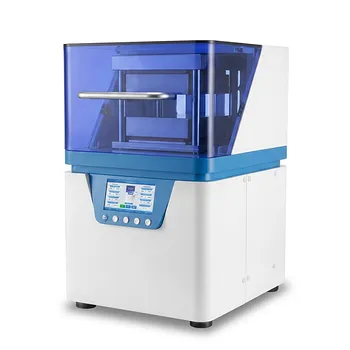
To calculate the stress applied to a pellet, divide the total force reading from the hydraulic press by the cross-sectional area of the die set's plunger. This calculation converts the raw mechanical load into a pressure value that describes what the sample material actually experiences.
While the press exerts a specific force (often measured in tons or Newtons), the sample responds to stress (pressure). Converting force to stress creates a standardized value that allows for accurate comparison regardless of the specific equipment or die diameter used.
The Fundamental Calculation
The Relationship Between Force and Area
The calculation is governed by the formula Stress = Force / Area. The "Force" is the value read directly from the press's gauge, representing the total load applied.
Identifying the Correct Area
The "Area" in this equation refers specifically to the cross-sectional area of the die set's plunger (or the sample surface area). This is the surface over which the machine's force is distributed.
The Role of Sample Size
As noted in experimental practice, the compaction pressure is a key parameter. It is determined by the area over which the press applies its load. Consequently, you can control the pressure not only by adjusting the machine's force but also by changing the size of the sample (the die diameter).
Why Stress is the Standard Metric
Independence from Equipment
Reporting raw force (e.g., "5 tons") is scientifically ambiguous because it depends on the tooling size. Stress is a standardized quantity. It describes the intensity of the compaction independent of the die's diameter.
Scientific comparability
Because stress is independent of the specific tool geometry, it is the standard metric used in scientific literature. Using stress values ensures your data can be compared directly with other studies, even if those researchers used different die sizes.
Understanding the Trade-offs
The Force-Area Trade-off
There is an inverse relationship between the die area and the resulting stress. If your hydraulic press has a limited maximum force, you can achieve higher compaction pressures by reducing the diameter of your die.
Calculation Precision
A common pitfall is ignoring the units during calculation. Ensure your force (e.g., Newtons or kg-force) and area (e.g., square millimeters or inches) are converted to compatible units to yield a correct stress value (typically Pascals or MPa).
Making the Right Choice for Your Goal
To ensure your pellet preparation is consistent and scientifically valid, apply the calculation based on your specific objectives:
- If your primary focus is replicating literature: Calculate the required force by multiplying the target stress found in the literature by your specific plunger area.
- If your primary focus is maximizing compaction: Use the smallest feasible die diameter, as this maximizes the stress applied to the pellet for a given force.
By normalizing force into stress, you ensure your results are a property of the material, not just a byproduct of the machine.
Summary Table:
| Parameter | Definition | Metric Unit (SI) | Imperial Unit |
|---|---|---|---|
| Force | The total load read from the press gauge | Newtons (N) | Tons-force (tonf) |
| Area | Cross-sectional area of the die plunger (πr²) | Square meters (m²) | Square inches (in²) |
| Stress | Force divided by Area (Intensity) | Pascals (Pa) / MPa | Pounds per sq inch (psi) |
| Die Diameter | Variable that dictates the resulting stress | Millimeters (mm) | Inches (in) |
Elevate Your Material Research with KINTEK Precision
Achieving consistent pellet quality starts with the right equipment and precise calculations. KINTEK specializes in comprehensive laboratory pressing solutions, offering a versatile range of manual, automatic, heated, and multifunctional models, as well as glovebox-compatible and isostatic presses (cold and warm) tailored for advanced battery research.
Don't let equipment limitations hinder your scientific accuracy. Whether you need to maximize compaction stress with smaller die sets or require automated precision for high-volume testing, our experts are here to help.
Contact KINTEK today to find the perfect pressing solution for your lab!
Related Products
- Automatic Hydraulic Hot Press with Large Plate and Precision Temperature Control for Advanced Material Sample Preparation and Industrial Research
- Automatic Hydraulic Heat Press Machine with Multi Stage Programmable Control and Integrated Water Cooling Plate Size 180x180mm
- Automatic High Temperature Heated Hydraulic Press Machine with Heated Plates for Lab
- Automatic Heated Hydraulic Lab Press with Programmable Touch Screen Controls and Precision Temperature Regulation
- Manual Heated Hydraulic Lab Press with Integrated Hot Plates Hydraulic Press Machine
People Also Ask
- What are the specific features and applications of hydraulic hot press machines? Precision Solutions for Modern Labs
- How does an automatic hydraulic press operate? Achieve Precision and Consistency in Lab Pelleting
- What are the advantages and common applications of an automatic hydraulic press? Elevate Your Lab's Precision
- What is the technical significance of setting a precise dwell time? Achieve Peak Material Density and Stability
- When is an automatic hydraulic press more suitable than a manual press? Scale Your Lab with Precision & Speed