
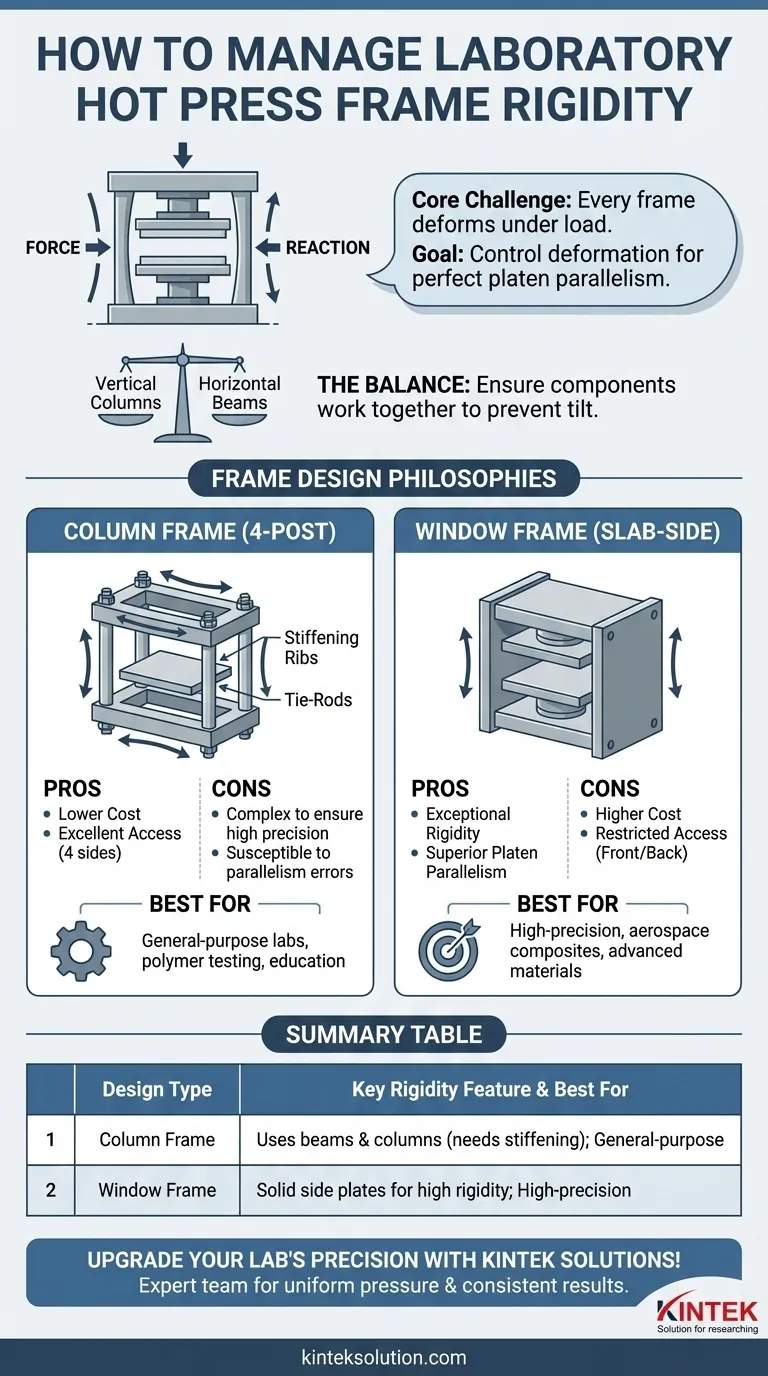
To properly manage the rigidity of a laboratory hot press frame, you must ensure its design prevents deformation that compromises the parallelism of the heated platens. This is achieved not simply by maximizing stiffness, but by carefully balancing the rigidity of the vertical columns and horizontal beams to ensure they work together under immense compressive force.
The core challenge is that under load, every frame deforms. The goal is to control this deformation so that pressure remains perfectly uniform across your entire sample, which is the sole purpose of a high-quality press.
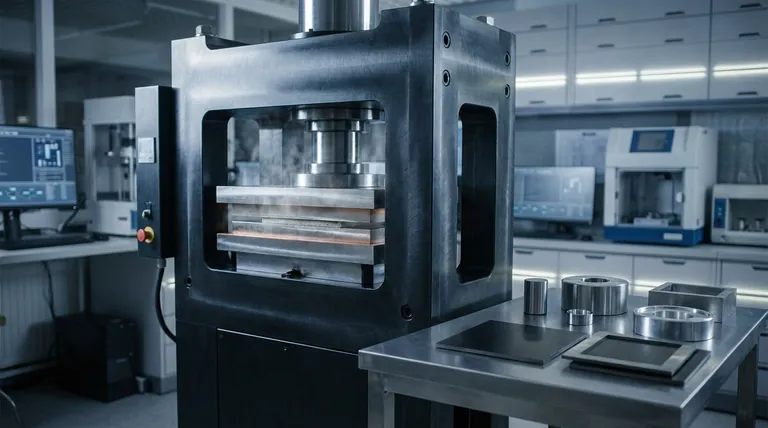
Why Frame Rigidity is the Cornerstone of Quality
A hot press combines temperature and force. While temperature is straightforward to control, applying force uniformly is a significant mechanical engineering challenge that hinges entirely on the frame's design.
The Goal: Perfect Platen Parallelism
The primary function of the press frame is to hold the two heated platens perfectly parallel to each other, even when applying tons of force. Any deviation from parallel results in uneven pressure on the sample.
The Problem: Deformation Under Load
Newton's third law dictates that for every action, there is an equal and opposite reaction. The force pushing the platens together is equally trying to stretch the frame apart, causing beams to bend and columns to flex.
Consequences of Poor Rigidity
When the frame deforms incorrectly, platens can tilt. This leads to parts of the sample receiving more pressure than others, resulting in inconsistent material density, flawed laminations, or unreliable experimental data.
Key Design Philosophies for Managing Rigidity
There are two primary approaches to designing a press frame, each with its own method for managing the immense forces involved.
The Column Frame (4-Post Design)
This is a common design using four vertical columns to connect the upper and lower crossheads or beams. It offers good access to the work area.
The key challenge, as noted in engineering analysis, arises when the horizontal beams are less rigid than the vertical columns. As the beams bend under load, they pull the tops and bottoms of the columns inward, causing the platens to tilt and lose parallelism.
To counteract this, designers must implement measures to restrict column bending. This can include adding stiffening ribs to the beams or using pre-stressed tie-rods to ensure the entire structure acts as a unified, rigid box.
The Window Frame (Slab-Side Design)
This design uses two solid plates of steel (the "windows" or "slabs") for the sides of the press. The crossheads and cylinder are mounted within these plates.
Window frames are inherently more rigid than most column frame designs. The solid side plates provide immense resistance to the bending and stretching forces, offering superior platen parallelism under extreme loads.
Understanding the Trade-offs
Choosing a frame design is a classic engineering trade-off between performance, accessibility, and cost. There is no single "best" answer, only the best fit for a specific application.
Column Frame: Versatility vs. Complexity
Pros: Generally lower manufacturing cost and excellent access to the pressing area from all four sides.
Cons: Achieving high precision requires a more complex design to manage the interaction between beam and column deflection. It is more susceptible to parallelism errors if not engineered correctly.
Window Frame: Precision vs. Cost
Pros: Delivers exceptional rigidity and platen parallelism, making it the default choice for high-precision, high-force applications.
Cons: Significantly higher material and manufacturing costs. Access to the pressing area is typically restricted to the front and back.
Making the Right Choice for Your Application
Your decision should be guided by the level of precision your work demands.
- If your primary focus is maximum precision and uniformity (e.g., aerospace composites, optical component molding, advanced materials research): A window frame (slab-side) press is the superior choice.
- If your primary focus is general-purpose applications (e.g., polymer testing, standard laminating, educational labs): A well-designed column frame offers a cost-effective and highly functional solution.
- If you are troubleshooting an existing column press: Investigate platen parallelism under load. Uneven results are often traced back to uncontrolled beam or column deformation.
Ultimately, managing frame rigidity is about making a conscious design choice to guarantee the force you apply is the force your sample actually receives, uniformly and repeatably.
Summary Table:
| Design Type | Key Rigidity Features | Best For Applications |
|---|---|---|
| Column Frame (4-Post) | Uses vertical columns and horizontal beams; requires stiffening to prevent bending | General-purpose labs, polymer testing, education |
| Window Frame (Slab-Side) | Solid side plates for high rigidity and superior parallelism | High-precision tasks, aerospace composites, advanced materials research |
Upgrade your lab's precision with KINTEK's reliable hot press solutions! We specialize in automatic lab presses, isostatic presses, and heated lab presses designed to deliver uniform pressure and consistent results for your materials testing needs. Our expert team can help you choose the right press to enhance efficiency and accuracy in your laboratory. Contact us today to discuss your requirements and get a tailored solution!
Visual Guide
Related Products
- 24T 30T 60T Heated Hydraulic Lab Press Machine with Hot Plates for Laboratory
- Laboratory Split Manual Heated Hydraulic Press Machine with Hot Plates
- Heated Hydraulic Press Machine with Heated Plates for Vacuum Box Laboratory Hot Press
- Automatic Heated Hydraulic Press Machine with Hot Plates for Laboratory
- Laboratory Manual Heated Hydraulic Press Machine with Hot Plates
People Also Ask
- Function of a Laboratory Hydraulic Press with Heated Platens in SSE? Enhance Battery Density & Conductivity
- Why is a laboratory hydraulic press with heating plates required for PLA/TEC films? Achieve Precise Sample Integrity
- What role does a laboratory heated hydraulic press play in LTCC? Essential for High-Density Ceramic Lamination
- What is the primary function of a laboratory heated hydraulic press? Mastering Thermoplastic Carbon Fiber Composites
- What is the critical role of a laboratory heated hydraulic press? Mastering PVC Sample Prep for Testing



















