
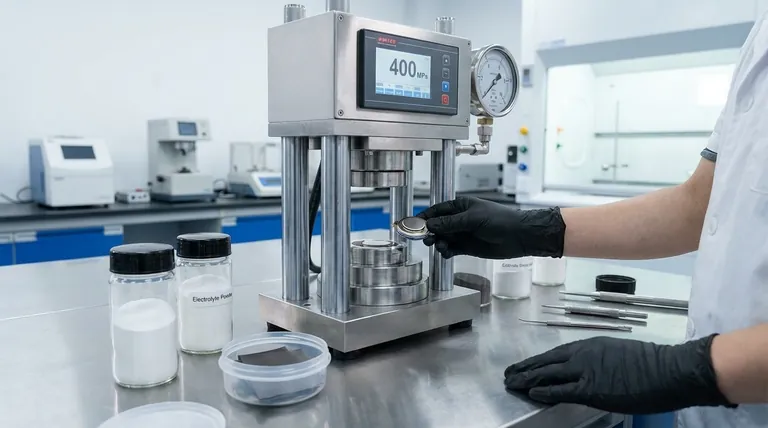
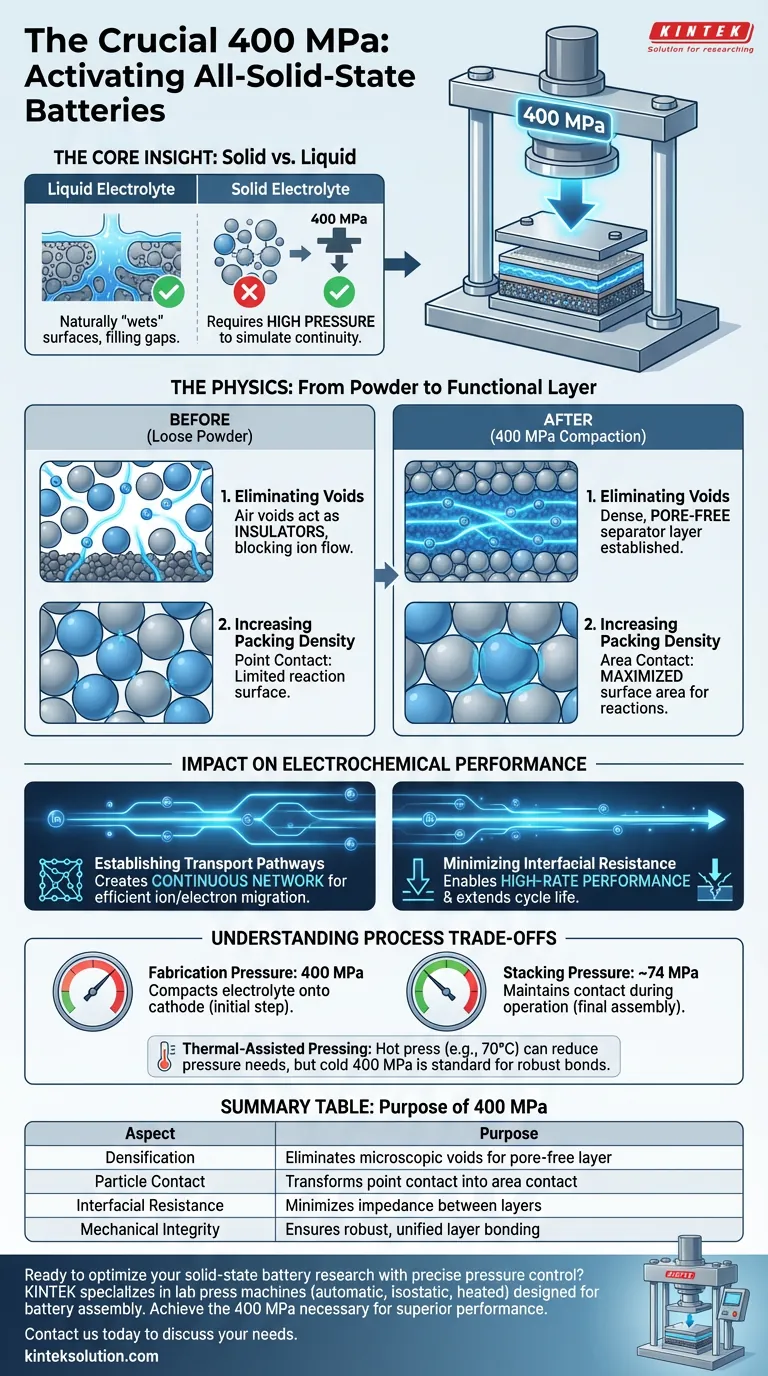
The application of 400 MPa using a lab press is a critical densification step required to transform loose solid-state electrolyte powder into a functional, pore-free separator layer. This extreme pressure eliminates microscopic voids at the cathode/electrolyte interface that would otherwise block lithium-ion transport, ensuring the mechanical integrity and low interfacial resistance necessary for the battery to function.
The Core Insight: Liquid electrolytes naturally "wet" surfaces, filling every gap. Solid electrolytes do not. You must use high pressure to mechanically force solid particles together, simulating the continuity of a liquid to create a viable pathway for ions to travel.
The Physics of Solid-Solid Interfaces
Eliminating Voids
In a liquid battery, the electrolyte flows into porous areas. In an all-solid-state battery, air voids act as insulators, completely blocking the flow of ions.
Applying 400 MPa compacts the electrolyte powder (such as LPSCl) to create a dense, pore-free separator layer. This densification is the only way to remove air pockets that would otherwise sever the ionic connection between the cathode and the anode.
Increasing Packing Density
The cathode mixture contains active materials, electrolytes, and conductive agents. High pressure significantly increases the packing density of these components.
This ensures intimate physical contact between the particles. Without this compaction, the particles would merely touch at single points (point contact), limiting performance. High pressure deforms the particles to create area contact, maximizing the surface area available for chemical reactions.
Impact on Electrochemical Performance
Establishing Transport Pathways
For a battery to function, lithium ions and electrons must move freely through the cell.
The 400 MPa compaction process creates continuous transport pathways throughout the electrode. By fusing the particles closer together, you establish a seamless network that allows ions to migrate efficiently from the electrolyte into the cathode material.
Minimizing Interfacial Resistance
The greatest challenge in solid-state batteries is interfacial impedance—the resistance ions face when crossing from one material to another.
Microscopic gaps caused by surface roughness or loose packing drastically increase this resistance. High-pressure assembly minimizes this impedance, directly enabling high-rate performance (charging/discharging speed) and extending the battery's cycle life.
Understanding the Process Trade-offs
Compaction vs. Stacking Pressure
It is vital to distinguish between fabrication pressure and operating pressure.
References indicate that while 400 MPa is necessary to compact the electrolyte powder onto the cathode initially, a lower pressure (e.g., 74 MPa) is often used for the final stacking of the full cell (anode, electrolyte, cathode). This lower "stacking pressure" maintains contact during operation without subjecting the entire sensitive assembly to the extreme forces used during the initial powder compaction.
Thermal-Assisted Pressing
Pressure requirements can change if heat is introduced.
Some processes utilize a hot press (e.g., 70°C at 20 MPa) to soften polymer binders and facilitate particle flow. While this reduces the pressure required to achieve density, the 400 MPa cold-press method remains the standard for creating robust mechanical bonds in inorganic solid electrolyte layers where binder flow is not the primary mechanism.
Making the Right Choice for Your Goal
Achieving the correct pressure is about balancing mechanical integrity with electrochemical needs.
- If your primary focus is Maximum Conductivity: Prioritize high-pressure compaction (400 MPa) to completely eliminate voids, as this is the primary driver for lowering internal resistance.
- If your primary focus is Structural Integrity: Ensure you transition from high compaction pressure to a moderate, sustained stacking pressure (approx. 74 MPa) to maintain layer contact without over-stressing the final cell assembly.
Ultimately, the application of 400 MPa is not just about squeezing materials; it is the fundamental mechanism that activates the solid-state interface, turning a mixture of powders into a unified electrochemical system.
Summary Table:
| Aspect | Purpose of 400 MPa Pressure |
|---|---|
| Densification | Eliminates microscopic voids to create a pore-free electrolyte layer |
| Particle Contact | Transforms point contact into area contact for better ion transport |
| Interfacial Resistance | Minimizes impedance between cathode and electrolyte layers |
| Mechanical Integrity | Ensures robust, unified layer bonding for structural stability |
Ready to optimize your solid-state battery research with precise pressure control? KINTEK specializes in lab press machines, including automatic, isostatic, and heated lab presses, designed to meet the exacting demands of battery assembly. Our equipment ensures you achieve the 400 MPa compaction necessary for superior ionic conductivity and long-lasting battery performance. Contact us today to discuss how our solutions can enhance your laboratory's capabilities and accelerate your development process.
Visual Guide
References
- Seungwoo Lee, Ungyu Paik. Stabilized Conductive Agent/Sulfide Solid Electrolyte Interface via a Halide Solid Electrolyte Coating for All‐Solid‐State Batteries. DOI: 10.1002/cey2.70051
This article is also based on technical information from Kintek Solution Knowledge Base .
Related Products
- Warm Isostatic Press for Solid State Battery Research Warm Isostatic Press
- Button Battery Sealing Press Machine for Lab
- Laboratory Hydraulic Press Lab Pellet Press Button Battery Press
- Automatic Laboratory Hydraulic Press for XRF and KBR Pellet Pressing
- Lab Infrared Press Mold for Laboratory Applications
People Also Ask
- Why must composite cathodes be sealed in vacuum lamination bags for WIP? Ensure Battery Stability and Density
- How do sacrificial volume materials (SVM) maintain microchannels in isostatic pressing? Ensure Structural Integrity
- What is the function of elastic molds in warm isostatic pressing? Achieve Uniform Density in Composite Particles
- How does Warm Isostatic Pressing differ from traditional pressing methods? Unlock Uniform Density for Complex Parts
- What are the advantages of using a Warm Isostatic Press (WIP) for batteries? Achieve Superior Interface Contact



















