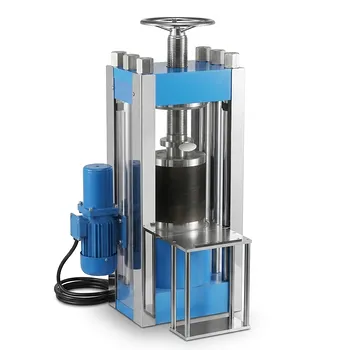
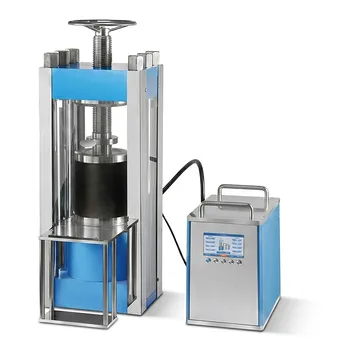
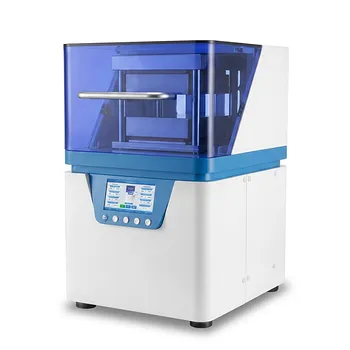
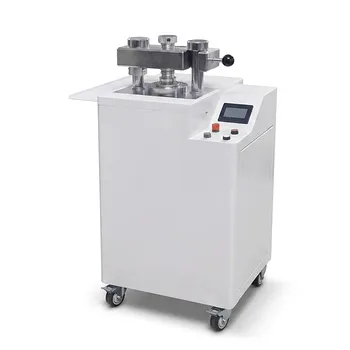
A Split manual press is primarily utilized in high-precision research fields involving new materials, superconductors, and powder ceramics. regarding environments, it is most frequently deployed in laboratories, research institutions, and small-scale manufacturing facilities where rigorous process control is more critical than high-volume throughput.
Core Takeaway The Split manual press is defined by its balance of precision and accessibility, serving as a critical tool for R&D rather than mass manufacturing. It allows researchers to produce experimental samples with exact specifications without requiring the floor space or capital investment of industrial automated machinery.
Key Industries and Applications
The Split manual press is engineered for sectors where material composition and density must be strictly controlled.
Advanced Material Science
Research into new materials and superconductors relies heavily on this equipment. Scientists use the press to create experimental samples where consistency is paramount for testing conductivity and durability.
Ceramics and Energy
In the field of powder ceramics, the press is used to compact powders into precise shapes before sintering. It is also vital in the development of new power sources, aiding in the fabrication of battery components or fuel cell materials.
Construction Material Testing
Developers of building materials utilize these presses to test small batches of composites. This allows for rigorous quality assurance and formula adjustments before moving to full-scale production.
Ideal Operational Environments
The physical design of the Split manual press dictates where it is most effective.
Research Laboratories
Due to its compact size, the press is ideal for academic and commercial labs with limited workspace. It delivers high-precision results without dominating valuable bench space.
Small-Scale Manufacturing
For facilities producing limited runs, this machine offers a cost-effective alternative to large automation. It allows for the creation of specific parts or samples without high operational overhead.
R&D Departments
The machine is optimized for environments focused on research and development. Its intuitive manual controls mean researchers can operate it without extensive specialized training, allowing for rapid iteration of prototypes.
Why It Suits These Environments
The "Split" feature and manual nature of the device solve specific workflow problems found in the environments listed above.
Simplified Maintenance
A defining feature is the separable mold cavity. This allows for easy disassembly, making cleaning and maintenance significantly faster than traditional presses.
Versatility in Sample Creation
Operators can easily change parameters to produce materials of various sizes, shapes, and compositions. This flexibility is essential in laboratory settings where requirements change from project to project.
Understanding the Trade-offs
While highly effective for research, the Split manual press is not a universal solution.
Volume Limitations
This device is designed for sample creation and small batches, not mass production. If your goal is high-throughput manufacturing, manual operation will become a bottleneck.
Physical Constraints
The compact design, while a benefit for space saving, limits the physical size of the samples you can produce. It is not suitable for pressing large industrial components.
Making the Right Choice for Your Goal
To determine if a Split manual press belongs in your facility, evaluate your primary objectives against its capabilities.
- If your primary focus is Precision R&D: This is an ideal choice for creating consistent experimental samples of superconductors or ceramics.
- If your primary focus is Budget and Space: The machine provides a high-value solution that fits easily into cramped laboratories without a massive capital outlay.
- If your primary focus is High-Volume Output: You should look for automated industrial presses, as the manual operation of this unit is too slow for mass manufacturing.
The Split manual press is the definitive tool for converting raw concepts into tangible, precise samples within a controlled laboratory environment.
Summary Table:
| Feature | Ideal Applications | Key Environments |
|---|---|---|
| Research Focus | Superconductors, New Materials | Academic & Commercial Labs |
| Material Type | Powder Ceramics, Composites | R&D Departments |
| Production Scale | Prototype Samples, Small Batches | Small-scale Manufacturing |
| Key Benefits | High Precision, Easy Maintenance | Space-constrained Facilities |
Elevate Your Research with Precision Pressing Solutions
Are you looking to achieve exact specifications in your material science or battery research? KINTEK specializes in comprehensive laboratory pressing solutions tailored for high-precision R&D. Whether you need the portability of a manual split press, the consistency of automatic and heated models, or the specialized capabilities of isostatic and glovebox-compatible presses, we provide the tools necessary to drive innovation.
Why choose KINTEK?
- Versatility: Solutions for superconductors, ceramics, and new energy materials.
- Precision: Engineered for rigorous process control and consistent sample density.
- Support: Expert guidance to help you select the right equipment for your lab's footprint.
Contact KINTEK Today to Find Your Perfect Press
Related Products
- Split Automatic Heated Hydraulic Press Machine with Heated Plates
- Split Warm Isostatic Lab Press 200 Ton Powder Compaction Chamber for Battery Research and Material Science
- Split Hot Isostatic Pressing Machine 150 Ton Laboratory Heated Isostatic Press
- Electric Split Lab Cold Isostatic Pressing CIP Machine
- Laboratory Hydraulic Split Electric Lab Pellet Press
People Also Ask
- What are the requirements for electrode pressing with high-viscosity ionic liquids like EMIM TFSI? Optimize Performance
- How does a laboratory heated hydraulic press facilitate PBN sample prep for WAXS? Achieve Precise X-Ray Scattering
- What are the industrial applications of heated hydraulic presses? Master Heat & Force for Precision Manufacturing
- Why is a laboratory hydraulic press with heating plates required for PLA/TEC films? Achieve Precise Sample Integrity
- Function of a Laboratory Hydraulic Press with Heated Platens in SSE? Enhance Battery Density & Conductivity