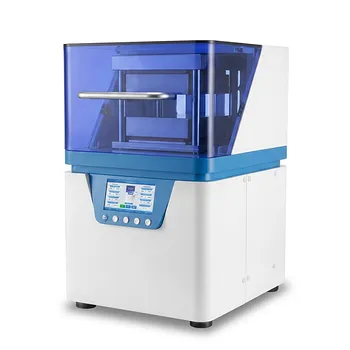
Hydraulic presses in the laboratory serve a distinct purpose from their industrial counterparts: they are engineered for precision tasks requiring immense, controlled compressive force, specifically within material science and spectroscopy. They are most commonly utilized for creating sample pellets, laminating complex layers, and punching electrodes for battery research.
Core Insight: While industrial presses focus on mass production and shaping, laboratory presses prioritize consistency and uniformity. Their primary value lies in preparing homogenous samples for analytical equipment (like XRF and FTIR) and subjecting new materials to rigorous stress tests during Research & Development (R&D).
Sample Preparation for Analysis
The most frequent application of a laboratory hydraulic press is converting loose powders into solid, stable forms for chemical analysis.
X-Ray Fluorescence (XRF)
XRF spectroscopy requires samples to be extremely flat and uniform to produce accurate results. Hydraulic presses compress powder mixtures into dense pellets, ensuring the smooth surface necessary for precise elemental analysis.
FTIR Spectroscopy
Similar to XRF, Fourier Transform Infrared (FTIR) spectroscopy relies on the transparency and uniformity of the sample. A hydraulic press is used to bond the sample material with a matrix (often Potassium Bromide) to create a transparent disc suitable for infrared transmission.
Ensuring Homogeneity
The quality of your data is often limited by the quality of your sample preparation. By applying consistent high pressure, these presses eliminate air pockets and density gradients that could otherwise skew analytical readings.
Material Science and R&D Applications
Beyond preparing samples for other machines, the hydraulic press is a fundamental tool for synthesizing and manipulating materials in the lab. This is particularly relevant in material science labs focusing on new compounds and energy storage.
Electrode Fabrication
As highlighted in primary research contexts, hydraulic presses are essential for punching electrodes. This is a critical step in battery research, where precise, uniform electrode discs must be cut and compressed to ensure consistent electrochemical performance.
Lamination
Researchers use these presses to fuse multiple layers of materials together. This is often required when developing composite materials, creating multi-layered sensors, or fabricating photovoltaic cells where interfacial contact is crucial.
Powder Compaction
General powder compacting is used to study how materials behave when consolidated. This allows researchers to create solid prototypes from experimental powder formulations before moving to larger-scale manufacturing trials.
Material Testing and Quality Control
In quality control and R&D departments, the press acts as a testing instrument rather than just a preparation tool.
Durability and Strength Testing
Hydraulic presses are used to apply destructive or non-destructive force to a material. This helps researchers measure the compressive strength of concrete, ceramics, or metals to verify they meet durability standards.
Property Evaluation Under Pressure
Some experiments require investigating how a substance's properties change under extreme stress. Laboratory presses allow scientists to maintain controlled high pressure to observe phase changes or structural deformations.
Understanding the Trade-offs
When selecting or using a hydraulic press in a lab, it is vital to understand the limitations and operational differences compared to other systems.
Hydraulic vs. Pneumatic Systems
Hydraulic systems are necessary when high force is required. While pneumatic systems usually top out around 100 psi, hydraulic systems efficiently transmit power to achieve pressures in the range of 10,000 psi or higher.
Speed vs. Precision
Laboratory presses are generally slower than industrial manufacturing presses. They are designed to hold pressure for set durations to ensure atomic-level bonding or settling, rather than for rapid-cycle output.
Making the Right Choice for Your Goal
To maximize the utility of a hydraulic press, align the equipment's capabilities with your specific research outcomes.
- If your primary focus is Spectroscopy (XRF/FTIR): Prioritize a press compatible with precision pellet press die sets to ensure perfectly flat, uniform discs.
- If your primary focus is Battery Research: Ensure the press is adaptable for punching electrodes and lamination tasks to support cell fabrication.
- If your primary focus is Material Testing: Look for a press with granular pressure controls to accurately measure compressive strength without overshooting limits.
Success in the laboratory relies on the integrity of your sample; a hydraulic press provides the foundational consistency required for reliable data.
Summary Table:
| Application Category | Primary Laboratory Task | Key Analytical/Research Benefit |
|---|---|---|
| Spectroscopy | XRF & FTIR Pellet Pressing | Ensures sample homogeneity and surface flatness for accurate readings. |
| Battery Research | Electrode Punching & Lamination | Facilitates consistent electrochemical performance in energy storage cells. |
| Material Science | Powder Compaction & Synthesis | Allows for the creation of solid prototypes and multi-layered composites. |
| Quality Control | Compressive Strength Testing | Verifies material durability and evaluates structural changes under stress. |
Elevate Your Research with KINTEK’s Precision Pressing Solutions
Don’t let inconsistent sample preparation compromise your data integrity. KINTEK specializes in comprehensive laboratory pressing solutions, providing the high-force precision required for the most demanding R&D environments. Whether you are conducting advanced battery research, performing delicate FTIR/XRF spectroscopy, or synthesizing new materials, our versatile range includes:
- Manual & Automatic Models: For varied force requirements and throughput.
- Heated & Multifunctional Presses: To support complex material synthesis.
- Glovebox-Compatible & Isostatic Presses (CIP/WIP): Ideal for sensitive energy storage applications.
Contact KINTEK today to find the perfect press for your lab and ensure your samples meet the highest standards of uniformity and consistency.
Related Products
- Automatic Hydraulic Hot Press with Large Plate and Precision Temperature Control for Advanced Material Sample Preparation and Industrial Research
- Automatic Hydraulic Heat Press Machine with Multi Stage Programmable Control and Integrated Water Cooling Plate Size 180x180mm
- Automatic High Temperature Heated Hydraulic Press Machine with Heated Plates for Lab
- Automatic Heated Hydraulic Lab Press with Programmable Touch Screen Controls and Precision Temperature Regulation
- Manual Heated Hydraulic Lab Press with Integrated Hot Plates Hydraulic Press Machine
People Also Ask
- What are the specific features and applications of hydraulic hot press machines? Precision Solutions for Modern Labs
- How does an automatic hydraulic press operate? Achieve Precision and Consistency in Lab Pelleting
- What are the advantages and common applications of an automatic hydraulic press? Elevate Your Lab's Precision
- What is the technical significance of setting a precise dwell time? Achieve Peak Material Density and Stability
- When is an automatic hydraulic press more suitable than a manual press? Scale Your Lab with Precision & Speed