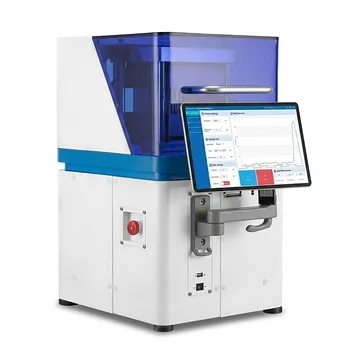
Laboratory presses serve as critical infrastructure across a diverse spectrum of sectors. While they are foundational to material science, their primary application spans the Rubber, Plastic, Food and Beverage, Pharmaceutical, and Metalworking industries. Beyond these core sectors, their utility extends into high-precision fields such as aerospace, electronics (computers), and environmental analysis.
The unifying value of a laboratory press across these industries is its ability to bridge the gap between theoretical R&D and full-scale production, facilitating precise material testing, prototyping, and lean manufacturing.
Core Industries and Applications
Material Synthesis and Molding
The most frequent application of laboratory presses occurs in industries dealing with malleable materials.
Rubber and Plastics In these sectors, presses are essential for compression molding and material characterization. They allow engineers to test polymer properties before committing to mass production molds.
Metalworking Metalworking facilities utilize these presses for small-scale forming, powder compaction, and testing the tensile strength of alloys.
Wood and Laminating Research facilities focus on bonding strength and lamination processes. The press ensures uniform pressure to test the durability of engineered wood products.
Regulated and Consumer Safety Sectors
Industries with strict compliance standards rely on laboratory presses for consistency and sample preparation.
Pharmaceuticals This is a major sector for laboratory presses. They are used extensively to press pellets for spectroscopy (material analysis) and to prototype tablet formulations.
Food and Beverage Here, presses are often used to extract fluids from samples for testing or to compress ingredients to analyze texture and density.
Medical Fields Distinct from pharmaceuticals, the medical device industry uses presses for molding precise plastic or rubber components used in life-saving equipment.
Advanced Technology Sectors
High-tech industries require presses for their ability to deliver exact pressure and temperature control.
Aerospace and Computers In these fields, presses are often used for laminating circuit boards or creating composite materials that must withstand extreme conditions.
Operational Context: Why They Are Used
Understanding the industry is only half the picture; understanding the operational goal is the other.
Research and Development (R&D)
Regardless of the specific industry, the press is the standard tool for R&D. It allows scientists to create prototypes without disrupting the main production line.
Lean Manufacturing and Short Runs
Laboratory presses are not limited to the lab; they are vital for cell manufacturing and limited production runs. They allow facilities to produce small batches of a product economically, avoiding the overhead of industrial-sized machinery.
Understanding the Trade-offs
Volume vs. Precision
While versatile, laboratory presses are not designed for high-volume mass production. Their strength lies in precision and control, not speed or throughput.
Specificity of Application
A press optimized for crushing aggregate in a mining lab may not offer the thermal control required for curing aerospace composites. Selecting a press requires balancing tonnage (force) with the need for heated platens or programmable cycles.
Making the Right Choice for Your Goal
Whether you are in a university lab or a manufacturing plant, the industry dictates the configuration, not just the machine choice.
- If your primary focus is Material Formulation (Rubber/Plastic): Prioritize a press with heated platens and programmable cooling cycles to simulate molding processes.
- If your primary focus is Analysis (Pharma/Environmental): Look for high-tonnage manual or automated presses designed specifically for pelletizing samples for XRF or FTIR analysis.
- If your primary focus is Lean Production (Small Batch): Ensure the press has a large enough platen area to handle multiple molds simultaneously to maximize efficiency.
The right laboratory press transforms a raw material concept into a testable, viable reality.
Summary Table:
| Industry Sector | Primary Applications | Key Benefits |
|---|---|---|
| Rubber & Plastics | Compression molding, material characterization | Testing polymer properties before mass production |
| Pharmaceuticals | Pelletizing for spectroscopy, tablet prototyping | High precision for regulated compliance and analysis |
| Metalworking | Powder compaction, alloy tensile testing | Accurate small-scale forming and material synthesis |
| Food & Beverage | Texture analysis, fluid extraction | Precise sample preparation for quality control |
| Advanced Tech | Circuit board lamination, composite curing | Exact pressure and temperature control for R&D |
Elevate Your Research with KINTEK Pressing Solutions
At KINTEK, we understand that precision is the foundation of innovation. Whether you are developing the next generation of solid-state batteries or preparing pharmaceutical samples, our comprehensive laboratory pressing solutions are engineered to meet your exact specifications.
Why choose KINTEK?
- Versatile Range: From manual and automatic models to heated and multifunctional systems.
- Advanced Technology: Specialized cold and warm isostatic presses for high-density material research.
- Expert Support: Specialized solutions for glovebox-compatible workflows and battery research.
Ready to transform your material concepts into testable realities? Contact KINTEK today to find the perfect press for your lab's unique requirements.
Related Products
- Laboratory Hydraulic Press Lab Pellet Press Button Battery Press
- Laboratory Hydraulic Press Lab Pellet Press Machine for Glove Box
- Laboratory Split Manual Heated Hydraulic Press Machine with Hot Plates
- Laboratory Hydraulic Pellet Press for XRF KBR FTIR Lab Press
- Laboratory Hydraulic Split Electric Lab Pellet Press
People Also Ask
- How is a laboratory hydraulic press used for HAP composite gels? Master Mineral Substrate Standardization
- What role does a laboratory hydraulic press play in reaction pellets? Optimizing Lunar Soil and Metal Fuel Density
- What role does a laboratory hydraulic press play in the preparation of piezoelectric ceramic discs for DC-PG? | KINTEK
- Why is a laboratory hydraulic press required for PBAT and PLA sample preparation? Achieve Flawless Characterization
- What role does a laboratory hydraulic press play in the assembly of all-solid-state battery test cells? Expert Guide