
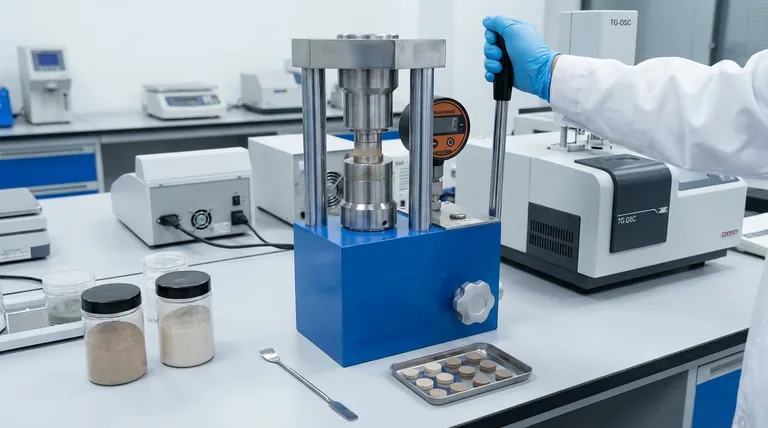
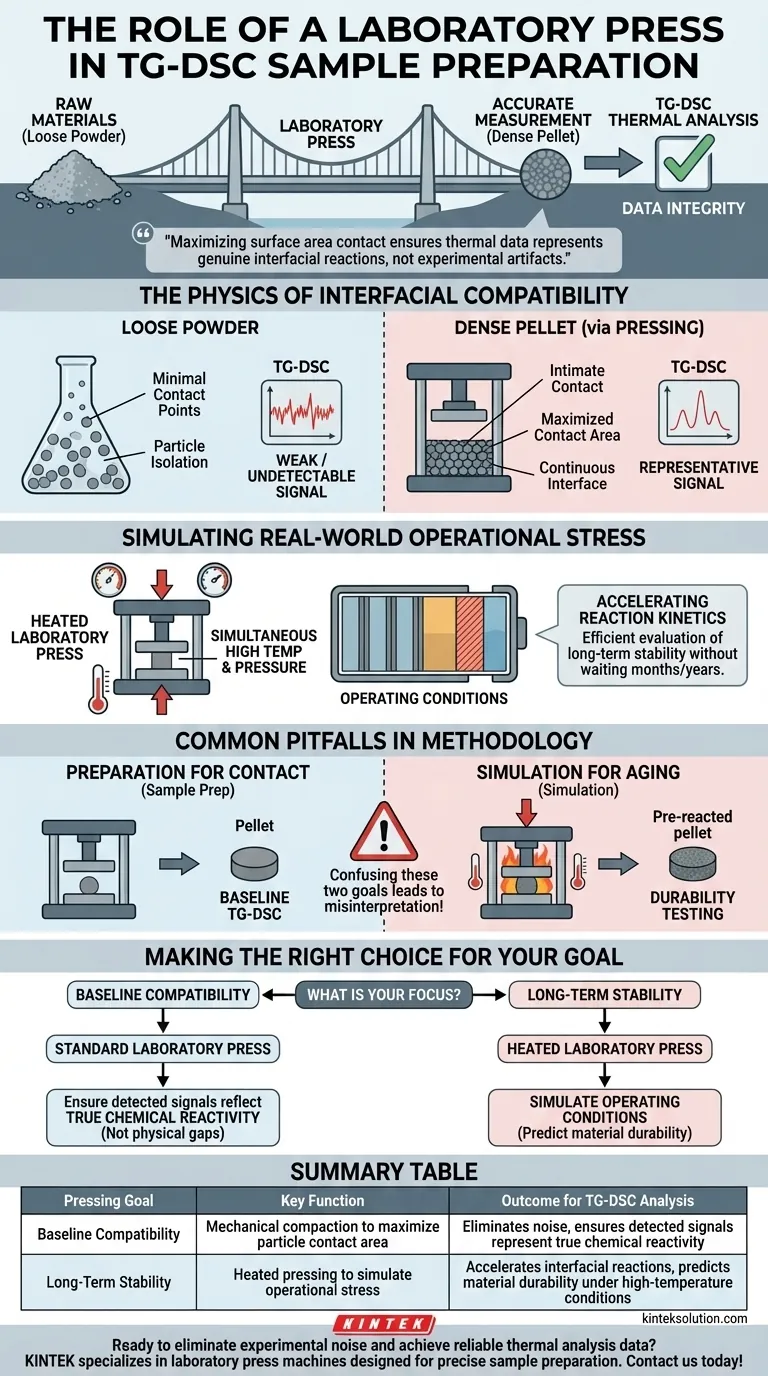
The laboratory press is the foundational tool for ensuring data integrity in thermal analysis. It functions as the critical bridge between raw materials and accurate measurement by compacting loose powder mixtures into dense pellets. This mechanical consolidation guarantees intimate contact between solid-state electrolytes and electrode materials, without which TG-DSC results are often rendered useless by experimental noise.
By maximizing surface area contact through high-pressure compaction, a laboratory press ensures that thermal data represents genuine interfacial reactions rather than experimental artifacts caused by poor particle connectivity.
The Physics of Interfacial Compatibility
To evaluate how materials interact, they must physically touch. A laboratory press solves the inherent limitations of loose powders.
Overcoming Particle Isolation
In a loose powder mixture, the contact points between the solid-state electrolyte and electrode particles are minimal.
The laboratory press applies mechanical force to compact this mixture.
This creates a dense pellet, forcing particles into a state of intimate contact that simple mixing cannot achieve.
Maximizing Contact Area
The primary goal of using a press is to maximize the specific contact area between different material phases.
When the contact area is maximized, the chemical interaction potential is optimized.
This ensures that the interface between the materials is continuous rather than interrupted by air gaps.
Eliminating False Negatives
Thermal analysis techniques like TG-DSC rely on detecting heat flow peaks or mass changes.
If particles are not in close contact, these thermal events may be weak or undetectable, leading to false assumptions about stability.
Compacting the sample ensures that detected signals are truly representative of interfacial reactions, effectively filtering out artifacts caused by poor physical connectivity.
Simulating Real-World Operational Stress
Beyond basic sample preparation, advanced pressing techniques allow researchers to mimic the actual environment inside a device, such as a solid-state battery.
The Role of Heated Pressing
A heated laboratory press offers a distinct advantage by applying high temperature and pressure simultaneously.
This capability creates a precisely controlled environment during the preparation phase.
It allows researchers to move beyond static analysis and simulate the dynamic operating conditions of the materials.
Accelerating Reaction Kinetics
Co-pressing powders at specific temperatures can accelerate potential chemical reactions at the interface.
This process allows for the efficient evaluation of long-term stability without waiting months or years for natural degradation.
It exposes how material combinations will behave under the thermal and mechanical stresses of high-temperature operation.
Common Pitfalls in Methodology
While pressing is essential, understanding the intent behind the pressure is critical for accurate data interpretation.
Distinguishing Preparation from Simulation
It is vital to distinguish between pressing for contact (sample prep) and pressing for aging (simulation).
Standard mechanical pressing prepares the sample for a baseline TG-DSC run to check compatibility.
Using a heated press changes the state of the sample, effectively "pre-reacting" or aging the interface to test durability. Confusing these two goals can lead to misinterpretation of the material's initial stability.
Making the Right Choice for Your Goal
To obtain the most valuable data from your thermal analysis, tailor your pressing strategy to your specific research objective.
- If your primary focus is baseline compatibility: Use a standard laboratory press to create a dense pellet, ensuring that any peaks in your TG-DSC data reflect true chemical reactivity, not physical gaps.
- If your primary focus is long-term stability: Utilize a heated laboratory press to simulate operating conditions, accelerating interfacial reactions to predict how the materials will endure high-temperature stress over time.
Reliable thermal analysis begins not in the analyzer, but in the precision of the sample preparation.
Summary Table:
| Pressing Goal | Key Function | Outcome for TG-DSC Analysis |
|---|---|---|
| Baseline Compatibility | Mechanical compaction to maximize particle contact area | Eliminates noise, ensures detected signals represent true chemical reactivity |
| Long-Term Stability | Heated pressing to simulate operational stress | Accelerates interfacial reactions, predicts material durability under high-temperature conditions |
Ready to eliminate experimental noise and achieve reliable thermal analysis data?
KINTEK specializes in laboratory press machines—including automatic lab presses, isostatic presses, and heated lab presses—designed to meet the precise sample preparation needs of materials research laboratories. Our equipment ensures your TG-DSC results reflect genuine interfacial reactions, not artifacts.
Contact us today to discuss how our presses can enhance your research accuracy and efficiency!
Visual Guide
Related Products
- Laboratory Hydraulic Press Lab Pellet Press Button Battery Press
- Laboratory Hydraulic Press 2T Lab Pellet Press for KBR FTIR
- Laboratory Hydraulic Press Lab Pellet Press Machine for Glove Box
- Laboratory Split Manual Heated Hydraulic Press Machine with Hot Plates
- Laboratory Hydraulic Pellet Press for XRF KBR FTIR Lab Press
People Also Ask
- How is a laboratory hydraulic press used for HAP composite gels? Master Mineral Substrate Standardization
- What role does a laboratory hydraulic press play in the preparation of piezoelectric ceramic discs for DC-PG? | KINTEK
- What role does a laboratory hydraulic press play in reaction pellets? Optimizing Lunar Soil and Metal Fuel Density
- Why is a laboratory hydraulic press required for PBAT and PLA sample preparation? Achieve Flawless Characterization
- What role does a laboratory hydraulic press play in the assembly of all-solid-state battery test cells? Expert Guide



















