
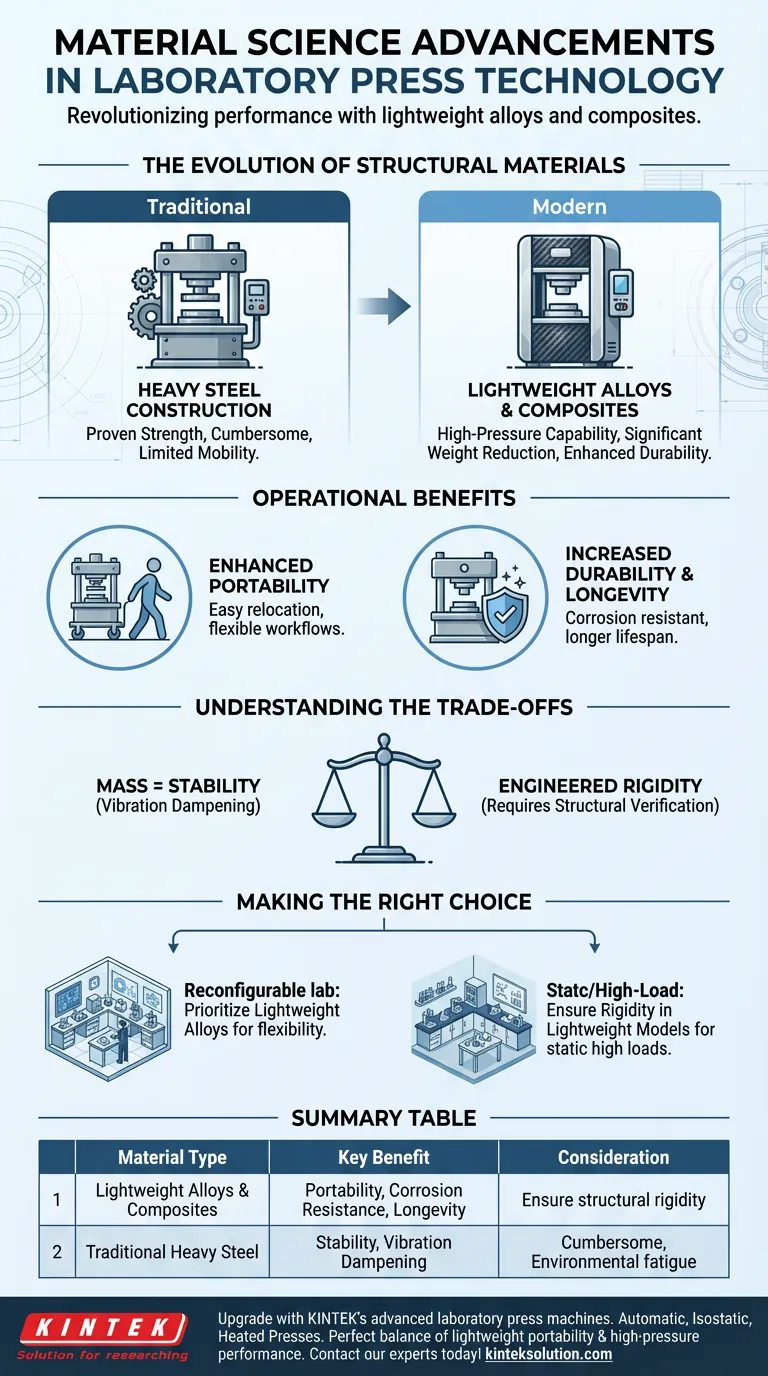
Material science is revolutionizing laboratory press technology by moving beyond traditional construction methods to incorporate advanced lightweight alloys and composites. This shift allows manufacturers to produce equipment that retains high-pressure capabilities while significantly reducing overall weight and improving long-term durability.
The integration of modern composites and alloys addresses the historical limitation of laboratory presses—excessive weight—creating units that are portable and durable without sacrificing performance.
The Evolution of Structural Materials
Moving Beyond Heavy Steel
For decades, the industry standard for laboratory presses relied on heavy steel construction. While steel provides undeniable strength, the resulting equipment is often cumbersome and difficult to maneuver. This reliance on mass for stability has historically limited how and where researchers can deploy these essential tools.
The Introduction of Alloys and Composites
Newer designs are actively exploring lightweight alloys and composites as viable alternatives to solid steel. These advanced materials are engineered to withstand significant compressive forces while shedding unnecessary mass. By utilizing these materials, manufacturers can decouple the machine's weight from its force generation capabilities.
Operational Benefits in the Laboratory
Enhanced Portability
The most immediate impact of using advanced materials is improved portability. A press constructed from lightweight alloys can be relocated within a facility with much greater ease than its steel counterparts. This flexibility allows laboratory managers to reconfigure workflows without requiring heavy lifting equipment or specialized movers.
Increased Durability and Longevity
Beyond weight reduction, these innovative materials contribute to the overall longevity of the equipment. Advanced composites are often resistant to corrosion and environmental fatigue that can affect traditional metals over time. This results in a press that maintains its structural integrity and performance metrics over a longer operational lifespan.
Understanding the Trade-offs
Mass vs. Stability
While reducing weight is generally advantageous, traditional heavy steel presses utilize their sheer mass to dampen vibrations during high-pressure operations. When moving to lightweight alloys, the engineering must ensure that structural rigidity is not compromised. Users must verify that the lighter footprint does not introduce instability during peak load applications.
Adoption of New Standards
Transitioning to composites and alloys represents a departure from long-standing industry norms. Laboratories accustomed to the "over-engineered" feel of massive steel units may need to adjust their expectations regarding the physical look and feel of the machinery. Trusting the strength-to-weight ratio of modern materials requires a shift in perspective from traditional mechanical assumptions.
Making the Right Choice for Your Lab
Selecting the right press requires evaluating your specific workflow requirements against the physical constraints of your facility.
- If your primary focus is flexibility and mobility: Prioritize presses built with lightweight alloys, as they allow for easy reconfiguration of lab space.
- If your primary focus is static, high-load applications: Ensure that any lightweight model you choose has verified structural rigidity to match traditional heavy steel performance.
By embracing these material advancements, laboratories can secure equipment that delivers robust performance while adapting to the dynamic needs of modern research environments.
Summary Table:
| Material Type | Key Benefit | Consideration |
|---|---|---|
| Lightweight Alloys & Composites | Enhanced portability, corrosion resistance, longer lifespan | Ensure structural rigidity for high-load applications |
| Traditional Heavy Steel | Proven stability and vibration dampening | Cumbersome, difficult to move, prone to environmental fatigue |
Upgrade your lab's capabilities with KINTEK's advanced laboratory press machines.
Our automatic lab presses, isostatic presses, and heated lab presses are engineered with the latest material science innovations to provide the perfect balance of lightweight portability and high-pressure performance. Whether you need flexibility for dynamic workflows or robust stability for demanding applications, KINTEK delivers durable, efficient solutions tailored to your laboratory's needs.
Ready to enhance your research efficiency? Contact our experts today to find the ideal press for your specific requirements!
Visual Guide
Related Products
- Laboratory Hydraulic Press Lab Pellet Press Button Battery Press
- Laboratory Hydraulic Press 2T Lab Pellet Press for KBR FTIR
- Laboratory Hydraulic Press Lab Pellet Press Machine for Glove Box
- Laboratory Split Manual Heated Hydraulic Press Machine with Hot Plates
- Laboratory Hydraulic Pellet Press for XRF KBR FTIR Lab Press
People Also Ask
- How is a laboratory hydraulic press used for HAP composite gels? Master Mineral Substrate Standardization
- What role does a laboratory hydraulic press play in the preparation of piezoelectric ceramic discs for DC-PG? | KINTEK
- What role does a laboratory hydraulic press play in reaction pellets? Optimizing Lunar Soil and Metal Fuel Density
- Why is a laboratory hydraulic press required for PBAT and PLA sample preparation? Achieve Flawless Characterization
- What role does a laboratory hydraulic press play in the assembly of all-solid-state battery test cells? Expert Guide



















