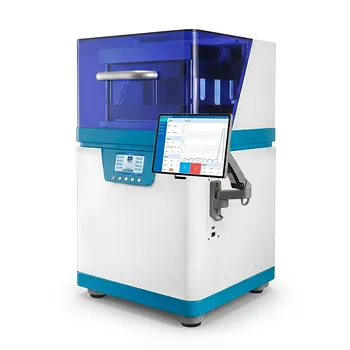
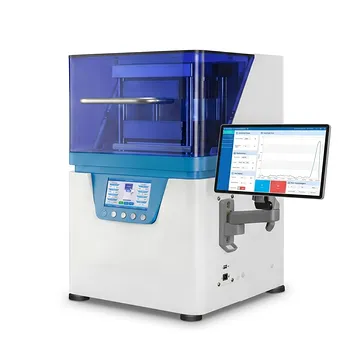
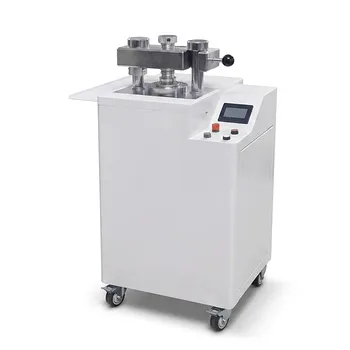
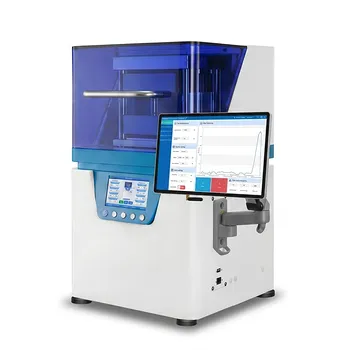
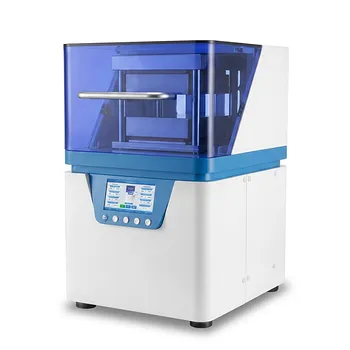
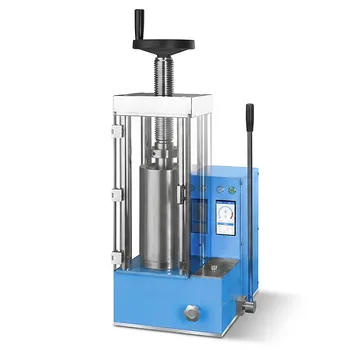
Precision laboratory presses are versatile tools used for highly specialized tasks requiring sub-micron accuracy and strict environmental control. Specifically, they are essential for producing microchip lead frames, fabricating carbon-fiber aerospace components, and engineering cellular scaffolds for tissue transplantation.
Modern laboratory presses have evolved beyond simple force application into sophisticated instruments capable of sub-micron precision. They are critical for R&D applications where heat, pressure, and exact positioning must converge to manipulate materials at a microscopic level.
High-Precision Industrial and Research Applications
Microelectronics Manufacturing
Precision is paramount in the electronics sector, particularly for the mounting of microchips.
Tailored precision presses are used to produce lead frames—the metal structures inside a chip package that carry signals from the die to the outside world. This process requires sub-micron accuracy to ensure perfect connectivity and structural integrity.
Advanced Aerospace Materials
In the aerospace industry, strength-to-weight ratios are critical.
Laboratories employ heated presses to fabricate advanced components from carbon-fiber-reinforced plastics. The combination of heat and precise pressure allows researchers to cure these materials effectively, ensuring optimal bonding and structural performance.
Biomedical and Tissue Engineering
One of the most innovative applications for precision presses is found in the field of regenerative medicine.
Researchers utilize these presses to create cellular scaffolds. These scaffolds serve as the structural foundation for growing new tissues intended for transplantation, requiring exact porosity and density to support cell growth.
Analytical and Routine Laboratory Tasks
Spectroscopy Sample Preparation
While high-end research uses sub-micron precision, analytical labs rely on presses for consistency.
A primary application is preparing samples for spectroscopy, such as pressing pellets from a KBr matrix for infrared (IR) analysis. Similarly, presses are used to briquette inorganic samples for X-ray fluorescence (XRF) spectroscopy, where sample uniformity is vital for accurate readings.
Pharmaceutical Development
In pharmaceutical labs, presses are used to create compressed pellets from powdered materials.
This is essential for both pill making and R&D testing. It allows scientists to study how materials behave under compression and to prepare samples for bomb calorimetry.
Understanding the Operational Trade-offs
Precision vs. Force Capability
There is often an inverse relationship between extreme precision and maximum force.
Presses designed for sub-micron accuracy (like those for microchips) may offer lower total tonnage compared to rugged industrial compactors. You must balance the need for positional accuracy against the raw power required to compress dense metals or ceramics.
Thermal Management Complexity
Adding heated platens for applications like aerospace composites introduces variables in thermal dynamics.
Precise temperature uniformity across the platen surface is difficult to maintain but critical for consistent results. Furthermore, heated cycles increase process time due to the heating and cooling periods required before and after the press cycle.
Selecting the Right Press for Your Research
To maximize the utility of a laboratory press, you must align the machine's capabilities with your specific material goals.
- If your primary focus is Microelectronics: Prioritize presses with sub-micron positional accuracy and vibration control to handle delicate lead frames.
- If your primary focus is Advanced Composites: Ensure the unit features heated platens with precise temperature control for curing carbon-fiber materials.
- If your primary focus is Spectroscopy: Look for durability and repeatability to consistently produce uniform KBr pellets or XRF briquettes.
True precision in the laboratory is not just about how much pressure you apply, but exactly how and where you apply it.
Summary Table:
| Application Field | Specific Use Case | Key Press Feature Required |
|---|---|---|
| Microelectronics | Lead frame manufacturing | Sub-micron positional accuracy |
| Aerospace | Carbon-fiber-reinforced plastics | Heated platens with precise thermal control |
| Biomedical | Engineering cellular scaffolds | Exact porosity and density control |
| Analytical Chemistry | KBr pellets and XRF briquettes | High repeatability and uniformity |
| Pharmaceuticals | Tablet development & calorimetry | Controlled compression of powders |
Elevate Your Research with KINTEK Precision Solutions
At KINTEK, we understand that true precision is defined by more than just raw power. Whether you are developing next-generation battery technologies, aerospace composites, or life-saving biomedical scaffolds, our laboratory pressing solutions are engineered to meet your exact specifications.
Why choose KINTEK?
- Comprehensive Range: From manual and automatic models to heated, multifunctional, and glovebox-compatible presses.
- Specialized Technology: Offering advanced cold and warm isostatic presses optimized for battery research.
- Sub-Micron Control: Achieve the accuracy required for high-tech microelectronics and material science.
Ready to enhance your lab's efficiency and accuracy? Contact our experts today to find the perfect press for your application.
Related Products
- Automatic Hydraulic Hot Press with Large Plate and Precision Temperature Control for Advanced Material Sample Preparation and Industrial Research
- Lab Polygon Press Mold
- Automatic Heated Hydraulic Lab Press with Programmable Touch Screen Controls and Precision Temperature Regulation
- Laboratory Hydraulic Pellet Press for XRF KBR FTIR Lab Press
- Laboratory Hydraulic Press Lab Pellet Press Machine for Glove Box
People Also Ask
- What are the specific features and applications of hydraulic hot press machines? Precision Solutions for Modern Labs
- How does an automatic hydraulic press operate? Achieve Precision and Consistency in Lab Pelleting
- What are the advantages and common applications of an automatic hydraulic press? Elevate Your Lab's Precision
- What is the technical significance of setting a precise dwell time? Achieve Peak Material Density and Stability
- When is an automatic hydraulic press more suitable than a manual press? Scale Your Lab with Precision & Speed