
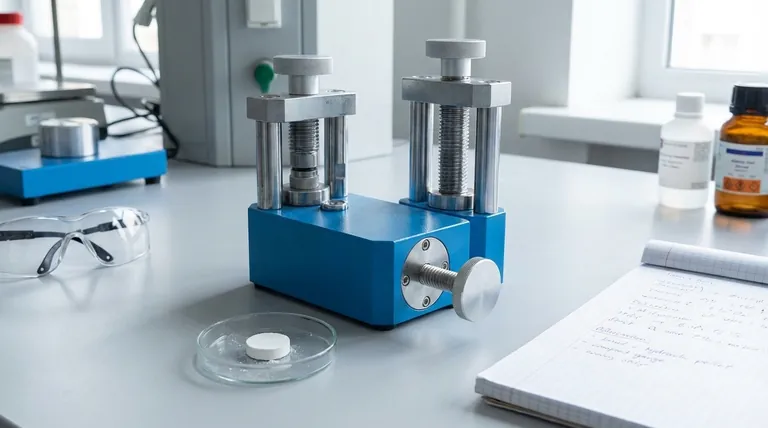
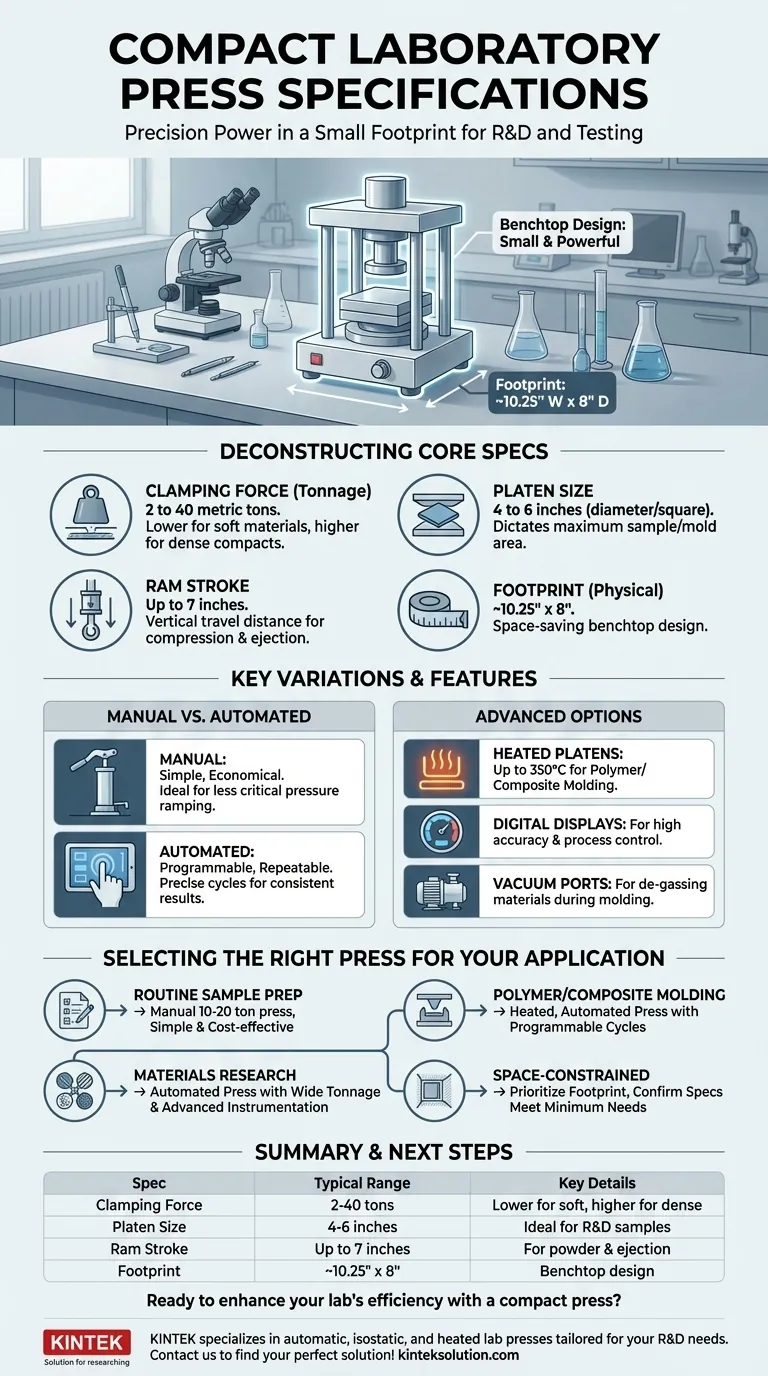
At their core, compact laboratory presses are defined by a small footprint, typically around 10 inches wide by 8 inches deep, designed for benchtop use. They feature platen sizes ranging from 4 to 6 inches, a ram stroke पुलिसकर्मी 7 inches, and can generate clamping forces anywhere from 2 to 40 metric tons, making them powerful tools for space-constrained environments.
A compact laboratory press is not just a smaller version of an industrial press; it is a precision instrument designed to deliver high, controllable force in a minimal footprint. Understanding its specifications is key to matching the right tool to your specific research or testing application.
Deconstructing the Core Specifications
To select the right press, you must first understand what its primary specifications mean in a practical context. These numbers define the physical and operational limits of the machine.
Clamping Force (Tonnage)
The clamping force, measured in metric tons, is the most critical specification. Most compact models offer a range between 2 and 40 tons.
A lower tonnage (2-15 tons) is often sufficient for applications like KBr pellet pressing for FTIR analysis, crushing soft materials, or simple compression molding of някои polymers.
Higher tonnage (20-40 tons) is necessary for forming dense ceramic or metal powder compacts, high-pressure molding of composites, or running flow tests on viscous materials.
Platen Size and Ram Stroke
The platen size, typically 4 to 6 inches in diameter or square, dictates the maximum surface area of your sample or mold. This size is ideal for R&D样品, not large-scale production.
The ram stroke, often up to 7 inches, defines the maximum vertical travel distance. A longer stroke is useful for compressing "fluffy" powders or for applications requiring significant part ejection altura.
Footprint and Physical Design
A key feature of a compact press is its small footprint, often around 10.25 inches wide by 8 inches deep.
This "benchtop" design prinsip is what allows these powerful machines to be used in crowded labs, fume hoods, or glove boxes where floor space is at a premium.
Key Features and Model Variations
Beyond the core numbers,不同的模型 offer features that tailor them to specific tasks. The choice between these variations depends entirely on your need for control and repeatability.
Manual vs. Automated Operation
Manual presses are operated with a hydraulic hand pump. They are simple,经济, and excellent for tasks where precise pressure ramping or dwelling is not critical.
Automated presses use an electric-powered hydraulic system. They allow for programmable pressure cycles, digital displays, and precise control, ensuring高 repeatability between tests.
Heated Platens (Hot Presses)
Many applications, particularly in polymer and composite science, require heat. Hot presses integrate heating elements into the platens.
A common specification for these models is a maximum temperature of 350°C and a pressure of up to 40 tons, often with slightly larger platens around 200x200mm (approx. 8x8 inches).
Advanced Instrumentation
For advanced research, some presses offer additional features. These can include digital pressure displays for accuracy, ports for applying a vacuum during a cycle, or even tilting platens. These features are critical for process control and de-gassing materials during molding.
Understanding the Trade-offs
A compact press is a specialized tool, and its benefits come with inherent limitations. Acknowledging these trade-offs is crucial for making a wise investment.
The Compromise of "Compact"
The most obvious trade-off is sample size. A 6-inch platen limits you to small-scale experiments, sample preparation, and short, pilot production runs. These are not machines for manufacturing large components.
Manual Control vs. Repeatability
A manual press价格便宜 and intuitive, but it is difficult for an operator to perfectly replicate a pressure cycle every time. If your process is sensitive to the rate of pressure application, an automated press is necessary for consistent results.
Application-Specific Design
A press强大 enough for forming ceramics at 40 tons may lack the fine control needed for gently extracting fluid from plant tissue at 0.5 tons. Ensure the press's gauge and hydraulic system are sensitive enough for the low end of your pressure range if your work requires it.
Selecting the Right Press for Your Application
Your choice should be driven by your primary use case. Match the machine's capabilities to your scientific or उत्पादन目标.
- If your primary focus is routine sample preparation for analysis: A simple, manual 10-20 ton press with a clear pressure gauge is likely sufficient and cost-effective.
- If your primary focus is polymer or composite molding: A heated press with automated, programmable temperature and pressure cycles is essential for process control and repeatability.
- If your primary focus is materials research with diverse needs: An automated press with a wide tonnage range (e.g., up to 40 tons) and advanced instrumentation provides the most flexibility.
- If your primary focus is working in a very constrained space: Prioritize the footprint and confirm that your chosen model still meets your minimum tonnage and platen size requirements.
By aligning the specifications with your core task, you can select a compact press that serves as a powerful and precise tool for your work.
Summary Table:
| Specification | Typical Range | Key Details |
|---|---|---|
| Clamping Force | 2 to 40 tons | Lower for soft materials, higher for dense compacts |
| Platen Size | 4 to 6 inches | Dictates sample/mold area, ideal for R&D |
| Ram Stroke | Up to 7 inches | Allows for powder compression and part ejection |
| Footprint | ~10.25" x 8" | Benchtop design for space-constrained labs |
| Max Temperature (Hot Presses) | Up to 350°C | For polymer and composite applications |
| Operation Types | Manual or Automated | Manual for simplicity, automated for precision |
Ready to enhance your laboratory's efficiency with a compact press? KINTEK specializes in lab press machines, including automatic lab presses, isostatic presses, and heated lab presses, tailored for your R&D and testing needs. Our equipment delivers precise force control, space-saving designs, and reliable performance to boost your productivity. Contact us today to find the perfect solution for your application!
Visual Guide
Related Products
- Laboratory Hydraulic Press Lab Pellet Press Machine for Glove Box
- Lab Round Bidirectional Press Mold
- 24T 30T 60T Heated Hydraulic Lab Press Machine with Hot Plates for Laboratory
- Laboratory Hydraulic Press 2T Lab Pellet Press for KBR FTIR
- Laboratory Hydraulic Press Lab Pellet Press Button Battery Press
People Also Ask
- How does a laboratory hydraulic press contribute to the preparation of Li3-3xScxSb samples? Optimize Ionic Conductivity
- What is the function of a laboratory hydraulic press in FT-IR of curcumin-coated MWCNTs? Achieve Optical Clarity.
- Why is a laboratory hydraulic press required for compression molding boron-siloxane? Solve High-Loading Density Challenges
- What role does a laboratory hydraulic press play in the preparation of piezoelectric ceramic discs for DC-PG? | KINTEK
- What role does a laboratory hydraulic press play in reaction pellets? Optimizing Lunar Soil and Metal Fuel Density



















