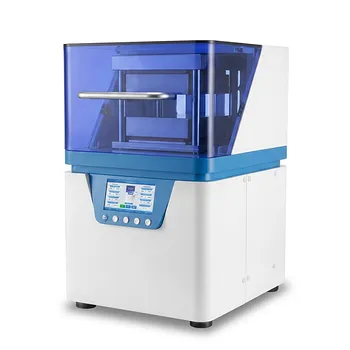
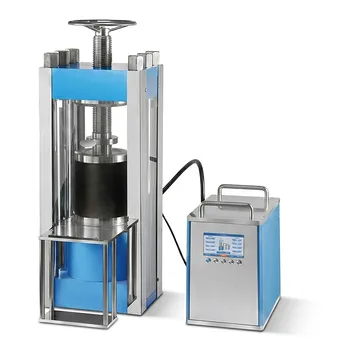
Hot pressing provides a faster, more precise, and chemically cleaner alternative to solution casting for fabricating thick ionomer membranes. This method utilizes a laboratory heating press to fuse multiple layers of commercial films or powders into a single, dense structure under specific temperature and tonnage-level pressure. By shifting from a solvent-based process to a thermal-mechanical one, researchers can achieve superior thickness control while avoiding the common structural defects associated with traditional casting.
Hot pressing bypasses the chemical and structural inconsistencies inherent in solution casting by using synchronized heat and pressure to fuse materials. This results in membranes with higher density, better mechanical strength, and exact dimensional control in a fraction of the time required for solvent evaporation.
Overcoming the Limitations of Solution Casting
Eliminating Solvent Management Issues
In solution casting, preparing thick membranes often requires large volumes of solvent and lengthy, difficult evaporation periods. Hot pressing is a solvent-free process, which removes the risk of residual solvent pockets that can compromise the chemical purity and structural stability of the ionomer.
Achieving Precise Thickness Control
Solution casting frequently results in uneven thickness due to "coffee-ring" effects or meniscus formation during drying. Hot pressing offers superior dimensional precision, as the thickness is determined by the specific gap of the press or the volume of the starting material, ensuring high-quality, repeatable results.
Reducing Labor Intensity
Fabricating thick membranes via casting usually involves repetitive operations and layering to reach the desired thickness. Hot pressing streamlines production by allowing multiple layers of commercial films to be stacked and fused in a single, rapid cycle.
Structural and Mechanical Enhancements
Superior Densification and Microstructure
The application of uniaxial pressure at elevated temperatures facilitates particle rearrangement and plastic flow. This synergistic action allows the material to achieve full densification at lower temperatures, effectively suppressing abnormal grain growth and resulting in a fine-grained microstructure.
Enhanced Interfacial Wetting and Surface Quality
Hot pressing produces electrolyte films with highly smooth surfaces and high flexibility. These characteristics significantly improve the interfacial wetting between the membrane and other components, such as zinc metal anodes or electrodes, which is critical for electrochemical performance.
Molecular-Level Uniformity
The synchronized application of heat and pressure facilitates the softening and flow of polymer chains. In composite membranes, this ensures the uniform embedding of fillers or salts within the polymer matrix, preventing the detachment of particles during use.
Understanding the Trade-offs
Thermal Sensitivity of Ionomers
While hot pressing is efficient, it requires strict temperature management to prevent thermal degradation of the polymer chains. Exceeding the material's stable temperature range can lead to de-sulfonation or chain scission, which permanently damages the ion-conducting properties.
Material Restrictions
Hot pressing is primarily effective for thermoplastic materials that can soften and flow under heat. If a polymer is heavily cross-linked or has a decomposition temperature lower than its flow temperature, hot pressing may not be a viable alternative to solution casting.
Equipment Requirements
Unlike solution casting, which requires little more than a glass substrate and a fume hood, hot pressing requires a calibrated laboratory heating press. While the initial investment is lower than specialized methods like isostatic pressing, it still represents a higher entry cost than simple casting.
How to Apply This to Your Project
When deciding between these two methods, consider the specific requirements of your experimental design and the nature of your ionomer.
- If your primary focus is rapid prototyping and time efficiency: Hot pressing is the ideal choice as it combines heating and pressing into a single, short operation that avoids multi-day drying times.
- If your primary focus is maximum mechanical strength and density: Utilize hot pressing to achieve a fine-grained microstructure and superior interfacial wetting through controlled plastic flow.
- If your primary focus is working with materials that are highly heat-sensitive: Stick to solution casting to avoid the risk of thermal degradation, provided you have the means to manage solvent evaporation and thickness uniformity.
By prioritizing precise thermal control and pressure application, researchers can produce high-performance membranes that are more consistent and durable than those produced by traditional casting.
Summary Table:
| Feature | Hot Pressing | Solution Casting |
|---|---|---|
| Solvent Use | Solvent-free (Cleaner) | High volume required |
| Thickness Control | High precision (Calibrated) | Variable (Meniscus/Coffee-ring) |
| Processing Speed | Rapid (Single cycle) | Slow (Days for evaporation) |
| Microstructure | Dense, fine-grained | Potential residual pockets |
| Surface Quality | Highly smooth & flexible | Often uneven |
| Complexity | Simple, repeatable | Labor-intensive layering |
Elevate Your Membrane Research with KINTEK Precision
Optimize your laboratory workflow and achieve unmatched membrane performance with KINTEK’s industry-leading pressing solutions. Whether you are conducting cutting-edge battery research or developing advanced polymer composites, our equipment ensures precise control over temperature and pressure to deliver superior material density and uniformity.
Our Specialized Range Includes:
- Heated Presses: Perfect for thermoplastic ionomer fusion.
- Automatic & Manual Models: Tailored to your throughput needs.
- Multifunctional & Glovebox-Compatible Systems: For sensitive experimental environments.
- Cold & Warm Isostatic Presses: For comprehensive densification requirements.
Ready to transition from tedious solution casting to high-efficiency hot pressing? Contact our technical experts today to find the perfect pressing solution for your lab and accelerate your path to discovery!
References
- Shelby E. Nelson. Feasibility Study of Custom Manufacturing of Ionic Polymer-Metal Composite Sensors. DOI: 10.34917/7777321
This article is also based on technical information from Kintek Solution Knowledge Base .
Related Products
- Automatic Hydraulic Hot Press with Large Plate and Precision Temperature Control for Advanced Material Sample Preparation and Industrial Research
- Automatic High Temperature Heated Hydraulic Press Machine with Heated Plates for Lab
- Heated Hydraulic Press Machine with Heated Plates for Vacuum Box Laboratory Hot Press
- Automatic Heated Hydraulic Press Machine with Hot Plates for Laboratory
- Heated Hydraulic Press Machine With Heated Plates For Vacuum Box Laboratory Hot Press
People Also Ask
- What are the specific features and applications of hydraulic hot press machines? Precision Solutions for Modern Labs
- How does an automatic hydraulic press operate? Achieve Precision and Consistency in Lab Pelleting
- What are the advantages and common applications of an automatic hydraulic press? Elevate Your Lab's Precision
- What is the technical significance of setting a precise dwell time? Achieve Peak Material Density and Stability
- When is an automatic hydraulic press more suitable than a manual press? Scale Your Lab with Precision & Speed