
In short, the primary advantages of a general-purpose hydraulic press are its superior versatility, more precise pressure control, and higher capacity for larger sample volumes. While a dedicated KBr pellet press is excellent for its specific task, a general-purpose hydraulic press is a multi-functional laboratory tool capable of much more than just preparing FTIR samples.
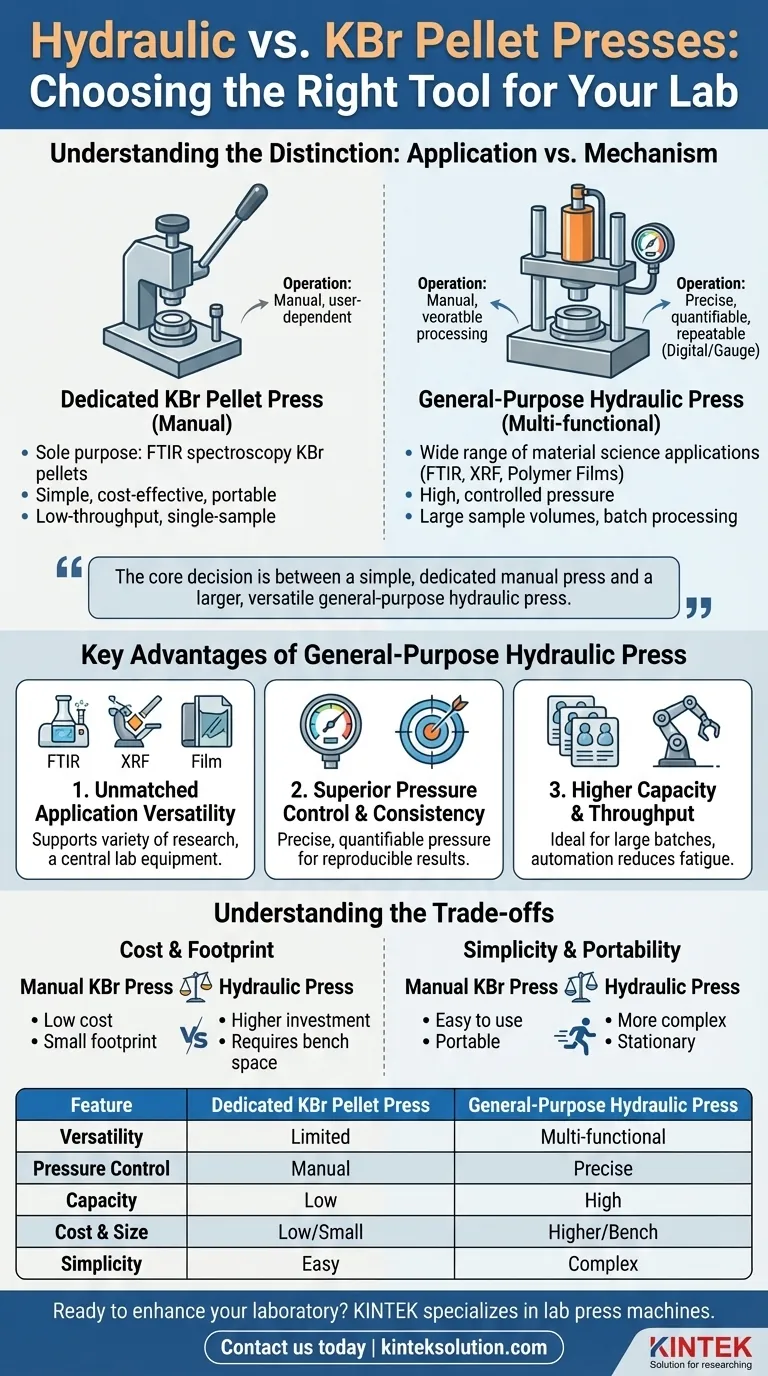
The core decision is not between "hydraulic" and "KBr pellet" presses, as many KBr presses are hydraulic. The real choice is between a simple, dedicated manual press designed only for KBr pellets and a larger, more versatile general-purpose hydraulic press that can perform many different lab functions.
Clarifying the Terminology: Application vs. Mechanism
Before comparing advantages, it is critical to understand the distinction. The question often implies a false choice, as the operating principle (hydraulic) can be found in both types of instruments. The true difference lies in their design focus and intended application.
What is a Dedicated KBr Pellet Press?
A dedicated KBr pellet press, often called a "hand press," is a small, typically manual device. Its sole purpose is to create small, transparent KBr pellets for FTIR spectroscopy.
These presses are simple, cost-effective, and highly portable, requiring minimal lab space. Operation is straightforward and designed for low-throughput, single-sample preparation.
What is a General-Purpose Hydraulic Press?
A general-purpose hydraulic press is a larger, more powerful, and more complex piece of laboratory equipment. While it can easily make KBr pellets, its design is not limited to that single function.
These presses are built for a wide range of material science applications, including preparing samples for XRF (X-ray fluorescence), creating polymer films, and conducting other tests that require high, controlled pressure.
Key Advantages of a General-Purpose Hydraulic Press
When you move from a dedicated hand press to a general-purpose hydraulic model, you gain significant capabilities that can justify the higher cost and larger footprint.
Unmatched Application Versatility
The most significant advantage is the ability to perform multiple tasks with a single instrument. A general-purpose press can support a wide variety of research beyond just FTIR.
This flexibility makes it a central piece of equipment in a materials characterization lab, serving sample preparation needs for different analytical techniques.
Superior Pressure Control and Consistency
While a manual press relies on user feel, a larger hydraulic press offers precise, quantifiable, and repeatable pressure application. This is often managed with a digital display or a calibrated gauge.
This level of control is critical for ensuring that every sample is prepared under identical conditions, leading to more reproducible and reliable analytical results.
Higher Capacity and Throughput
General-purpose hydraulic presses are better suited for preparing large batches of samples. Their operation is less labor-intensive than a manual hand press.
For labs that process many samples, the automation and consistency of a hydraulic press dramatically improve workflow efficiency and reduce operator fatigue.
Understanding the Trade-offs
A general-purpose hydraulic press is not always the better choice. A dedicated KBr press excels in specific scenarios due to its focused design.
Cost and Footprint
The most obvious trade-off is cost and size. A dedicated manual KBr press is a fraction of the cost of a general-purpose hydraulic press and can be stored in a drawer.
A larger press is a significant capital investment and requires dedicated bench space, which can be a major constraint in a crowded lab.
Simplicity and Portability
A manual KBr press is incredibly simple to operate and requires virtually no maintenance. Its portability allows it to be used anywhere in the lab without needing power or a permanent home.
In contrast, a general-purpose press is a stationary piece of equipment that may require more complex setup and routine maintenance.
Making the Right Choice for Your Lab
Selecting the correct press requires a clear understanding of your lab's primary goals, sample volume, and budget.
- If your primary focus is routine FTIR spectroscopy only: A dedicated manual KBr press is the most cost-effective, simple, and space-efficient solution.
- If your primary focus is materials research and versatility: A general-purpose hydraulic press is essential for its ability to support multiple applications like XRF and polymer film preparation.
- If your primary focus is high-throughput sample preparation: A general-purpose hydraulic press provides the consistency and reduced labor needed to process large batches efficiently.
Ultimately, choosing the right press is about aligning the tool's capabilities with the specific demands of your work.
Summary Table:
| Feature | Dedicated KBr Pellet Press | General-Purpose Hydraulic Press |
|---|---|---|
| Versatility | Limited to FTIR KBr pellets | Multi-functional for FTIR, XRF, polymer films, etc. |
| Pressure Control | Manual, user-dependent | Precise, quantifiable, and repeatable |
| Capacity | Low throughput, single samples | High throughput, batch processing |
| Cost & Size | Low cost, small footprint | Higher cost, requires bench space |
| Simplicity | Easy to use, portable | More complex, stationary |
Ready to enhance your laboratory's capabilities with a versatile hydraulic press? KINTEK specializes in lab press machines, including automatic lab presses, isostatic presses, and heated lab presses, designed to meet the diverse needs of laboratories for precise sample preparation in applications like FTIR and XRF. Contact us today to discuss how our solutions can improve your efficiency and results!
Visual Guide
Related Products
- Automatic High Temperature Heated Hydraulic Press Machine with Heated Plates for Lab
- Manual Heated Hydraulic Lab Press with Integrated Hot Plates Hydraulic Press Machine
- Heated Hydraulic Press Machine with Heated Plates for Vacuum Box Laboratory Hot Press
- Laboratory Hydraulic Press 2T Lab Pellet Press for KBR FTIR
- Laboratory Hydraulic Press Lab Pellet Press Machine for Glove Box
People Also Ask
- Function of a Laboratory Hydraulic Press with Heated Platens in SSE? Enhance Battery Density & Conductivity
- What are the requirements for electrode pressing with high-viscosity ionic liquids like EMIM TFSI? Optimize Performance
- How does a laboratory heated hydraulic press facilitate PBN sample prep for WAXS? Achieve Precise X-Ray Scattering
- What are the industrial applications of heated hydraulic presses? Master Heat & Force for Precision Manufacturing
- Why is a laboratory hydraulic press with heating plates required for PLA/TEC films? Achieve Precise Sample Integrity



















