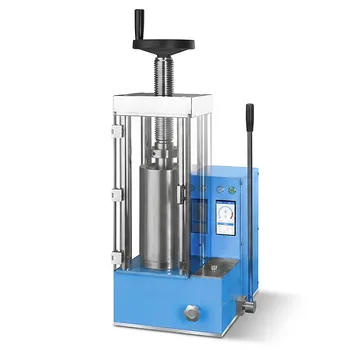
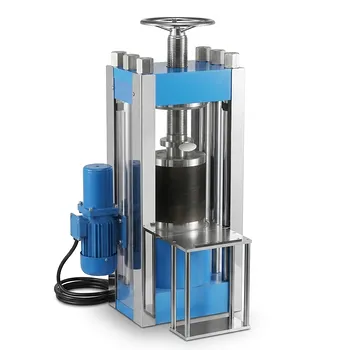
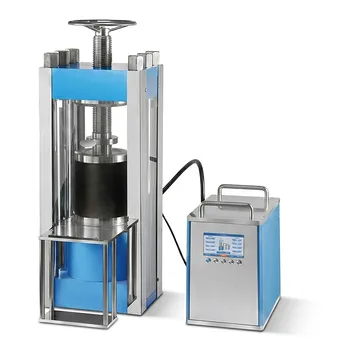
Cold Isostatic Pressing (CIP) provides a critical advantage over uniaxial pressing by applying equal, high-intensity pressure from all directions. This isotropic force eliminates the internal density gradients and friction-induced irregularities common in uniaxial methods, resulting in a zirconia green body with superior structural uniformity. By ensuring that the powder particles are packed consistently throughout the entire volume, CIP prevents the warping, cracking, and uneven shrinkage that often occur during the final sintering process.
Core Takeaway: CIP uses hydrostatic pressure to achieve uniform density and eliminate internal voids, which is essential for producing high-strength, defect-free zirconia components that maintain their shape during high-temperature firing.
Achieving Isotropic Density Uniformity
The Mechanics of All-Directional Pressure
Unlike uniaxial pressing, which compresses powder along a single axis between two rigid punches, CIP utilizes a liquid medium to apply pressure. This hydrostatic approach ensures that every surface of the zirconia green body is subjected to the same stress state. Because the pressure is perfectly matched across all principal stresses, the resulting material lacks the "soft spots" or density variations typically found in die-pressed parts.
Eliminating Friction and Density Gradients
In uniaxial pressing, friction between the powder and the mold walls leads to significant density gradients, where the center or bottom of a part is less dense than the top. CIP bypasses this issue entirely because the powder is contained in a flexible mold and compressed by fluid. This creates a homogeneous microstructure, ensuring the zirconia particles are aligned consistently regardless of the part's thickness or geometry.
Reducing Micro-voids and Porosity
The high isotropic pressure—often reaching 200 to 250 MPa—effectively forces zirconia particles into a tighter alignment. This process significantly reduces the intermolecular distance and eliminates micro-voids within the green body. The result is a denser, more stable "pre-form" that is better prepared for the physical changes of sintering.
Ensuring Structural Integrity During Sintering
Preventing Deformation and Warping
Sintering causes ceramic materials to shrink as particles fuse together. If a green body has uneven density, it will shrink unevenly, leading to warping or irregular dimensions. Because CIP-pressed zirconia has a uniform density distribution, it undergoes consistent shrinkage in all directions, allowing the final component to maintain its intended macroscopic shape.
Mitigating Micro-cracks and Internal Stress
Uneven densification during the pressing stage creates internal stresses that manifest as micro-cracks during the thermal expansion and contraction of firing. CIP provides a "critical safeguard" by ensuring the stress state is uniform before the part ever enters the kiln. This is especially vital for fast-firing processes or high-performance applications like dental zirconia and industrial ceramics.
Enhancing Final Mechanical Strength
The superior packing density achieved through CIP translates directly to the finished product’s performance. By promoting tighter alignment of molecules and reducing internal defects, CIP-processed zirconia exhibits higher hardness and mechanical strength after sintering. This reliability is essential for components that must withstand high stress or require consistent optical properties.
Understanding the Trade-offs
Process Complexity and Speed
While CIP produces a superior green body, it is generally slower and more complex than uniaxial pressing. Uniaxial die pressing allows for rapid, automated production of simple shapes, whereas CIP requires sealing parts in flexible molds and submerged cycles. This makes CIP less ideal for high-volume, low-margin components where minor density variations are tolerable.
Geometric Limitations and Tooling
CIP requires flexible tooling (elastomeric molds) which can be more difficult to design for extremely precise "net-shape" features compared to rigid steel dies. While it excels at producing uniform bulk materials, parts produced via CIP often require secondary machining in their green or fired state to achieve final tolerances.
How to Apply This to Your Project
Selecting the right pressing method depends on the complexity and performance requirements of your final zirconia component.
- If your primary focus is dimensional precision and high-volume throughput: Uniaxial pressing is often the more cost-effective choice for simple, shallow geometries.
- If your primary focus is maximum mechanical strength and reliability: Cold Isostatic Pressing is necessary to eliminate the internal defects that lead to structural failure.
- If your primary focus is avoiding deformation in complex or large parts: CIP provides the isotropic shrinkage required to keep dimensions stable during high-temperature sintering.
By prioritizing uniform density at the green body stage, you ensure the highest possible quality and longevity for the finished ceramic material.
Summary Table:
| Feature | Uniaxial Pressing | Cold Isostatic Pressing (CIP) |
|---|---|---|
| Pressure Direction | Single axis (one or two directions) | Isotropic (equal from all directions) |
| Density Uniformity | High gradients (soft spots in center/bottom) | Homogeneous microstructure; no gradients |
| Sintering Result | Prone to warping, cracking, and deformation | Uniform shrinkage; maintains macroscopic shape |
| Internal Defects | Friction-induced voids common | Minimal micro-voids and high-packing density |
| Mechanical Strength | Lower/Inconsistent | Superior hardness and structural reliability |
Elevate Your Material Precision with KINTEK
Don't let density gradients compromise your zirconia components. KINTEK specializes in comprehensive laboratory pressing solutions designed for the most demanding applications in battery research and advanced ceramics.
Whether you require a manual, automatic, heated, or multifunctional lab press, or a sophisticated Cold/Warm Isostatic Press, our equipment is engineered to eliminate internal defects and ensure isotropic uniformity. We also offer glovebox-compatible models for specialized environments.
Ready to achieve defect-free, high-strength results? Contact our expert team today to find the perfect pressing solution for your lab!
References
- Sa-Hak Kim. A Study on the Colors of Zirconia and Veneering Ceramics. DOI: 10.14347/kadt.2012.34.2.129
This article is also based on technical information from Kintek Solution Knowledge Base .
Related Products
- Electric Lab Cold Isostatic Press CIP Machine
- Electric Split Lab Cold Isostatic Pressing CIP Machine
- Automatic Lab Cold Isostatic Pressing CIP Machine
- Manual Cold Isostatic Pressing CIP Machine Pellet Press
- Electric Isostatic Pressing Machine 40 Tons Automatic Laboratory Powder Compacting Press
People Also Ask
- What role do electric lab cold isostatic presses play in industrial contexts? Bridge R&D and Manufacturing with Precision
- What are the applications of electric lab cold isostatic presses in research settings? Advance Material R&D with High-Pressure CIPs
- How does electrical Cold Isostatic Pressing (CIP) contribute to cost savings? Unlock Efficiency and Reduce Expenses
- What are some research applications of electric lab CIPs? Unlock Uniform Powder Densification for Advanced Materials
- What are the characteristics of standard off-the-shelf electric lab CIP solutions? Achieve Immediate, Cost-Effective Processing