
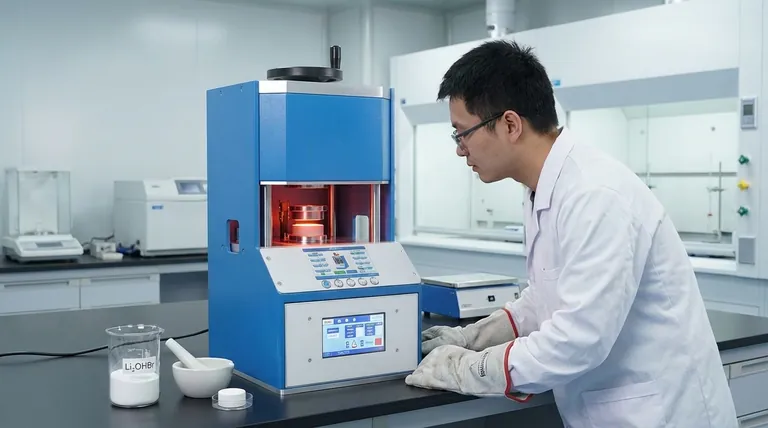
The primary advantage of using a heated laboratory press for Li₂OHBr is the activation of plastic deformation. By applying heat (e.g., 120°C) simultaneously with pressure, you enable the material to soften and flow, eliminating microscopic voids that cold pressing cannot remove. This results in pellets with significantly higher density and superior electrochemical performance.
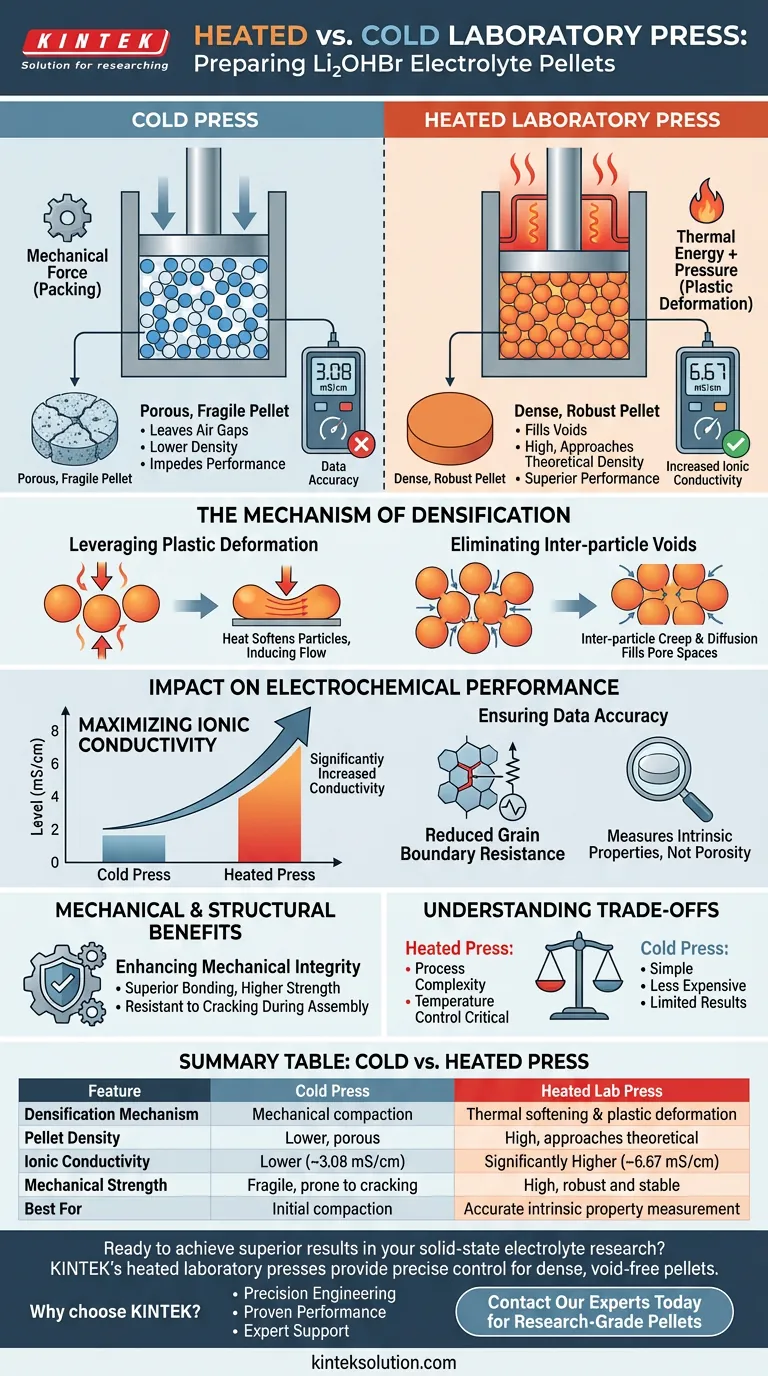
Core Takeaway Cold pressing relies on mechanical force to pack particles together, often leaving air gaps that impede performance. Hot pressing leverages thermal energy to soften the Li₂OHBr, allowing particles to fuse and plastically deform. This process creates a solid-solid interface that approaches theoretical density, which is essential for measuring the material's true ionic conductivity.
The Mechanism of Densification
Leveraging Plastic Deformation
While cold pressing compacts powder, it often fails to overcome the material's yield strength, leaving gaps between particles. Applying heat—such as 120°C for Li₂OHBr—softens the powder particles. This induces plastic deformation, allowing the material to change shape under pressure rather than simply fracturing or rearranging.
Eliminating Inter-particle Voids
The combination of heat and pressure promotes inter-particle creep and diffusion. This action effectively fills the pore spaces that typically remain in cold-pressed compacts. The result is a transition from a loosely packed powder to a cohesive, dense solid with intimate contact between grains.
Impact on Electrochemical Performance
Maximizing Ionic Conductivity
Density is directly correlated with conductivity in solid-state electrolytes. By removing voids, hot pressing creates a continuous pathway for lithium ions to move. This can boost ionic conductivity significantly—references suggest increases from 3.08 mS/cm (cold pressed) to 6.67 mS/cm (hot pressed) in similar electrolyte systems.
Reducing Grain Boundary Resistance
The "sintering" effect of the heated press fuses particles together. This minimizes the resistance typically found at the boundaries between grains. Lower grain boundary resistance is critical for achieving high overall performance and efficiency in the electrolyte.
Ensuring Data Accuracy
For researchers characterizing Li₂OHBr, density is a prerequisite for accuracy. Measurements taken on porous, cold-pressed pellets often reflect the limitations of the pellet fabrication, not the material itself. Hot pressing ensures you are measuring the material's intrinsic ionic conductivity, not the artifacts of a poor interface.
Mechanical and Structural Benefits
Enhancing Mechanical Integrity
Pellets formed via hot pressing exhibit superior bonding between particles. This fusion results in higher mechanical strength compared to the relatively fragile nature of cold-pressed compacts. A mechanically stable pellet is easier to handle and more resistant to cracking during cell assembly or cycling.
Understanding the Trade-offs
Process Complexity and Control
While hot pressing yields superior results, it introduces variables that must be tightly controlled. The temperature must be high enough to induce plasticity but low enough to prevent chemical decomposition of the Li₂OHBr. Furthermore, the equipment required is more complex and expensive than a standard hydraulic press, potentially limiting throughput in high-volume screening.
Making the Right Choice for Your Goal
To maximize the effectiveness of your electrolyte preparation, consider your primary objective:
- If your primary focus is measuring intrinsic conductivity: You must use a heated press to eliminate voids and ensure the data reflects the material properties, not the pellet porosity.
- If your primary focus is mechanical stability: Hot pressing is required to fuse particles sufficiently for the pellet to withstand handling and cycling stresses without disintegrating.
Hot pressing is not merely an optimization step for Li₂OHBr; it is a fundamental requirement for achieving the high density necessary for viable solid-state electrolyte performance.
Summary Table:
| Feature | Cold Press | Heated Lab Press |
|---|---|---|
| Densification Mechanism | Mechanical compaction | Thermal softening & plastic deformation |
| Pellet Density | Lower, porous | High, approaches theoretical density |
| Ionic Conductivity | Lower (e.g., ~3.08 mS/cm) | Significantly Higher (e.g., ~6.67 mS/cm) |
| Mechanical Strength | Fragile, prone to cracking | High, robust and stable |
| Best For | Initial powder compaction | Accurate measurement of intrinsic material properties |
Ready to achieve superior results in your solid-state electrolyte research?
For researchers focused on Li₂OHBr and similar materials, the quality of your pellet directly impacts the accuracy of your data. KINTEK's heated laboratory presses are engineered to provide the precise combination of heat and pressure required to create dense, void-free pellets, ensuring you measure true intrinsic ionic conductivity and mechanical properties.
Why choose KINTEK for your lab press needs?
- Precision Engineering: Our automatic lab presses, isostatic presses, and heated lab presses offer exact control over temperature and pressure.
- Proven Performance: Achieve the high-density pellets essential for viable solid-state electrolyte development.
- Expert Support: We specialize in serving the precise needs of laboratory research and development.
Don't let pellet porosity compromise your findings. Contact our experts today to find the perfect heated press for your laboratory and start producing research-grade pellets.
Visual Guide
Related Products
- 24T 30T 60T Heated Hydraulic Lab Press Machine with Hot Plates for Laboratory
- Heated Hydraulic Press Machine with Heated Plates for Vacuum Box Laboratory Hot Press
- Laboratory Split Manual Heated Hydraulic Press Machine with Hot Plates
- Automatic Heated Hydraulic Press Machine with Hot Plates for Laboratory
- Automatic Heated Hydraulic Press Machine with Heated Plates for Laboratory
People Also Ask
- Function of a Laboratory Hydraulic Press with Heated Platens in SSE? Enhance Battery Density & Conductivity
- Why is a laboratory hydraulic press with heating plates required for PLA/TEC films? Achieve Precise Sample Integrity
- What role does a laboratory heated hydraulic press play in LTCC? Essential for High-Density Ceramic Lamination
- What is the primary function of a laboratory heated hydraulic press? Mastering Thermoplastic Carbon Fiber Composites
- What is the critical role of a laboratory heated hydraulic press? Mastering PVC Sample Prep for Testing



















