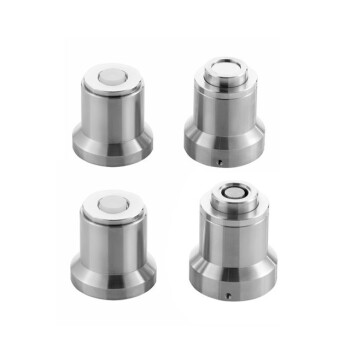
High-strength ceramic molds are essential for ensuring dimensional stability and chemical purity when processing solid-state battery pellets. By maintaining their shape under pressures reaching several hundred megapascals, these molds prevent the deformation common in softer materials while simultaneously eliminating the risk of metal contamination that can compromise electrochemical results.
Core Takeaway To achieve the low-impedance interfaces required for solid-state batteries, pellets must be pressed with extreme force without introducing impurities. High-strength ceramic molds solve this dual challenge by offering the structural rigidity of metal without its chemical reactivity, ensuring uniform density and consistent layer thickness.
Achieving Mechanical Precision Under Load
Withstanding Extreme Pressure
Solid-state battery fabrication requires compressing powders at pressures reaching several hundred megapascals.
High-strength ceramic molds are designed to withstand these forces without undergoing plastic deformation. This rigidity serves as a reliable container for pressure transmission, ensuring the mechanical energy is directed entirely into densifying the powder rather than expanding the mold walls.
Ensuring Uniform Pressure Distribution
The internal diameter of these ceramic molds is engineered with high precision.
This geometric accuracy ensures that force is applied evenly across the entire surface area of the powder. Uniform pressure distribution is critical for eliminating internal stress concentrations and preventing density gradients that could lead to micro-cracks or warping in the finished pellet.
Preserving Chemical Integrity
Eliminating Metal Contamination
A primary failure mode in battery research involves the introduction of impurities during the pressing process.
Standard metal molds can release trace particles into the battery material under high friction and pressure. Ceramic molds are chemically inert in this context, effectively preventing metal contamination. This ensures that the electrolyte separators and composite electrode layers remain pure.
Reliable Electrochemical Testing
The combination of high density and chemical purity provides a dependable baseline for analysis.
Because the mold ensures the sample is chemically pure and mechanically uniform, any variations in performance can be attributed to the battery chemistry itself rather than defects introduced during manufacturing. This provides a reliable basis for accurate electrochemical performance testing.
Improving Component Quality
Consistent Layer Thickness
The stability of the ceramic mold results in electrolyte and electrode layers with consistent thickness.
Variation in thickness can lead to uneven current distribution and potential hot spots in a battery. By maintaining strict dimensional control, ceramic molds help produce layers that are uniform throughout.
Optimizing Density
Achieving high density is a fundamental prerequisite for efficient ion transport.
The rigid containment provided by the ceramic mold allows for the compaction necessary to create a low-impedance solid-solid interface. This high density facilitates better contact between particles, which is essential for the overall performance of the solid-state battery.
Understanding Material Selection Context
Ceramic vs. Engineering Plastics (PEEK)
While high-strength ceramics are superior for maximum pressure stability and density, they are not the only option for all scenarios.
Supplementary data suggests that high-performance plastics like PEEK are often selected when in-situ electrochemical testing is required. While ceramics are excellent for the pressing phase to achieve high density, PEEK molds offer electrical insulation that allows the battery cell to be tested directly inside the mold without transfer.
The Trade-off of Transfer
Using a ceramic mold typically implies removing the pellet after pressing.
Transferring a pressed pellet can introduce risks of interface damage or delamination. In contrast, molds designed for in-situ testing (like PEEK) avoid this risk but may not support the same extreme pressure levels as high-strength ceramics.
Making the Right Choice for Your Goal
To maximize the effectiveness of your solid-state battery preparation, align your mold choice with your specific processing stage:
- If your primary focus is Maximum Densification: Choose high-strength ceramic molds to apply hundreds of megapascals of pressure for the highest possible pellet density and dimensional stability.
- If your primary focus is Chemical Purity: Rely on ceramic molds to prevent metal contamination that could skew electrochemical data or cause short circuits.
- If your primary focus is In-Situ Testing: Consider if an alternative like PEEK is necessary to test without moving the sample, acknowledging potential trade-offs in maximum pressure limits.
High-strength ceramic molds provide the foundational rigidity and purity necessary to transform loose powder into a high-performance, solid-state electrochemical component.
Summary Table:
| Feature | Advantage | Benefit to Solid-State Batteries |
|---|---|---|
| Structural Rigidity | Withstands >100s MPa | Prevents deformation; ensures high-density pellets |
| Chemical Inertia | Zero metal leaching | Eliminates contamination for accurate electrochemical data |
| Geometric Precision | Uniform pressure distribution | Prevents micro-cracks and ensures consistent thickness |
| Surface Quality | Low friction & high hardness | Facilitates smooth, low-impedance solid-solid interfaces |
Elevate Your Battery Research with KINTEK Precision
Maximize the performance of your solid-state electrolytes and electrodes by eliminating contamination and achieving superior densification. KINTEK specializes in comprehensive laboratory pressing solutions, offering manual, automatic, heated, multifunctional, and glovebox-compatible models, alongside cold and warm isostatic presses designed for the rigors of battery material synthesis.
Ready to achieve the perfect pellet? Contact KINTEK today to find the ideal ceramic mold and pressing system tailored to your lab’s specific requirements!
References
- Min Ji Kim, Dae Soo Jung. Half-Covered ‘Glitter-Cake’ AM@SE Composite: A Novel Electrode Design for High Energy Density All-Solid-State Batteries. DOI: 10.1007/s40820-024-01644-6
This article is also based on technical information from Kintek Solution Knowledge Base .
Related Products
- Lab Cylindrical Press Mold for Laboratory Use
- XRF KBR Plastic Ring Lab Powder Pellet Pressing Mold for FTIR
- Lab XRF Boric Acid Powder Pellet Pressing Mold for Laboratory Use
- XRF KBR Steel Ring Lab Powder Pellet Pressing Mold for FTIR
- Carbide Lab Press Mold for Laboratory Sample Preparation
People Also Ask
- What is the purpose of incorporating cartridge heaters into a lab press mold for MLCC block compression? Optimize Results
- What is the function of a pressing tool in thermoplastic panels? Master Precision Shaping & Fusion Bonding
- Why is precise cooling management of the lab press mold necessary? Protect Core Integrity in Thermoforming
- Why is a high-performance laboratory molding press critical for in-situ electrolyte formation? Unlock Battery Success
- How does the geometry of laboratory molds influence mycelium-based composites? Optimize Density and Strength