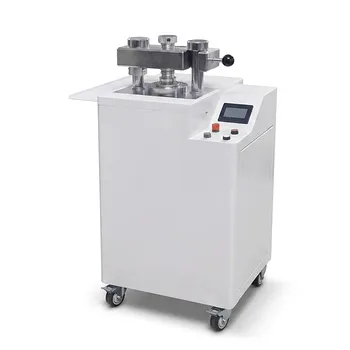
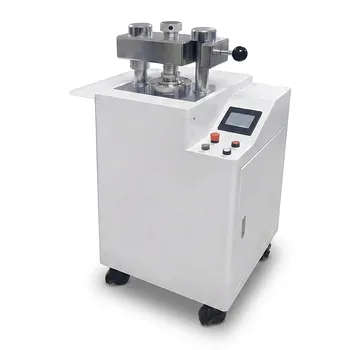
A laboratory pellet press is a versatile instrument used to transform powdered materials into solid, uniform pellets for analysis and development across a wide spectrum of scientific industries. Its applications span from Materials Science and Engineering, where it prepares samples for mechanical testing, to Chemistry for creating catalysts, Geology for analyzing ore samples, and Medicine for drug formulation.
Core Takeaway: The laboratory pellet press is the gatekeeper of data integrity; by converting loose powders into consistent, dense pellets, it ensures that analytical techniques like X-Ray Diffraction (XRD) and Scanning Electron Microscopy (SEM) yield reproducible and accurate results.
Applications in Material Development and Chemistry
Advancing Materials Science
In Materials Science and Engineering, the pellet press is essential for R&D and testing. It allows researchers to compress rubbers, polymers, and composites into standardized shapes to test their physical properties.
Chemical Compound Formulation
In the field of Chemistry, the press is used to form samples of various compounds. A common application is the creation of solid catalysts, where the physical form of the material significantly impacts reaction rates and efficiency.
Supporting Lean Manufacturing
Beyond pure research, these presses support "short production runs" and cell manufacturing. They allow engineers to produce limited batches of materials (like plastics or laminates) to verify quality before scaling up to mass production.
The Role in Analytical Characterization
Preparing Samples for Spectroscopy
Materials Characterization relies heavily on the pellet press to prepare samples for high-precision instruments. Techniques such as Scanning Electron Microscopy (SEM) and X-Ray Diffraction (XRD) require samples to be flat and uniform to generate accurate readings.
Geological and Mining Analysis
In Geology and Mining, raw rocks and ores are pulverized and then pressed into pellets. This ensures that the sample presents a consistent surface area and density, allowing for precise determination of mineral composition and value.
Specialized Uses in Life Sciences and Energy
Energy Sector Innovation
The press plays a critical role in developing sustainable technologies, particularly for electrode materials. Researchers use it to consolidate powders into dense electrodes for battery testing and energy storage applications.
Biological and Pharmaceutical Research
In Medicine and Biology, the press is utilized to prepare drug and tissue samples. This is vital for pharmaceutical R&D, where the compaction of active ingredients into tablets must be precise to ensure correct dosage and dissolution rates.
Food and Agriculture Quality Control
The device is also employed in Food and Agriculture to prepare samples for quality analysis. By compressing food powders or soil samples, laboratories can efficiently test for nutritional content or contaminants.
Understanding the Trade-offs
Balancing Density and Porosity
While high pressure increases sample density, more pressure is not always better. For materials like Metal-Organic Frameworks (MOFs) used in water harvesting, there is a delicate balance; higher density improves storage capacity per volume, but excessive pressure can crush the internal pores.
The Risk of Pore Occlusion
If the pressing force is too high, it can lead to "occlusion," where the internal pores of a material are sealed off. This drastically reduces the specific surface area, rendering materials like catalysts or adsorbents ineffective despite their high mechanical strength.
Precision vs. Force
Users must weigh the need for mechanical durability against the need for material functionality. A laboratory press offers the advantage of precise control, allowing users to dial in the exact pressure needed to maintain structural integrity without compromising the material's chemical properties.
Making the Right Choice for Your Goal
To maximize the utility of a laboratory pellet press, align your usage with your specific analytical or production objectives.
- If your primary focus is Materials Characterization (XRD/SEM): Prioritize surface smoothness and uniformity to eliminate scattering errors during analysis.
- If your primary focus is Product Development (Pharma/Energy): Focus on the reproducibility of pressure settings to ensure every batch of electrodes or tablets performs identically.
- If your primary focus is Fundamental Research (MOFs/Catalysts): carefully titrate pressure to find the "sweet spot" where mechanical strength is achieved without destroying porosity.
Success with a pellet press relies not just on the force applied, but on the precise control of that force to preserve the functional identity of your sample.
Summary Table:
| Industry Field | Key Applications | Analytical Techniques Supported |
|---|---|---|
| Materials Science | Polymer testing, composite development, & R&D | SEM, XRD, Mechanical Testing |
| Chemistry | Catalyst formulation & compound synthesis | Reaction Efficiency Analysis |
| Energy & Batteries | Electrode material consolidation & storage testing | Conductivity & Cycle Life Testing |
| Pharmaceuticals | Drug formulation, tablet compaction, & tissue samples | Dosage & Dissolution Studies |
| Geology & Mining | Ore sample preparation & mineral identification | Surface Area & Density Analysis |
| Food & Agriculture | Nutrient analysis & contaminant testing | Quality Control Monitoring |
Elevate Your Research Precision with KINTEK
Consistency is the foundation of scientific breakthrough. KINTEK specializes in comprehensive laboratory pressing solutions designed to give you absolute control over your sample integrity. Whether you are conducting cutting-edge battery research or pharmaceutical formulation, our range of manual, automatic, heated, multifunctional, and glovebox-compatible models, alongside cold and warm isostatic presses, ensures the perfect balance of density and porosity.
Don't let inconsistent sample preparation compromise your data. Partner with KINTEK to achieve reproducible results every time.
Contact our experts today to find your ideal pressing solution!
Related Products
- Laboratory Hydraulic Pellet Press for XRF KBR FTIR Lab Press
- Automatic Laboratory Hydraulic Press Lab Pellet Press Machine
- Laboratory Hydraulic Split Electric Lab Pellet Press
- Manual Laboratory Hydraulic Pellet Press Lab Hydraulic Press
- Laboratory Hydraulic Press Lab Pellet Press Machine for Glove Box
People Also Ask
- Laboratory Pellet Press for Solar PV Recycling: Ensuring High-Precision Material Analysis and Purity
- Why is a professional laboratory pellet press required for XRF of silica sand? Achieve +/- 0.10% Precision
- Why is precise pressure-holding control critical for biomass pellets? Master Your Densification Results
- What is the necessity of a laboratory pellet press for alcohol by-product fuels? Maximize Energy Density & Consistency
- What are the different types of pellet-making tools available for labs? Choose the Right Press for Your Sample