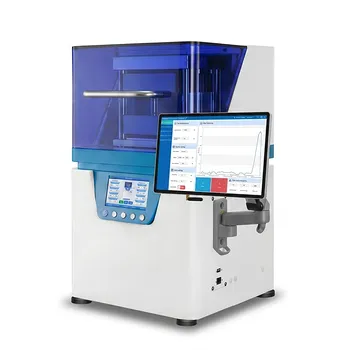
Fundamentally, a laboratory press is defined by three primary structural components: a robust frame, a stable baseplate, and a movable ram. While the mechanism driving the ram is typically either hydraulic or pneumatic, the interaction between these three elements forms the essential architecture required to apply controlled force to a sample.
Core Takeaway While the frame and ram provide the physical structure, the operational capability of a laboratory press depends on its force-generation system (pump and valves) and its control interface. A high-quality press is defined not just by how much force it generates, but by how precisely it can regulate pressure, time, and—in specific applications—temperature.
The Structural Foundation
The Frame and Baseplate
The frame serves as the skeleton of the machine, designed to withstand significant mechanical stress without deforming. It anchors the unit and ensures alignment is maintained during operation.
The baseplate acts as the stationary counter-surface to the ram. It provides a flat, rigid platform where the sample or die rests, absorbing the force generated by the press.
The Ram (Main Cylinder)
The ram is the dynamic component responsible for delivering force to the workpiece. In most laboratory settings, this is a piston housed within a cylinder that extends to compress the sample against the baseplate.
The Force Generation System
Hydraulic vs. Pneumatic Drive
The ram requires a drive system to move. Pneumatic systems utilize compressed air, generally suitable for lower-force applications requiring speed. Hydraulic systems use pressurized fluid to generate significantly higher force, making them the standard for pelletizing and heavy compression.
The Pump and Reservoir
In hydraulic models, a fluid reservoir stores the hydraulic oil. A pump pressurizes this fluid, creating the potential energy required to move the ram.
Control Valves and Plunger
To manage the movement of the ram, control valves regulate the flow and direction of the hydraulic fluid. A plunger often acts as the intermediary, pushing the fluid through pipes and hoses to transfer pressure from the pump to the main cylinder.
Control and Interface Systems
The Human-Machine Interface (HMI)
Modern presses utilize an HMI, such as a touchscreen or keypad, to serve as the command center. This allows the operator to input parameters, monitor status, and execute cycles without manually manipulating valves.
Pressure and Time Controllers
Precision is achieved through dedicated controllers. A pressure controller maintains the target force, while a timer dictates the duration of the compression stages. Advanced systems may allow for data logging to ensure process repeatability.
Specialized Components: The Hot Press
Many laboratory applications require heat in addition to pressure. A "hot press" introduces specific thermal components to the standard architecture.
Heating Platens and Elements
Standard steel surfaces are replaced or augmented with heating platens, often made of tool steel or aluminum alloy for high thermal conductivity. These are powered by heating elements, such as resistance wires or cartridges, which convert electricity into heat.
Thermal Regulation
To ensure accuracy, PID (Proportional-Integral-Derivative) controllers regulate the heating rate and holding time. Thermocouples (sensors) embedded in the platens provide real-time temperature feedback to the controller.
Understanding the Trade-offs
Manual vs. Automated Operation
Manual presses rely on hand pumps and analog gauges. They are cost-effective and durable but prone to operator variance. Automated presses use electric pumps and digital controls, offering higher repeatability but at a higher cost and with greater maintenance complexity.
Component Quality and Maintenance
The reliability of a press is often dictated by its seals and valves. Low-quality hydraulic components can lead to fluid leaks and pressure drops, compromising the "holding time" of an experiment. Furthermore, heating platens require insulation; without high-quality insulation materials, heat loss can lead to inefficiency and inconsistent sample processing.
Making the Right Choice for Your Goal
When evaluating a laboratory press, select components that align with your specific experimental requirements.
- If your primary focus is basic sample preparation (e.g., KBr pellets): Prioritize a manual hydraulic press with a rigid frame and a simple, high-quality analog gauge for durability and cost-efficiency.
- If your primary focus is polymer bonding or laminating: You typically require a hot press featuring heating platens, water cooling capabilities, and a digital PID controller for precise thermal management.
- If your primary focus is high-throughput production: Invest in an automated system with an HMI and programmable cycles to eliminate operator fatigue and ensure identical results across batches.
The most effective laboratory press is one where the structural integrity of the frame is matched by the precision of its control system.
Summary Table:
| Component Category | Key Elements | Function |
|---|---|---|
| Structural | Frame, Baseplate, Ram | Provides mechanical integrity and force delivery. |
| Force Generation | Pump, Reservoir, Valves | Creates and regulates the pressure required for compression. |
| Control System | HMI, Pressure/Time Controllers | Enables precise parameter input and process repeatability. |
| Thermal (Hot Press) | Heating Platens, PID Controllers | Delivers and monitors heat for advanced material bonding. |
| Operational | Manual or Automated Drive | Determines the method of force application and throughput. |
Elevate Your Research with KINTEK’s Precision Pressing Solutions
Don't let subpar equipment compromise your experimental results. KINTEK specializes in comprehensive laboratory pressing solutions designed to meet the rigorous demands of battery research and material science. Whether you need a compact manual unit for KBr pellets or a sophisticated heated automated system for polymer bonding, our experts are here to help.
Our value to you:
- Diverse Range: From manual and automatic to heated and glovebox-compatible models.
- Advanced Technology: High-precision cold and warm isostatic presses.
- Unmatched Reliability: Robust frame designs paired with precise PID and pressure controls.
Ready to find the perfect press for your lab? Contact us today to speak with a specialist and optimize your sample preparation workflow!
Related Products
- Special Shape Lab Press Mold for Laboratory Applications
- Assemble Square Lab Press Mold for Laboratory Use
- Laboratory Hydraulic Press Lab Pellet Press Button Battery Press
- Lab Heat Press Special Mold
- Lab Infrared Press Mold for Laboratory Applications
People Also Ask
- What is the purpose of incorporating cartridge heaters into a lab press mold for MLCC block compression? Optimize Results
- Why is a high-performance laboratory molding press critical for in-situ electrolyte formation? Unlock Battery Success
- Why are high-precision laboratory molds and specific compaction processes required? Ensure Data Integrity in Soil Research
- Why are precision laboratory molds essential for forming basalt-reinforced lightweight concrete specimens?
- How does the geometry of laboratory molds influence mycelium-based composites? Optimize Density and Strength