
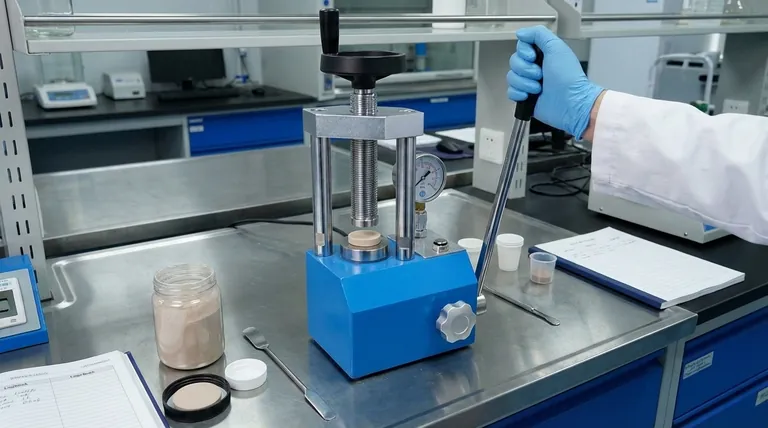
Manual hydraulic presses are cost-effective laboratory tools designed to create high-quality sample pellets by applying hand-operated force to a die. They are the ideal solution for laboratories with lower throughput requirements and limited budgets, offering a way to produce accurate, reproducible samples for X-ray Fluorescence (XRF) and Infrared Spectroscopy (FTIR) without the expense of automation.
Manual presses bridge the gap between affordability and precision, providing the necessary high-pressure capabilities for spectral analysis while relying on operator effort rather than automated mechanical cycles.
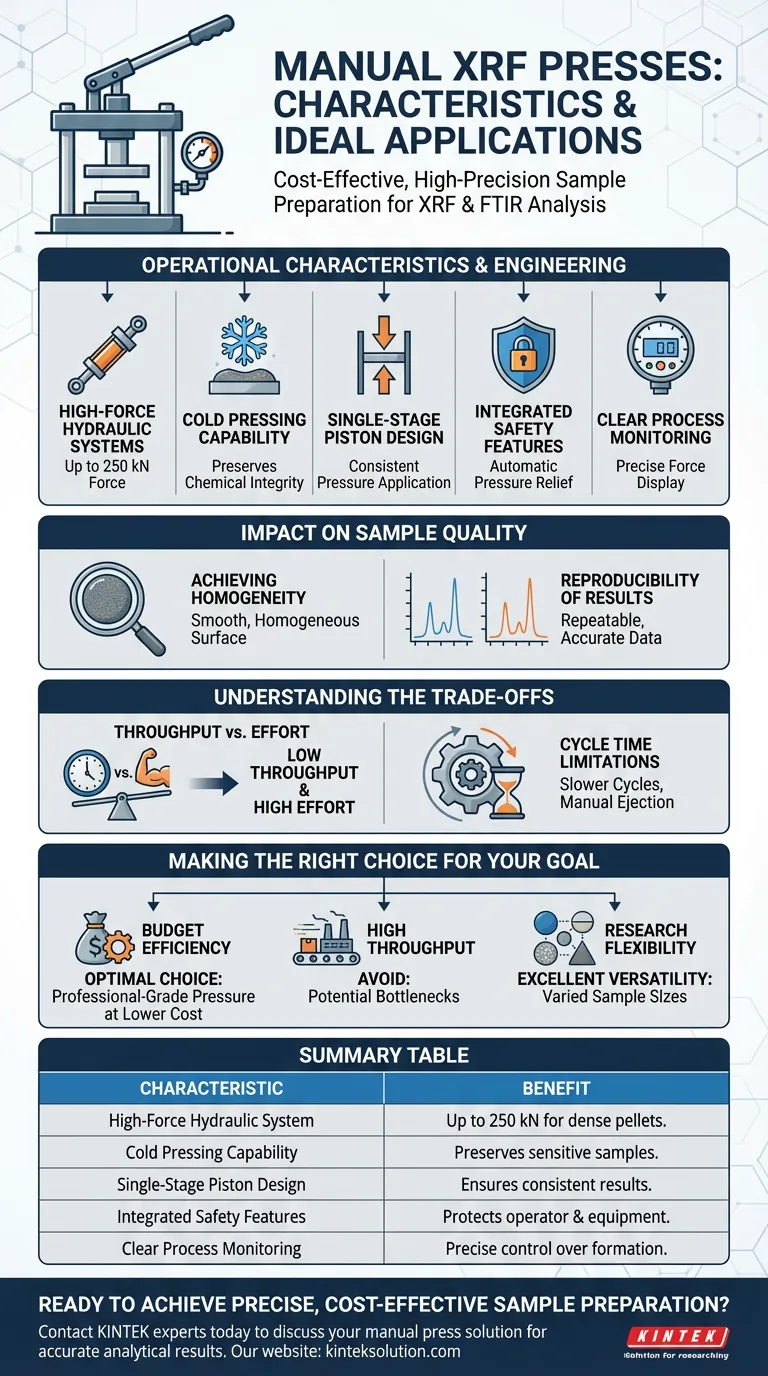
Operational Characteristics and Engineering
High-Force Hydraulic Systems
Despite being hand-operated, these presses are capable of generating significant force. They typically utilize a hydraulic system to apply variable pressure up to 250 kN.
Cold Pressing Capability
A defining characteristic of these units is their ability to exert high pressure without applying additional heat. This preserves the chemical integrity of sensitive samples during the pelletizing process.
Single-Stage Piston Design
To ensure consistency across different samples, manual presses often feature a single-stage piston stroke. This mechanical simplicity aids in maintaining uniform pressure application every time a sample is processed.
Integrated Safety Features
Modern manual presses are designed with operator safety in mind. They include automatic pressure relief mechanisms that activate if overstress occurs, preventing the user from exceeding operational limits.
Clear Process Monitoring
These units feature clear pressure force displays. This allows the operator to monitor levels precisely, ensuring the pellet is formed under the exact conditions required for the specific material.
Impact on Sample Quality
Achieving Homogeneity
The primary goal of the press is to create a sample with a smooth, homogeneous surface. When used with powders milled to a fine, consistent particle size, the press compacts the material into a dense disk essential for accurate data collection.
Reproducibility of Results
For analytical techniques like XRF and FTIR, the physical consistency of the sample is just as important as the chemical composition. Manual presses deliver the repeatability needed to ensure that variances in data are due to the sample chemistry, not the preparation method.
Understanding the Trade-offs
Throughput vs. Effort
The most significant trade-off is the relationship between cost and labor. While more affordable, manual presses demand more time and physical effort from the operator compared to automated systems.
Cycle Time Limitations
Unlike automated hydraulic presses, which are built for swift operational cycles and quick extraction, manual presses are slower. They lack the mechanical systems designed to rapidly eject finished pellets, making them less suitable for high-volume repetitive tasks.
Making the Right Choice for Your Goal
To determine if a manual press fits your laboratory's workflow, consider your specific constraints regarding volume and budget.
- If your primary focus is Budget Efficiency: A manual press is the optimal choice, delivering professional-grade high pressure at a fraction of the cost of automated systems.
- If your primary focus is High Throughput: You should likely avoid manual presses, as the physical effort and slower cycle times will create bottlenecks in high-volume workflows.
- If your primary focus is Research Flexibility: The manual press offers excellent versatility for varying sample sizes and pressing tools without the complex setup of automated machinery.
For laboratories prioritizing precision over speed, the manual hydraulic press remains the industry standard for reliable sample preparation.
Summary Table:
| Characteristic | Benefit |
|---|---|
| High-Force Hydraulic System | Generates up to 250 kN of pressure for dense, uniform pellets. |
| Cold Pressing Capability | Preserves chemical integrity of sensitive samples without heat. |
| Single-Stage Piston Design | Ensures consistent pressure application for reproducible results. |
| Integrated Safety Features | Automatic pressure relief protects the operator and equipment. |
| Clear Process Monitoring | Precise force display allows for exact control over pellet formation. |
Ready to achieve precise, cost-effective sample preparation?
If your laboratory prioritizes budget efficiency and research flexibility for XRF or FTIR analysis, a manual press from KINTEK is your ideal solution. We specialize in robust lab press machines, including manual hydraulic presses, designed to deliver the high-pressure capabilities and reproducibility you need without the cost of automation.
Contact our experts today to discuss how a KINTEK manual press can enhance your sample preparation workflow and ensure accurate analytical results.
Visual Guide
Related Products
- Automatic Laboratory Hydraulic Press for XRF and KBR Pellet Pressing
- Laboratory Hydraulic Pellet Press for XRF KBR FTIR Lab Press
- Manual Laboratory Hydraulic Pellet Press Lab Hydraulic Press
- Automatic Laboratory Hydraulic Press Lab Pellet Press Machine
- Manual Laboratory Hydraulic Press Lab Pellet Press
People Also Ask
- Why is pressing powder into a pellet critical before sintering? Ensure Dense, Conductive Solid-State Electrolytes
- What is the role of a laboratory pressure machine and KBr in FTIR? Master Sample Preparation for Flame Retardants
- What are the advantages of using a laboratory automatic hydraulic press for HEA green compact forming?
- What are the advantages of using a lab automatic hydraulic press for HEA green body molding? Ensure Material Integrity
- What are the advantages of using an automatic laboratory hydraulic press? Enhance Precision in Sample Preparation



















