
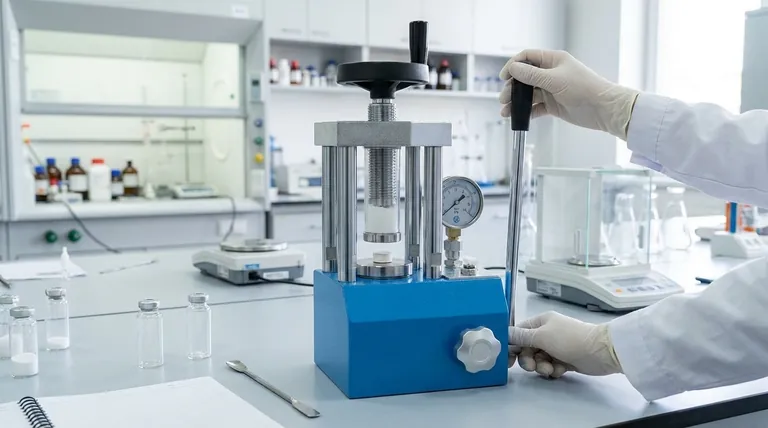
Hydraulic mini presses are compact, handheld devices designed to deliver significant force in environments where space and mobility are restricted. Typically weighing around 4 kilograms, these units use a manual hydraulic pump to generate up to 2 tons of pressure, offering a user-friendly and cost-effective alternative to full-sized floor units.
The core value of a hydraulic mini press lies in its ratio of size to power. While it lacks the massive tonnage of industrial machinery, it provides sufficient, controlled force for laboratory sample preparation and pharmaceutical tasks without the footprint or expense of standard equipment.
Core Characteristics
Extreme Portability
The defining feature of the mini press is its form factor. Weighing approximately 4 kilograms, these units are classified as handheld and portable.
They are specifically engineered for laboratories with limited bench space or field operations where equipment must be moved frequently.
Hydraulic Mechanical Advantage
Despite their small stature, these presses utilize a hydraulic mechanism involving an oil-filled plunger and system valves.
This allows the operator to generate up to 2 tons of pressure with minimal physical effort. This hydraulic advantage makes them significantly easier to operate than mechanical screw presses of similar size.
Precision and Control
To ensure scientific rigor, these devices are typically equipped with a pressure gauge.
This feature allows the user to monitor force application precisely, ensuring that processes such as sample compression are consistent and repeatable across different trials.
Primary Applications
Pharmaceutical Laboratories
Mini presses are particularly favored in the pharmaceutical sector.
Their low cost and mobility make them ideal for decentralizing tasks, allowing individual researchers to perform compression tasks at their specific workstations rather than waiting for shared, large-scale equipment.
Powder Compacting and Sample Prep
While general hydraulic presses handle heavy metal forming, the mini press is optimized for powder compacting.
This is essential for creating solid samples from powders for analytical testing. The 2-ton capacity is generally sufficient to bind pharmaceutical compounds or chemical samples into stable forms for analysis.
Understanding the Trade-offs
Force Limitations
It is critical to recognize the ceiling of these devices. With a maximum output of roughly 2 tons, they are wholly unsuitable for industrial metal forming, heavy-duty forging, or tasks requiring the immense force of standard industrial presses.
Attempting to use a mini press for applications like automotive part stamping or scrap baling will result in equipment failure or inadequate results.
Manual Operation Volume
These units are operated manually via a handle. While the hydraulic system reduces effort, high-volume production environments may find manual operation inefficient compared to automated or electric-driven systems.
Making the Right Choice for Your Goal
To determine if a hydraulic mini press is the right tool for your specific application, consider your force requirements and workspace constraints:
- If your primary focus is Pharmaceutical or Lab Research: The mini press is likely your best option, offering sufficient force for powder compacting and sample prep in a portable format.
- If your primary focus is Industrial Manufacturing: You must look beyond the mini category toward standard hydraulic presses capable of metal forming, bending, and heavy assembly.
- If your primary focus is Field Mobility: The 4kg weight and handheld design make the mini press the only viable hydraulic option for transportable testing.
By aligning the press's 2-ton limit with your specific workload, you ensure precise results without over-investing in unnecessary industrial power.
Summary Table:
| Characteristic | Specification | Typical Application |
|---|---|---|
| Portability | ~4 kg, Handheld | Field testing, labs with limited space |
| Force Capacity | Up to 2 tons | Powder compacting, sample preparation |
| Key Feature | Built-in pressure gauge | Pharmaceutical research, ensuring precision |
| Operation | Manual hydraulic pump | Low-volume production, individual workstations |
Need precise, portable force for your laboratory?
KINTEK specializes in lab press machines, including automatic lab presses, isostatic presses, and heated lab presses. Our hydraulic mini presses are engineered to deliver the controlled power and mobility essential for pharmaceutical research and sample preparation.
Let us help you enhance your lab's efficiency and precision.
Contact our experts today to find the perfect press for your specific application!
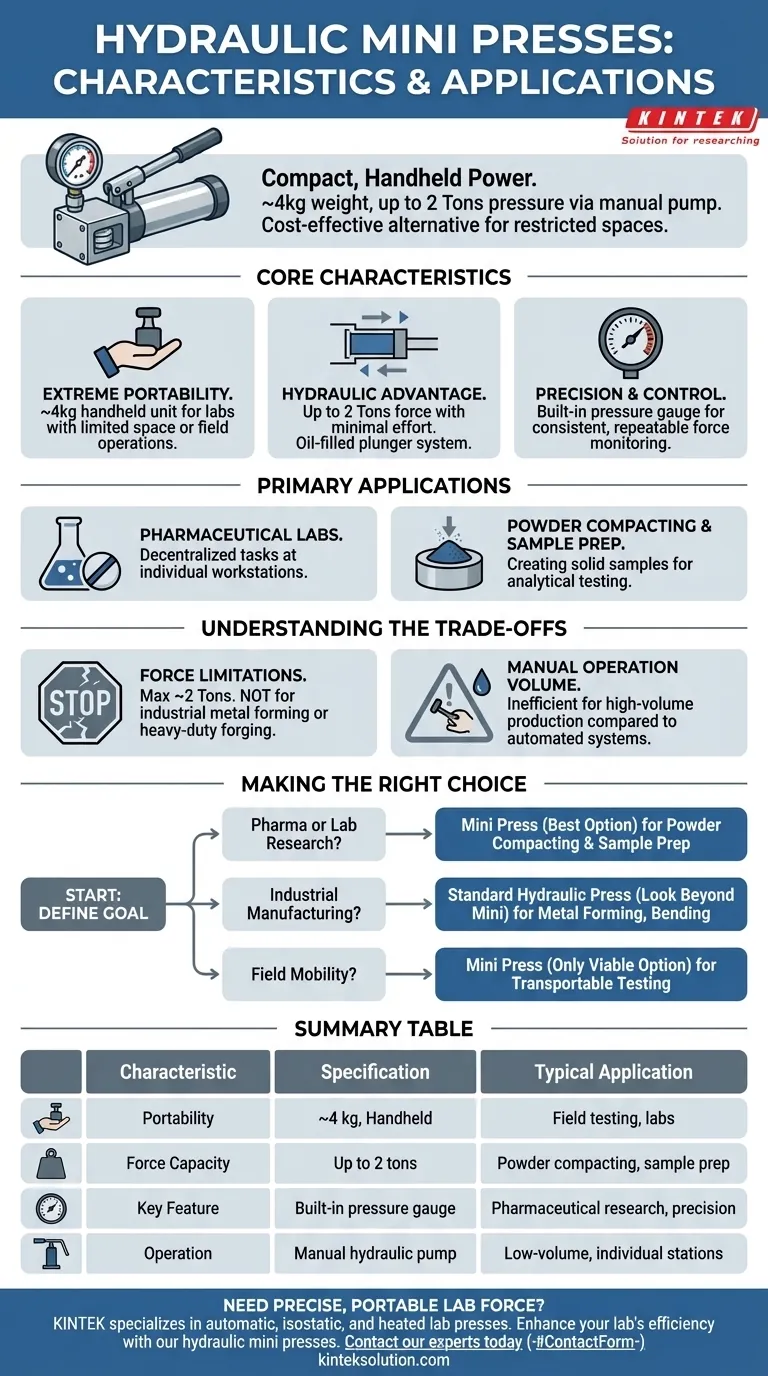
Visual Guide
Related Products
- Automatic Laboratory Hydraulic Press Lab Pellet Press Machine
- Laboratory Hydraulic Press Lab Pellet Press Machine for Glove Box
- Laboratory Hydraulic Press Lab Pellet Press Button Battery Press
- Laboratory Hydraulic Press 2T Lab Pellet Press for KBR FTIR
- Heated Hydraulic Press Machine with Heated Plates for Vacuum Box Laboratory Hot Press
People Also Ask
- What is the primary purpose of a manual lab hydraulic pellet press? Ensure Accurate Sample Prep for XRF and FTIR
- What is the primary purpose of manual lab hydraulic pellet presses? Achieve High-Precision Sample Preparation for Spectroscopy
- How does an automatic laboratory hydraulic press improve KBr pellet preparation? Achieve Precision IR Spectroscopy
- What are the advantages of using an automatic laboratory hydraulic press? Enhance Precision in Sample Preparation
- What are the technical advantages of an automatic laboratory hydraulic press for biomimetic surfaces?



















